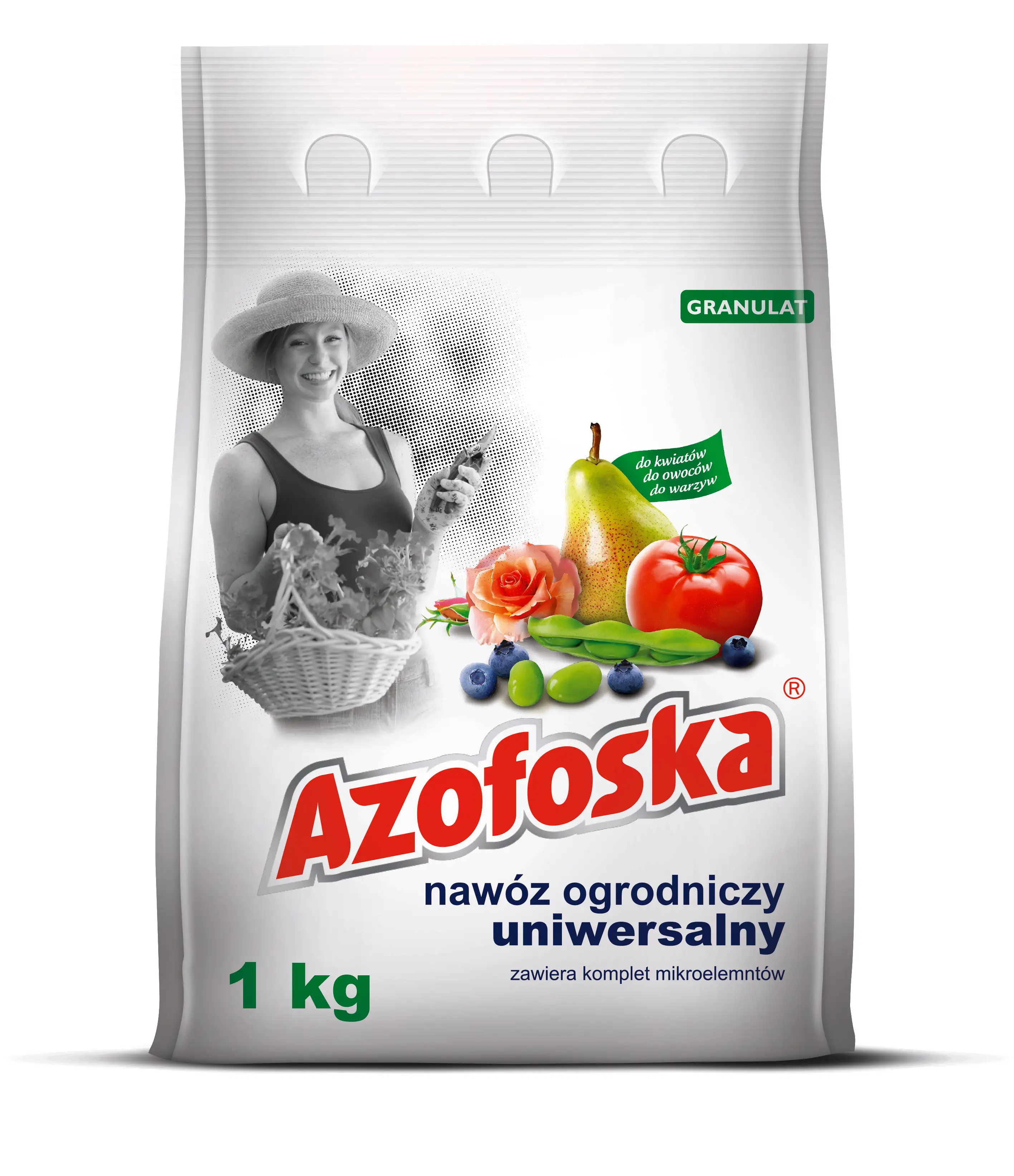
Azofoska Dusty INCO Veritas - garden fertiliser
Azofoska Dusty INCO VERITAS fertiliser ensures abundant yields thanks to a perfectly balanced NPK formula with micronutrients and low chloride content, which minimises the negative impact on plant growth.
Description
Azofoska Dusty INCO VERITAS fertiliser - ensures abundant yields
- Perfectly balanced,
- Low chloride content,
- NPK fertiliser with micronutrients,
- Contains optimal nutrient proportions for plants,
- Easily absorbed.
Azofoska Dusty is a fertiliser containing a complete set of six micronutrients, including important sulphur and magnesium for plants, which reduce plant susceptibility to pests and diseases. The fertiliser can also be used in the absence of organic fertilisation. It has a low chloride content - high chloride levels in the growing medium cause poor plant growth and negatively affect the size and quality of yields, as well as storage ability. Azofoska fertiliser contains optimal nutrient proportions for most plants. All fertiliser components are in a form easily absorbed by plants shortly after application. This allows effective utilisation of Azofoska fertiliser by plants both in top dressing and pre-sowing fertilisation.
Azofoska Dusty INCO Veritas - fertiliser composition:
- NPK (MgO + SO3) 13.3 - 6.1 - 17.1 (4.5 + 21.0)
- Also contains: boron, copper, iron, manganese, molybdenum, zinc, magnesium, sulphur.
Azofoska Dusty INCO Veritas fertiliser - dosing instructions:
Annual plants:
- Before sowing or planting, the appropriate dose of fertiliser should be evenly spread over the fertilised area and thoroughly mixed with the cultivated soil layer.
- Sowing seeds or planting plants is best done a few days after fertiliser application.
- WARNING: During top dressing, avoid spreading fertiliser directly on the plant (leaves, stems, etc.), and do not apply a single dose greater than 5 kg/100 m2.
Perennial plants:
- The recommended dose should be evenly spread over the fertilised area according to the table recommendations. If possible, mix the fertiliser with the topsoil layer (without damaging roots).
- WARNING: During top dressing, avoid spreading fertiliser directly on the plant (leaves, stems, etc.), and do not apply a single dose greater than 5 kg/100 m2.
Detailed dosing is available in the "Dosage" tab.
Application and dosage
|
Crop |
How to apply? Dosage |
When to apply? |
|---|---|---|
|
late cabbage, Brussels sprouts, red cabbage, cauliflower, pumpkin |
Dosage: 12-15 kg/ 100 m2. Apply 25% of the dose 2-3 weeks after planting seedlings. Fertiliser should be applied as early as possible, mixing it with a 10-20 cm soil layer. If vegetables are grown in the first year after manure, reduce the fertiliser dose by 20-40%. |
Before sowing/ planting |
|
onion, leek, celery |
Dosage: 12-15 kg/ 100 m2. 25% of the dose can be applied as top dressing - no later than 15 June. Fertiliser should be applied as early as possible, mixing it with a 10-20 cm soil layer. If vegetables are grown in the first year after manure, reduce the fertiliser dose by 20-40%. |
Before sowing/ planting |
|
sugar beet, kohlrabi, garlic, sweet pepper |
Dosage: 6-7 kg/ 100 m2. In beet cultivation, apply 20% of the dose 2-3 weeks after emergence. Fertiliser should be applied as early as possible, mixing it with a 10-20 cm soil layer. If vegetables are grown in the first year after manure, reduce the fertiliser dose by 20-40%. |
Before sowing/ planting |
|
tomato, cucumber, parsley, carrot |
Dosage: 10-12 kg/ 100 m2. Fertiliser should be applied as early as possible, mixing it with a 10-20 cm soil layer. If vegetables are grown in the first year after manure, reduce the fertiliser dose by 20-40%. |
Before sowing/ planting |
|
early cabbage |
Dosage: 8-10 kg/ 100 m2. Fertiliser should be applied as early as possible, mixing it with a 10-20 cm soil layer. If vegetables are grown in the first year after manure, reduce the fertiliser dose by 20-40%. |
Before sowing/ planting |
|
lettuce, radish, rutabaga |
Dosage: 5-6 kg/ 100 m2. Fertiliser should be applied as early as possible, mixing it with a 10-20 cm soil layer. If vegetables are grown in the first year after manure, reduce the fertiliser dose by 20-40%. |
Before sowing/ planting |
|
bean, pea, broad bean |
Dosage: 3-4 kg/ 100 m2. Fertiliser should be applied as early as possible, mixing it with a 10-20 cm soil layer. If vegetables are grown in the first year after manure, reduce the fertiliser dose by 20-40%. |
Before sowing/ planting |
|
sweet maize |
Dosage: 4-6 kg/ 100 m2. Fertiliser should be applied as early as possible, mixing it with a 10-20 cm soil layer. If vegetables are grown in the first year after manure, reduce the fertiliser dose by 20-40%. |
Before sowing/ planting |
|
chrysanthemum, peony, iris, tulip, pansy, dahlia, sunflower, zinnia, carnation, stock, gladiolus |
Dosage: 5-8 kg/ 100 m2. For summer-flowering plants, repeat treatment in mid-May using 50% of the dose. Mix fertiliser with soil if possible. |
Single application, spring; after soil thaw |
|
begonia, marigold, aster, petunia, lily, marigold, daffodil, daisy, sage |
Dosage: 4-6 kg/ 100 m2. For summer-flowering plants, repeat treatment in mid-May using 50% of the dose. Mix fertiliser with soil if possible. |
Single application, spring; after soil thaw |
|
amaranth, stock, nasturtium, begonia, pelargonium, knotweed |
Dosage: 3-4 kg/ 100 m2. For summer-flowering plants, repeat treatment in mid-May using 50% of the dose. Mix fertiliser with soil if possible. |
Single application, spring; after soil thaw |
|
coniferous and deciduous trees and shrubs – before planting |
Dosage: 4-5 kg/ 100 m2. For summer-flowering plants, repeat treatment in mid-May using 50% of the dose. Mix fertiliser with soil if possible. |
Single application, spring |
|
coniferous trees and shrubs |
Dosage: 3-4 kg/ 100 m2. For summer-flowering plants, repeat treatment in mid-May using 50% of the dose. Mix fertiliser with soil if possible. |
Single application, spring; after vegetation starts |
|
deciduous trees and shrubs |
Dosage: 2-3 kg/ 100 m2. For summer-flowering plants, repeat treatment in mid-May using 50% of the dose. Mix fertiliser with soil if possible. |
Single application, spring; after vegetation starts |
|
fruit trees in the 1st year after planting |
Dosage: 1.5-3 kg/ 100 m2. Fertilise with a wide ring 20-30 cm from the tree to the end of the growing young, unpruned crown shoots. Berry bushes should be fertilised once in spring during the first years. After entering the fruiting period, fertilise twice with 50% of the dose: 2 weeks before flowering and 2 weeks after flowering. |
Twice: early spring and mid-June |
|
currants and gooseberries |
Dosage: 5-7 kg/ 100 m2. Fertilise with a wide ring 20-30 cm from the tree to the end of the growing young, unpruned crown shoots. Berry bushes should be fertilised once in spring during the first years. After entering the fruiting period, fertilise twice with 50% of the dose: 2 weeks before flowering and 2 weeks after flowering. |
Single application, spring |
|
raspberries, strawberries in the 1st year |
Dosage: 4-6 kg/ 100 m2. Fertilise with a wide ring 20-30 cm from the tree to the end of the growing young, unpruned crown shoots. Berry bushes should be fertilised once in spring during the first years. After entering the fruiting period, fertilise twice with 50% of the dose: 2 weeks before flowering and 2 weeks after flowering. |
Single application, spring |
|
strawberries in subsequent years |
Dosage: 2-4 kg/ 100 m2. Fertilise with a wide ring 20-30 cm from the tree to the end of the growing young, unpruned crown shoots. Berry bushes should be fertilised once in spring during the first years. After entering the fruiting period, fertilise twice with 50% of the dose: 2 weeks before flowering and 2 weeks after flowering. |
Single application, spring |
|
young orchards (2-4 years old) |
Dosage: 6-8 kg/ 100 m2. Fertilise with a wide ring 20-30 cm from the tree to the end of the growing young, unpruned crown shoots. Berry bushes should be fertilised once in spring during the first years. After entering the fruiting period, fertilise twice with 50% of the dose: 2 weeks before flowering and 2 weeks after flowering. |
Single application, spring |
|
fruiting orchards (over 4 years) |
Dosage: 4-6 kg/ 100 m2. Fertilise with a wide ring 20-30 cm from the tree to the end of the growing young, unpruned crown shoots. Berry bushes should be fertilised once in spring during the first years. After entering the fruiting period, fertilise twice with 50% of the dose: 2 weeks before flowering and 2 weeks after flowering. |
Single application, spring |
|
recreational lawns |
Dosage: 3 kg/ 100 m2. Fertilise after mowing the grass. Use until 15 August. Do not exceed a total dose of 150 g/m2 per year. |
From spring, every 4 weeks |
|
ornamental and sports lawns |
Dosage: 1-2 kg/ 100 m2. Fertilise after mowing the grass. Use until 15 August. Do not exceed a total dose of 150 g/m2 per year. |
From spring, every 4 weeks |
|
plants under cover - seedlings sensitive to growing medium salinity - growing media with high peat content |
Dosage: up to 1 kg/ 100 m2. Fertiliser dose should be determined based on chemical analysis of the growing medium. |
|
|
plants under cover - seedlings less sensitive to growing medium salinity - growing media with high peat content |
Dosage: up to 1.5 kg/ 100 m2. Fertiliser dose should be determined based on chemical analysis of the growing medium. |
|
|
plants under cover - seedlings sensitive to growing medium salinity - growing media with high peat content |
Dosage: up to 1.5 kg/ 100 m2. Fertiliser dose should be determined based on chemical analysis of the growing medium. |
|
|
plants under cover - seedlings less sensitive to growing medium salinity - growing media with high peat content |
Dosage: up to 2 kg/ 100 m2. Fertiliser dose should be determined based on chemical analysis of the growing medium. |
|
|
plants under cover - vegetables - soil, garden soils |
Dosage: 1.5-2.5 kg/ 10 m2. |
Pre-vegetation, depending on soil fertility and cultivated species |
|
plants under cover - ornamental plants - soil, garden soils |
Dosage: 1-2 kg/ 10 m2. |
Pre-vegetation, depending on soil fertility and cultivated species |
|
plants under cover - vegetables, ornamental plants - soil, garden soils |
Dosage: up to 0.5 kg/ 10 m2. Top dressing |
|
|
early potatoes |
Dosage: 500-600 kg/ ha. In good sites, the dose can be reduced by 10% |
Pre-sowing, early spring at least 1 week before sowing/ planting. |
|
late potatoes |
Dosage: 750-800 kg/ ha. In good sites, the dose can be reduced by 10% |
Pre-sowing, early spring at least 1 week before sowing/ planting. |
|
maize for grain |
Dosage: 850-900 kg/ ha. Assuming at least medium soil phosphorus fertility. |
Pre-sowing, early spring at least 1 week before sowing/ planting. |
|
maize for silage |
Dosage: 900-950 kg/ ha. |
Pre-sowing, early spring at least 1 week before sowing/ planting. |
|
spring cereals |
Dosage: 700-750 kg/ ha. |
Pre-sowing, early spring at least 1 week before sowing/ planting. |
|
brewing barley |
Dosage: up to 600 kg/ ha. |
Pre-sowing, early spring at least 1 week before sowing/ planting. |