 SKU 28662-c
Inazuma 130 WG
Insecticide Inazuma 130 WG is a granulated preparation for making a water suspension, acting contact and stomach poison, intended for the control of chewing and sucking pests.
Description
Insecticide in granule form for making a water suspension with contact and stomach action, intended for the control of chewing and sucking pests. It acts on the plant surface, internally and systemically.
Inazuma 130 WG
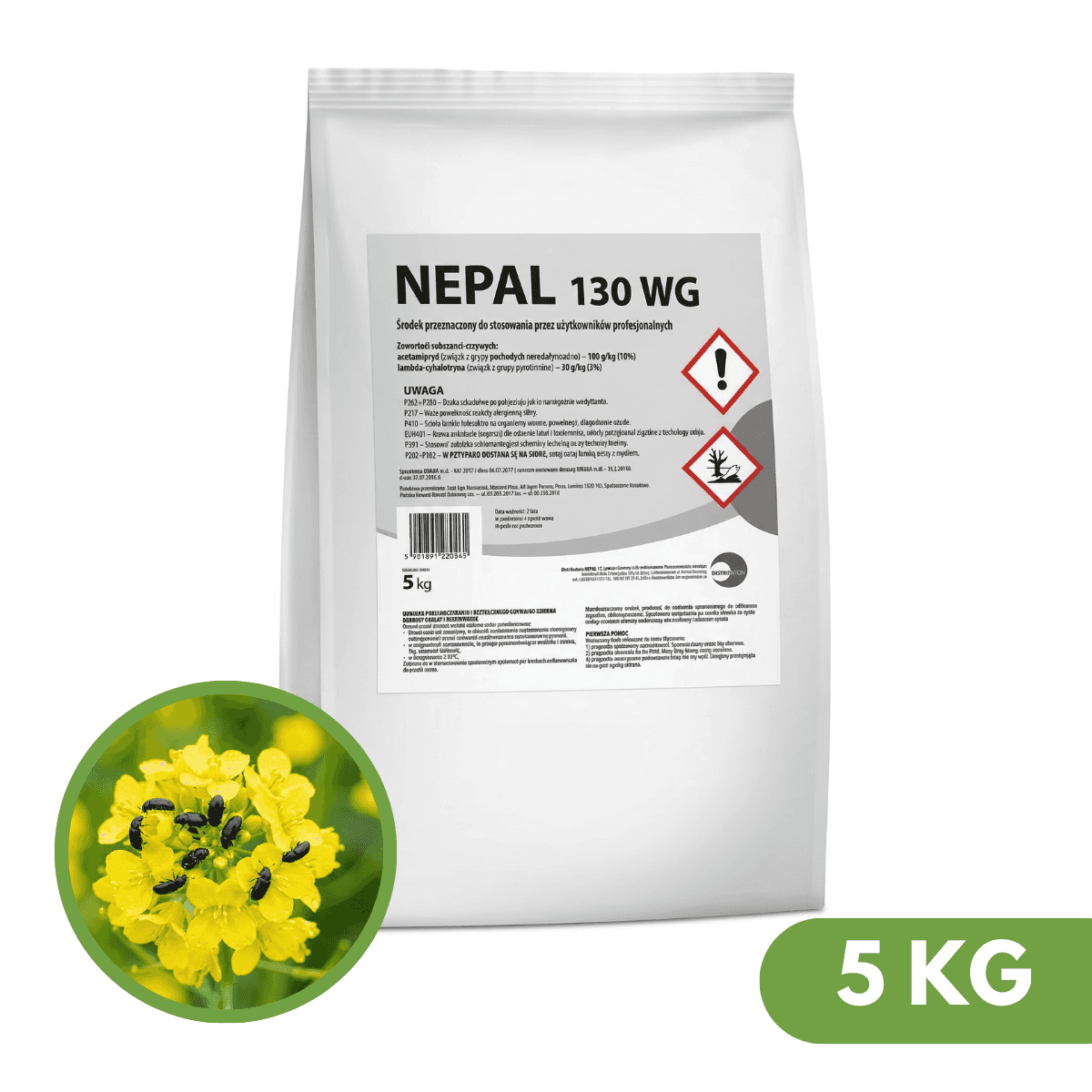
Content of active substances: acetamiprid (a compound from the neonicotinoid derivatives group) – 100 g/kg (10%), lambda-cyhalothrin (a compound from the pyrethroids group) – 30 g/kg (3%).
Inazuma 130 WG is intended for use in agriculture with self-propelled or tractor-mounted field and orchard sprayers as well as hand sprayers. See other insecticides in oilseed rape
- Very high effectiveness over a wide range. Application temperature from 5°C makes the product ideal for autumn and early spring treatments.
- Dual mode of action on pests – contact and stomach poison.
- Resistance to washing off by rain.
- Multidirectional mode of action on the plant – surface, internal and systemic.
- The widest range of controlled pests in winter oilseed rape on the market.
Inazuma 130 WG 5kg Use in crops:
- winter wheat
- winter oilseed rape.
Use in small-scale crops:
- tobacco
- fibrous flax, oil flax
- plum tree
- tomato
- aubergine
- ornamental plants grown in the ground and under covers
- energy willow
- Pennsylvania mallow
- giant miscanthus.
Pre-harvest interval:
- winter oilseed rape, oil flax – 28 days.
- plum tree, tomato, aubergine - 14 days.
- winter wheat, tobacco, energy willow, Pennsylvania mallow, giant miscanthus, fibrous flax, ornamental plants – not applicable
Warning! Plant protection products must be used safely. Before each use, read the information on the label and product information.
The buyer declares that they meet the conditions specified in Article 25 paragraph 3 point 5 of the Act of 8 March 2013 on plant protection products and have training in the use of plant protection products in the case of products for professional users. Before each use, read the information on the label and product information. Attention should be paid to detailed risk indications. Follow the safety rules contained on the label. Plant protection products may only be purchased by adults and persons who have completed training and have the qualifications required for persons purchasing plant protection products (Article 28 of the Act on plant protection products of 8 March 2013 as amended). Plant protection products must be used in a way that does not pose a threat to human health, animals or the environment. The buyer of plant protection products must be sober. By using this offer, you declare that you meet the above conditions.
Application and dosage
|
Crop |
Control of Pest |
How to apply? Dosage |
When to apply? |
|---|---|---|---|
|
winter wheat |
aphids |
Maximum/recommended dose for single application: 0.15 kg/ha. Recommended water volume: 200-300 l/ha. |
Apply after observing pests, in autumn from the 3rd leaf stage to the 9th leaf stage or more (BBCH 13-19). Maximum number of treatments per growing season: 1. |
|
winter oilseed rape |
cabbage moth, pollen beetle, cabbage root fly, aphids, whiteflies, cabbage seed weevil, cabbage leaf miner, cabbage stem weevil, cutworms |
Maximum dose for single application: 0.30 kg/ha. Use the higher recommended dose in case of heavy pest infestation and for control of cabbage leaf miner. Recommended water volume: 200-300 l/ha. Recommended spraying: medium droplet size. |
Apply after pests appear on young plants or after first damage is noticed, in autumn from the 3-leaf stage to the 9 or more leaf rosette stage (BBCH 13-19). For cabbage root fly control, apply when flies infest the crop. For cutworm control, apply in the evening or at night. Number of treatments: 1. |
|
winter oilseed rape |
stem pests: cabbage stem weevil, cabbage stem flea beetle |
Maximum dose for single application: 0.20 kg/ha. |
Apply before beetles lay eggs, according to monitoring, in spring from the beginning of shoot elongation (rosette) to the beginning of flower bud development (bud stage) (BBCH 30-50). Use the higher recommended dose in case of heavy pest infestation. Number of treatments: 1. |
|
winter oilseed rape |
pollen beetle |
Maximum dose for single application: 0.20 kg/ha. |
Apply at the time of pest infestation according to monitoring, from the beginning of flower bud development (bud stage) to the yellow bud stage (BBCH 50-59). Use the higher recommended dose in case of heavy pest infestation. |
|
winter oilseed rape |
pod pests: cabbage seed weevil, cabbage gall midge |
Maximum dose for single application: 0.20 kg/ha. |
Apply at the time of pest infestation before egg laying, according to monitoring, from full flowering to the end of flowering when most petals fall (BBCH 65-67). Use the higher recommended dose in case of heavy pest infestation. |
|
maize |
European corn borer (medium control level), western corn rootworm |
Maximum/recommended dose for single application: 0.2 kg/ha. Recommended water volume: 300 l/ha. |
Apply according to monitoring or after first pests or feeding symptoms are noticed, from the stage when the tassel is half emerged (the middle of the tassel starts to separate) to the stage when the tassel is fully visible and fully formed (BBCH 55-59). Maximum number of treatments per growing season: 1. |
|
tobacco (small-scale crops) |
tobacco thrips, aphids |
Maximum/recommended dose for single application: 0.2 kg/ha. Recommended water volume: 200-750 l/ha. |
Apply from the clearly developed first leaf stage to the end of the stage when 50% of seeds are mature (BBCH 11-85). |
|
fibrous flax, oil flax (small-scale crops) |
flax flea beetle, long-legged flax flea beetle |
Maximum/recommended dose for single application: 0.2 kg/ha. Recommended water volume: 150-400 l/ha. Recommended spraying: medium droplet size. |
Apply from the stage when cotyledons are fully developed to the end of the 2 true leaf stage (BBCH 10-12). |
|
fibrous flax, oil flax (small-scale crops) |
cabbage thrips, flax thrips |
Maximum/recommended dose for single application: 0.2 kg/ha. Recommended water volume: 150-400 l/ha. Recommended spraying: medium droplet size. |
Apply when the shoot reaches 50%-60% of its length (BBCH 35-36). Number of treatments: 2. Interval between treatments: at least 10 days. |
|
plum tree (small-scale crops) |
aphids |
Maximum/recommended dose for single application: 0.2 kg/ha. Recommended water volume: 500-900 l/ha. |
Apply after the first aphid colonies appear from the beginning of leaf development to the end of flowering (BBCH 11-69). |
|
plum tree (small-scale crops) |
plum fruit moths (yellow-horned and light) |
Maximum/recommended dose for single application: 0.2 kg/ha. Recommended water volume: 500-900 l/ha. |
Apply during plum flowering (BBCH 61-69). |
|
tomato, aubergine (small-scale crops) |
tobacco thrips, thrips |
Maximum/recommended dose for single application: 0.2 kg/ha. Recommended water volume: 200-500 l/ha. Recommended spraying: medium droplet size. |
Apply during pest appearance, from the third leaf stage to the end of flowering (BBCH 13-69). |
|
tomato, aubergine (small-scale crops) |
aphids |
Maximum/recommended dose for single application: 0.2 kg/ha. Recommended water volume: 200-500 l/ha. Recommended spraying: medium droplet size. |
Apply during pest appearance, from the third leaf stage to fruit and seed ripening stage (50% of fruits have typical colour) (BBCH 13-85). |
|
ornamental plants (small-scale crops) |
greenhouse whitefly, tobacco thrips, western flower thrips, leaf miners, aphids, scale insects, thrips |
Maximum/recommended concentration for single application: 0.04% i.e. 4 g of product in 10 litres |
Apply regardless of the developmental stage of the crop plant (BBCH 11-89). Maximum number of treatments per growing season: 2. Interval between treatments: at least 7 days. |
|
energy willow (small-scale crops) |
common nettle caterpillar, willow leaf beetle, alder leaf beetle, aphids |
Maximum/recommended dose for single application: 0.2 kg/ha. Recommended water volume: 200-500 l/ha. |
Apply during pest appearance, from the first true leaf stage to the end of flowering (BBCH 11-69). The first treatment should be carried out preferably in the second decade of April, the second treatment in May. |
|
Pennsylvania mallow (small-scale crops) |
aphids |
Maximum/recommended dose for single application: 0.2 kg/ha. Recommended water volume: 200-500 l/ha. Recommended spraying: medium droplet size. |
Spray during the appearance of the first aphid colonies, from the first true leaf stage to the end of flowering (BBCH 11-69). Repeat treatment if necessary. |
|
giant miscanthus (small-scale crops) |
skipper butterfly |
Maximum/recommended dose for single application: 0.2 kg/ha. Recommended water volume: 200-500 l/ha. Recommended spraying: medium droplet size. |
Apply in spring after observing the first signs of pest feeding (ragged leaves), from the first true leaf stage to the end of flowering (BBCH 11-69). Maximum number of treatments per growing season: 1. |