 SKU 802-c
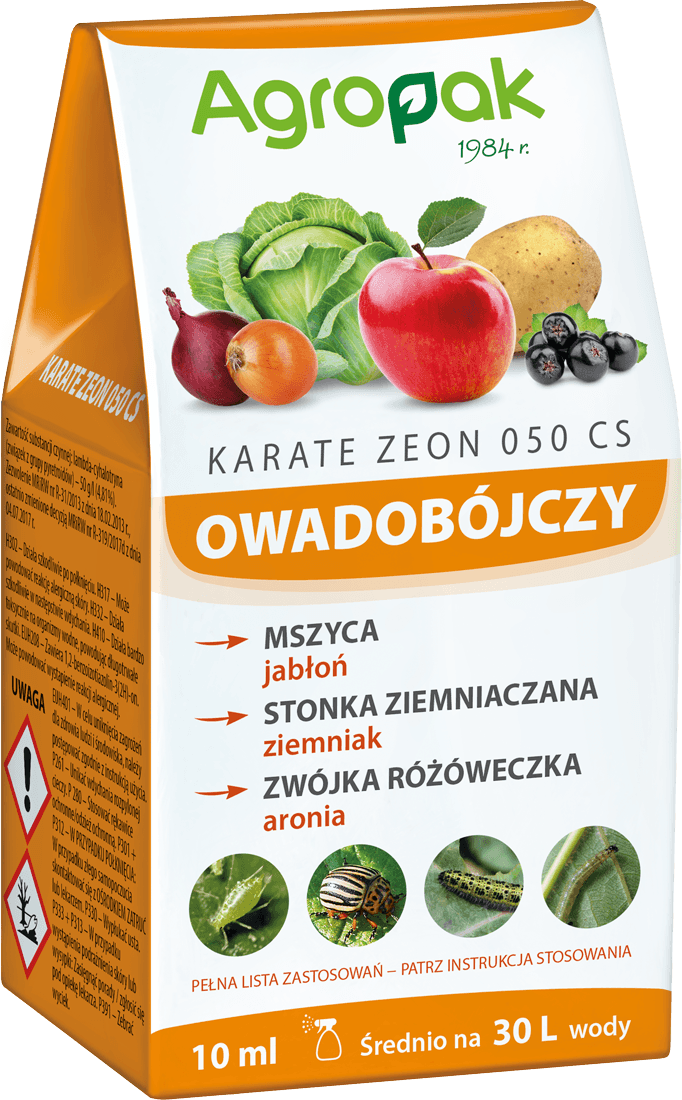
Karate Zeon 050 CS (lambda-cyhalothrin) - insecticide
Karate Zeon 050 CS is an insecticide in the form of capsule suspension in liquid (CS), used to protect agricultural, orchard and vegetable crops against chewing and sucking pests.
Description
Karate Zeon 050 CS - insecticide for agricultural, orchard and vegetable crops
What are the benefits of using the Karate Zeon 050 CS insecticide?
- For control of chewing and sucking pests,
- Has a broad spectrum of activity both in terms of crops and targeted insects,
- Exhibits contact and stomach action,
- Effectively eliminates unwanted insects.
Karate Zeon CS is a plant protection product from the insecticide group. It is available as a capsule suspension in liquid for dilution with water (CS).
Karate Zeon is intended for control of chewing and sucking pests in the cultivation of potato, winter oilseed rape, winter wheat, spring barley, maize, sweet maize, sugar beet, onion, cabbage, chokeberry, hops, flax (crop intended exclusively for the textile industry) and industrial hemp (crop intended exclusively for the textile industry).
The Karate Zeon insecticide is intended for use with self-propelled or tractor-mounted field sprayers, self-propelled or tractor-mounted orchard sprayers, or handheld sprayers.
What is the content of active substances in the Karate Zeon insecticide?
- Lambda-cyhalothrin (a compound from the pyrethroid group) – 50 g/l (4.81%).
How does the Karate Zeon 050 CS plant protection product work?
It exhibits contact and stomach action. It acts surface-wise on the plant.
In which crops can the Karate Zeon insecticide be used?
- potato,
- winter oilseed rape,
- winter wheat,
- spring barley,
- maize,
- sweet maize,
- sugar beet,
- onion,
- cabbage,
- chokeberry,
- hops,
- flax (crop intended exclusively for the textile industry),
- industrial hemp (crop intended exclusively for the textile industry).
Which insects does Karate Zeon control?
- Larvae and beetles of Colorado potato beetle,
- Aphids,
- Weevils - cabbage seed weevil, pollen beetle,
- Pollen beetle,
- Cabbage gall midge,
- Fleas: ground flea beetle, oilseed rape flea beetle, hop flea beetle, flax flea beetle, flax flea beetle long-legged,
- Oilseed rape blossom midge,
- Thrips,
- European corn borer, mountain corn borer,
- Gray leafhopper,
- Onion fly, cabbage root fly,
- Caterpillars of large white, small white, diamondback moth,
- Light brown apple moth, lily leafroller,
- Thrips – flax thrips, cabbage thrips, tobacco thrips.
How to use the Karate Zeon 050 CS insecticide?
Detailed information regarding dosing and use of the Karate Zeon 050 CS plant protection product can be found in the "Dosage" section and in the Plant Protection Product label attached in the downloadable files.
What is the pre-harvest interval and re-entry period when using Karate Zeon 050 CS?
During the re-entry period, i.e. from the application of the product until the day when people can enter the treated area and animals can be introduced, entry is prohibited until the spray liquid on the plant surface is completely dry.
The pre-harvest interval, i.e. the period from the last application to the day of crop harvest:
- Winter oilseed rape, winter wheat, spring barley - 28 days,
- Hops, sugar beet - 14 days,
- Potato, maize, sweet maize, chokeberry, apple tree, onion, cabbage - 7 days,
- Flax and industrial hemp – not applicable (crops intended exclusively for the textile industry).
The pre-harvest interval for fodder does not apply to Karate Zeon 050 CS.
What is the crop rotation interval when using the Karate Zeon insecticide?
In case of early destruction of the plantation, subsequent crops can be sown or planted after 30 days from the last treatment with Karate Zeon 050 CS.
What are the recommendations when using the spray liquid with Karate Zeon 050 CS?
- The product works more effectively at temperatures below 20°C. At higher temperatures, apply the treatment late in the day.
- When spraying plants (e.g. cabbage, onion) or pests (e.g. cabbage aphid) covered with waxy bloom, add a wetting agent to the spray liquid.
- Perform pest control treatments (especially for sucking pests) thoroughly to ensure all parts of the plants are covered with spray liquid.
- During application, avoid:
− drift of spray liquid onto neighbouring crops,
− overlapping of spray liquid at the edges of treatment strips and headlands.
More information can be found in the attached label in the downloadable files.
We invite you to learn more about the use of the Karate Zeon plant protection product on the following pages: Orchard Advisory, Vegetable Advisory, Agricultural Advisor.
Warning! Plant protection products must be used safely. Before each use, read the information on the label and product information.
The buyer declares that they meet the conditions specified in Article 25 paragraph 3 point 5 of the Act of 8 March 2013 on plant protection products and has training in the use of plant protection products in the case of products for professional users. Before each use, read the information on the label and product information. Pay attention to detailed risk indications. Follow the safety rules contained in the label. Plant protection products may only be purchased by adults and persons who have completed training and have the qualifications required for persons purchasing plant protection products (Article 28 of the Act on plant protection products of 8 March 2013 as amended). Plant protection products must be used in a way that does not pose a threat to human health, animals or the environment. The buyer of plant protection products must be sober. By using this offer, you declare that you meet the above conditions.
Application and dosage
|
Crop |
Target Pest |
How to apply? Dosage |
When to apply? |
|---|---|---|---|
|
Chokeberry |
Aphids, mountain corn borer, light brown apple moth |
Maximum dose for single application: 0.2 l/ha. |
Aphids: apply treatment after pest occurrence, from the stage when the first chokeberry leaf is developed until the end of flowering (BBCH 11-69). |
|
Hops |
Hop flea beetle, lily leafroller |
Maximum/recommended dose for single application: 0.15 l/ha. Recommended water volume: 300 - 500 l/ha. |
Apply treatment after pest occurrence when first damage is visible, up to 50 cm plant height. Spray rows or individual plants. |
|
Flax (crop intended exclusively for the textile industry) |
Flax flea beetle, flax flea beetle long-legged, flax thrips, cabbage thrips |
Maximum/recommended dose for single application: 0.15 l/ha. Recommended water volume: 300 - 400 l/ha. |
Apply treatment from the beginning of main shoot elongation to the beginning of flowering (BBCH 30-61). Maximum number of treatments per growing season: 2. |
|
Industrial hemp (crop intended exclusively for the textile industry) |
Hop flea beetle |
Maximum/recommended dose for single application: 0.15 l/ha. Recommended water volume: 300 - 400 l/ha. |
Apply treatment during emergence (BBCH 11-14), after pest occurrence. |
|
Industrial hemp (crop intended exclusively for the textile industry) |
European corn borer |
Maximum/recommended dose for single application: 0.2 l/ha. Recommended water volume: 300 - 400 l/ha. |
Apply during larval hatch according to monitoring (June). |
|
Sugar beet |
Gray leafhopper (medium control level) |
Maximum / recommended dose for single application: 0.2 l/ha. Recommended water volume: 250 - 400 l/ha. |
Apply treatment after pest occurrence up to BBCH39. For best efficacy, apply when active beetles are observed and air temperature does not exceed 18°C. |
|
Apple tree |
Apple tree aphid |
Maximum dose for single application: 0.2 l/ha. |
Apply treatment after pest occurrence. In commercial orchards, limit use to one treatment per growing season. Further necessary treatments should use products from other chemical groups. |
|
Onion grown in the field |
Tobacco thrips, onion fly |
Maximum dose for single application: 0.12 l/ha. |
Tobacco thrips: apply treatment after first pests appear. Onion fly: apply treatment during fly flight period, i.e. at the beginning of lilac flowering. Maximum number of treatments per growing season: 2. |
|
Cabbage grown in the field |
Caterpillars of large white, small white, diamondback moth, cabbage aphid, cabbage root fly, tobacco thrips |
Maximum dose for single application: 0.12 l/ha. Maximum / recommended dose for single application: 1.2 ml/100 m2. Recommended water volume: 5 - 6 l/100 m2. |
Caterpillars of large white, small white, diamondback moth: spray during mass hatching of caterpillars.
Cabbage root fly: apply treatment at the beginning of horse chestnut flowering.
Maximum number of treatments per growing season: 2. |
|
Potato |
Larvae and beetles of Colorado potato beetle |
Maximum dose for single application: 0.16 l/ha. Recommended water volume: 300 – 400 l/ha. |
|
|
Potato |
Aphids |
Maximum dose for single application: 0.2 l/ha. Recommended water volume: 300 – 400 l/ha. |
Apply treatment after pest occurrence. |
|
Winter oilseed rape |
Pollen beetle (treatment against pollen beetle also controls cabbage seed weevil) |
Maximum dose for single application: 0.12 l/ha. Recommended water volume: 300 l/ha. |
Spray before beetles lay eggs, according to monitoring. |
|
Winter oilseed rape |
Cabbage seed weevil |
Maximum dose for single application: 0.125 l/ha. Recommended water volume: 300 l/ha. |
Spray before beetles lay eggs, according to monitoring. |
|
Winter oilseed rape |
Cabbage seed weevil, cabbage gall midge |
Maximum dose for single application: 0.15 l/ha. Recommended water volume: 300 l/ha. |
Depending on pest appearance timing, apply treatment from the stage when closed individual flower buds are still visible on the main inflorescence until the end of flowering (BBCH 55-69). |
|
Winter oilseed rape |
Oilseed rape flea beetle, ground flea beetles |
Maximum dose for single application: 0.15 l/ha. Recommended water volume: 300 l/ha. |
Spray after beetles appear in the plantation, according to monitoring during rosette formation and development (BBCH 10-14), after first damage caused by flea beetles is noticed. |
|
Winter oilseed rape |
Oilseed rape blossom midge |
Maximum dose for single application: 0.15 l/ha. Recommended dose for single application: 0.12-0.15 l/ha. Recommended water volume: 300 l/ha. |
During rosette formation and development (BBCH 10-14), immediately after young larvae appear, when average density is 1 larva per plant. Interval between treatments: at least 10 -14 days. |
|
Winter wheat, spring barley |
Thrips, aphids, aphids (vectors of viral diseases in early cereal development) |
Maximum dose for single application: 0.1 l/ha. Recommended water volume: 300 – 400 l/ha. |
Thrips: apply from the beginning of larval hatch. Aphids: apply treatment after heading, no later than milk grain maturity stage. Aphids (vectors of viral diseases in early cereal development) apply treatment: Maximum number of treatments per growing season: 2. |
|
Maize |
European corn borer |
Maximum / recommended dose for single application: 0.2 l/ha. |
Apply treatment during maize tasselling after pest occurrence. |
|
Maize |
Aphids |
Maximum / recommended dose for single application: 0.1 l/ha. Recommended water volume: 300 - 400 l/ha. |
Apply treatment during mass flight of winged aphids on plants. Maximum number of treatments per growing season: 2. |
|
Sweet maize |
European corn borer |
Maximum/recommended dose for single application: 0.2 l/ha. Recommended water volume: 300 - 400 l/ha. Maximum/recommended dose for single application: 2.0 ml/100 m2. Recommended water volume: 3 - 4 l/100 m2. |
Apply treatment from beginning of tassel emergence to the stage when tassel tip is visible (BBCH 51-53), after pest occurrence. Maximum number of treatments per growing season: 1. |
|
Broccoli |
Caterpillars of large white, small white, cabbage moth, diamondback moth, cabbage aphid, cabbage root fly |
Maximum / recommended dose for single application: 0.2 l/ha. Recommended water volume: 300 – 600 l/ha. |
Caterpillars of large white, small white, cabbage moth, diamondback moth: spray during mass hatching of caterpillars. |
|
Walnut |
Walnut husk fly, aphids |
Maximum/recommended dose for single application: 0.2 l/ha. Recommended water volume: 800 – 1500 l/ha. |
Apply treatment after pest occurrence. The last developmental stage for treatment is the end of fruit development (BBCH 81). |
|
Common hazel |
Aphids, acorn weevil |
Maximum/recommended dose for single application: 0.2 l/ha. Recommended water volume: 800 – 1500 l/ha. |
Apply treatment after pest occurrence. The last developmental stage for treatment is the end of fruit development (BBCH 80). Maximum number of treatments per growing season: 1 |