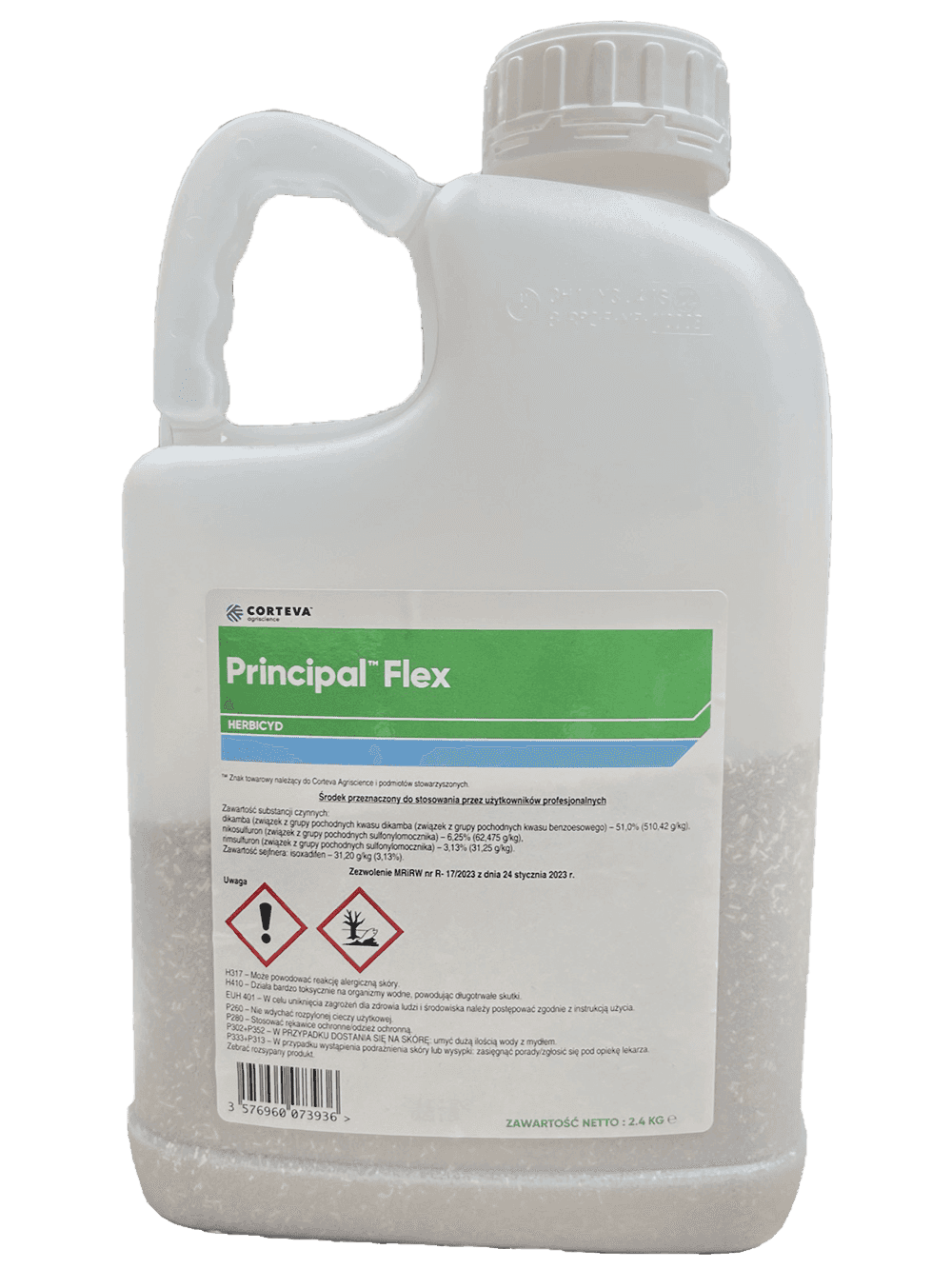
 SKU 44291-c
Nikita 562.5 WG (dicamba, mesotrione, nicosulfuron) Adama - herbicide
Nikita 562.5 WG Adama is a selective herbicide in water-soluble granule form, designed for the control of monocotyledonous and dicotyledonous weeds in maize cultivation.
Description
Nikita Adama - herbicide
- Effectively controls monocotyledonous and dicotyledonous weeds.
- Dedicated action - for use in maize cultivation.
- Contains as many as 3 active substances - for enhanced efficacy.
- Differing modes of action of active substances - prevents the development of weed resistance.
- Can be combined with other herbicides to broaden the spectrum of controlled weeds.
- In a convenient and efficient water-soluble granule form.
Nikita 562.5 WG is a selective herbicide in water-dispersible granule (WG) form. It acts systemically. For foliar application in the control of monocotyledonous and dicotyledonous weeds in maize cultivation.
The product is intended for use with self-propelled or tractor-mounted field sprayers.
Nikita Adama - mode of action:
The product contains three active substances belonging to different chemical groups with distinct modes of action.
Dicamba is classified as a growth and development inhibitor. In the plant, it disrupts cell division, leading to leaf and stem deformation, growth inhibition, stunting, followed by chlorosis, necrosis and plant wilting.
Mesotrione is mainly absorbed through leaves and additionally through weed roots, rapidly translocated within the plant, inhibiting its growth and development. It blocks carotenoid biosynthesis, resulting in chlorophyll destruction, visible as leaf bleaching.
Nicosulfuron is mainly absorbed through leaves and quickly translocated within the plant. Weed growth and development are inhibited shortly after application, followed by gradual discoloration of plants.
First symptoms of the product’s action can be observed 4-6 days after treatment, while full weed death occurs within 4 weeks of application. The speed of the herbicidal effect depends on the developmental stage of the weeds, prevailing weather conditions (temperature, air humidity), and weed growth rate.
Nikita 562.5 WG Adama - active substance content:
- Dicamba (a benzoic acid derivative) – 312.5 g/kg (31.3%),
- Mesotrione (a triketone derivative) - 150 g/kg (15%),
- Nicosulfuron (a sulfonylurea derivative) – 100 g/kg (10%).
According to HRAC classification, dicamba belongs to group 4 (formerly group O); mesotrione to group 27 (formerly group F2); and nicosulfuron to group 2 (formerly group B).
Nikita 562.5 WG Adama - controlled weeds:
Application in tank mix with adjuvant Adigor 440 EC at 1.0 l/ha:
- Sensitive weeds: common fumitory, common chickweed, purple dead-nettle, white goosefoot, field pansy, knotweed, volunteer winter oilseed rape, common sunflower, rough pigweed, shepherd's purse, field pennycress, green foxtail, common mallow.
- Moderately sensitive weeds: yellow foxtail, white campion, Persian speedwell, bindweed knotweed, blue foxtail, blackgrass.
- Moderately resistant weeds: bird knotweed.
Application in tank mix with adjuvant Adigor 440 EC at 1.5 l/ha:
- Sensitive weeds: common fumitory, common chickweed, purple dead-nettle, white goosefoot, broadleaf goosefoot, field pansy, Persian speedwell, knotweed, volunteer winter oilseed rape, common sunflower, rough pigweed, shepherd's purse, field pennycress, green foxtail, common mallow.
- Moderately sensitive weeds: yellow foxtail, white campion, bird knotweed, bindweed knotweed, blue foxtail, blackgrass.
Application in tank mix with adjuvant Olejan 85 EC at 1.5 l/ha:
- Sensitive weeds: common fumitory, common chickweed, purple dead-nettle, white goosefoot, volunteer winter oilseed rape, shepherd's purse, field pennycress.
- Moderately sensitive weeds: yellow foxtail, field violet, Persian speedwell, knotweed.
- Moderately resistant weeds: blue foxtail, blackgrass.
- Resistant weeds: bindweed knotweed.
Application in tank mix with herbicide Efica 960 EC at 0.8 l/ha:
- Sensitive weeds: yellow foxtail, common fumitory, field violet, common chickweed, purple dead-nettle, white goosefoot, Persian speedwell, knotweed, volunteer winter oilseed rape, common sunflower, rough pigweed, shepherd's purse, field pennycress.
- Moderately sensitive weeds: blue foxtail, blackgrass.
- Moderately resistant weeds: bindweed knotweed.
Nikita Adama herbicide - crop use:
Agricultural crops:
- Maize.
Nikita 562.5 WG Adama herbicide - pre-harvest interval and withholding period:
Pre-harvest interval - time from last application to crop harvest:
- Not required
Withholding period - time from application until people and animals can enter the treated area:
- Do not enter until the spray liquid has completely dried on the plant surfaces.
Nikita Adama herbicide - crop rotation:
In the year of application, tomatoes and tobacco must not be grown. If early destruction of the crop is necessary, maize or winter cereals may be grown as succeeding crops. When growing winter cereals, ploughing should be done before sowing. Sensitive crops such as sugar beet, legumes, winter oilseed rape, sunflower, vegetables and early sown cereals may suffer damage.
Nikita herbicide - preparation of spray liquid:
Prepare the spray liquid immediately before use. Before preparation, determine the required amount. Pour the measured amount of product into a sprayer tank half-filled with water (with agitator running). Triple rinse empty containers with water and pour rinsate into the sprayer tank. Fill up with water to the required volume and mix thoroughly. If the sprayer tank is not equipped with a hydraulic agitator, mix mechanically after adding the product. Keep the spray liquid in motion during transport and spraying by running the agitator. If spraying is interrupted, mix the spray liquid thoroughly before resuming work.
Nikita 562.5 WG Adama plant protection product - usage guidelines:
- The product should not be used more often than once every three years on the same field.
- Do not use on sweet maize.
- Resistance management strategy: To minimise the risk of weed resistance development to herbicides, follow Good Agricultural Practice:
– strictly follow the instructions on the plant protection product label - use the product at the recommended dose, number of applications, and timing to ensure optimal weed control and only in recommended tank mixes,
– select herbicides and decide on treatment based on current or potential weed infestation, considering dominant species and damage thresholds,
– rotate herbicides (active substances) with different modes of action,
– use mixtures of herbicides (active substances) with different modes of action,
– use herbicides acting on multiple weed life processes (with different modes of action) in rotation and/or mixtures,
– apply a herbicide with a given mode of action only once per growing season of the crop,
– adapt cultivation practices to field conditions, especially weed type and infestation level,
– use various weed control methods including crop rotation, mechanical control (avoid soil cultivation simplifications), etc.,
– use certified seed material,
– clean agricultural machinery to prevent spread of weed propagules to other sites,
– inform the authorisation holder about unsatisfactory weed control,
– contact an advisor, authorisation holder or their representative for detailed information. - Do not apply:
– during rain or before expected rain,
– to plants weakened or damaged by pests, frost, flooding or drought,
– in windy conditions that may cause spray drift onto neighbouring crops. - During application, avoid:
– spray drift onto neighbouring crops
− overlapping spray on treatment strip edges and headlands - Keep out of reach of children.
- Store plant protection products:
− in original packaging,
− to prevent contact with food, beverages or feed, environmental contamination and access by unauthorised persons,
− at 0°C - 30°C
− in a dry and well-ventilated place.
Warning! Use plant protection products safely. Before each use, read the label and product information carefully.
The purchaser declares that they meet the conditions specified in Article 25 paragraph 3 point 5 of the Act of 8 March 2013 on plant protection products and have received training in the use of plant protection products if the products are for professional users. Before each use, read the label and product information carefully. Pay attention to detailed risk indications. Follow safety rules contained on the label. Plant protection products may only be purchased by adults and persons who have completed training and possess the qualifications required for persons purchasing plant protection products (Article 28 of the Act on plant protection products of 8 March 2013, as amended). Plant protection products must be used in a way that does not pose a threat to human health, animals or the environment. The purchaser must be sober. By purchasing, you declare that you meet the above conditions.
Application and dosage
|
Crop |
Target pest control |
How to apply? Dosage |
When to apply? |
|---|---|---|---|
|
Maize |
common fumitory, common chickweed, purple dead-nettle, white goosefoot, broadleaf goosefoot, field pansy, Persian speedwell, knotweed, volunteer winter oilseed rape, common sunflower, rough pigweed, shepherd's purse, field pennycress, green foxtail, common mallow, yellow foxtail, white campion, bindweed knotweed, blue foxtail, blackgrass, bird knotweed, field violet |
Maximum/recommended dose for single application: 0.4 kg/ha. Product intended for use only in mixture: a) with adjuvant Adigor 440 EC: NIKITA 562.5 WG 0.4 kg/ha + Adigor 440 EC 1.0 l/ha; NIKITA 562.5 WG 0.4 kg/ha + Adigor 440 EC 1.5 l/ha b) with adjuvant Olejan 85 EC: NIKITA 562.5 WG 0.4 kg/ha + Olejan 85 EC 1.5 l/ha c) with product Efica 960 EC: NIKITA 562.5 WG 0.4 kg/ha + Efica 960 EC 0.8 l/ha Recommended water volume: 200 – 300 l/ha Recommended spraying: medium droplet Maximum number of treatments per growing season: 1 |
Application timing: apply after crop emergence, at 2-4 leaf stage (BBCH 12-14). |