SKU 44192-c
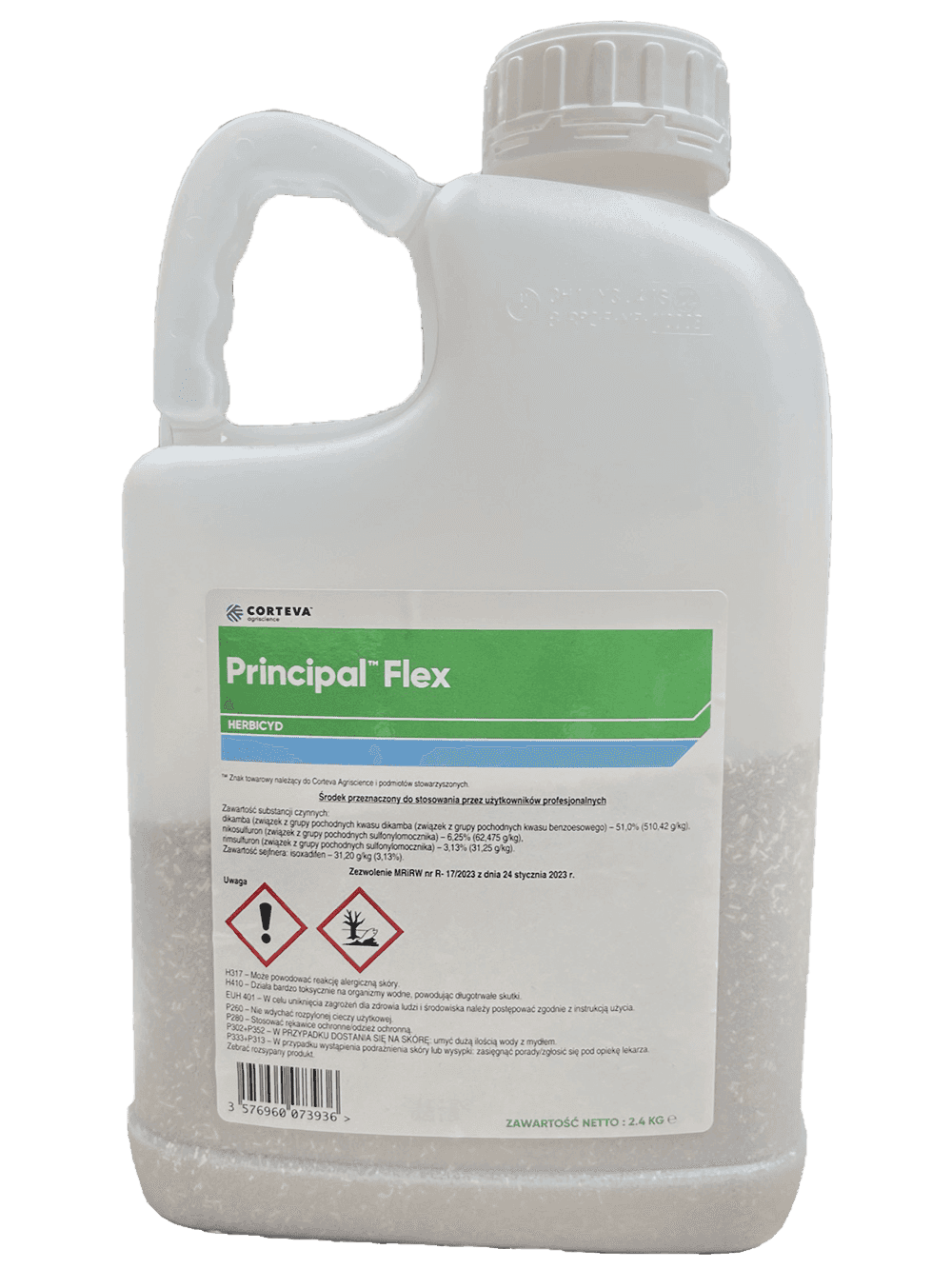
Principal Flex (dikamba, nikosulfuron, rimsulfuron) Corteva - herbicide
Principal Flex Corteva is a selective herbicide in the form of water dispersible granules (WG) with systemic action, dedicated for maize crops.
Description
Principal Flex Corteva - herbicide
- Effectively controls monocotyledonous and dicotyledonous weeds.
- Dedicated action - for use in maize cultivation.
- Contains as much as 3 active substances - for better efficacy.
- Differing modes of action of active substances - prevents the development of weed resistance.
- Contains safener - will not damage maize.
- In a convenient and efficient water dispersible granule form.
Principal Flex is a selective herbicide in the form of water dispersible granules (WG). It acts systemically. For foliar application in the control of monocotyledonous and dicotyledonous weeds in maize crops.
The product is intended for use with self-propelled or tractor-mounted field sprayers.
Principal Flex Corteva - mode of action:
The product contains active substances belonging to two chemical groups with different modes of action.
Nikosulfuron and rimsulfuron belong to the group of acetolactate synthase (ALS) inhibitors, and their mode of action is based on inhibiting the biosynthesis of three amino acids: valine, leucine, and isoleucine. This inhibits cell division in meristematic tissues, resulting in strong growth and development suppression of weeds and their gradual death.
Dikamba belongs to the group of growth inhibitors. In the plant, it disrupts cell division, leading to leaf and stem deformation, growth inhibition, dwarfing, followed by chlorosis, necrosis, and plant drying.
The product is mainly absorbed through leaves and rapidly translocated within the plant. It is most effective on young, actively growing weeds. Warm and humid weather accelerates its action, while cool and dry conditions may delay it.
Principal Flex Corteva herbicide - active substance content:
- Dikamba (a derivative of dikamba acid, a benzoic acid derivative) – 51.0% (510.42 g/kg),
- Nikosulfuron (a sulfonylurea derivative) – 6.25% (62.475 g/kg),
- Rimsulfuron (a sulfonylurea derivative) – 3.13% (31.25 g/kg),
- Safener content: isoxadifen – 31.20 g/kg (3.13%).
According to HRAC classification, nikosulfuron and rimsulfuron belong to group 2 (formerly group B), and dikamba belongs to group 4 (formerly group O).
Principal Flex Corteva - controlled weeds:
Single application with adjuvant:
- Sensitive weeds: green foxtail, common chickweed, purple dead-nettle, white goosefoot, many-seeded goosefoot, scentless mayweed, couch grass, cleavers, knotweed, pale persicaria, rough amaranth, field pansy, green foxtail, tall fescue, small-flowered yellow-cress.
- Moderately sensitive weeds: small geranium, field violet, redshank, Persian speedwell, bird's knotweed, bindweed knotweed.
Split dose application with adjuvant:
- Sensitive weeds: green foxtail, common chickweed, purple dead-nettle, white goosefoot, many-seeded goosefoot, scentless mayweed, couch grass, cleavers, knotweed, pale persicaria, rough amaranth, field pansy, green foxtail, tall fescue, small-flowered yellow-cress.
- Moderately sensitive weeds: small geranium, field violet, redshank, Persian speedwell, bird's knotweed, bindweed knotweed.
Principal Flex Corteva herbicide - crop use:
Agricultural crops:
- Maize grown for grain,
- Maize grown for fodder.
Principal Flex herbicide - pre-harvest interval and withholding period:
Pre-harvest interval - time from last application to crop harvest:
- Maize - not required.
Withholding period - time from application until people and animals can enter the treated area:
- 1 day.
Principal Flex Corteva herbicide - crop rotation:
In normal crop rotation, after maize harvest in autumn of the same calendar year, all winter cereals can be grown. In the following spring, spring cereals, spring oilseed rape, potatoes, sugar beet, sunflower, flax, soybean, peas, beans, and tomatoes can be grown. If earlier ploughing of the treated crop is necessary (due to damage from hail, diseases, pests, or frost), after 3 weeks from application and ploughing before sowing, maize can be grown, and in autumn of the same year, after ploughing before sowing, winter cereals can also be grown.
Principal Flex herbicide - preparation of spray liquid:
Before preparing the spray liquid, accurately determine the required amount. Do not use water conditioners that acidify the spray liquid or adjuvants that lower water pH. Add an anti-foaming agent in doses recommended by its manufacturer to the sprayer tank partially filled with water (with the agitator on). Add the measured amount of Principal Flex to the sprayer tank partially filled with water while continuously mixing the spray liquid. Triple rinse empty packaging with water and pour rinsate into the sprayer tank. Fill the sprayer tank with water to the required volume. Then, while continuing to mix, add the recommended adjuvant in doses recommended by its manufacturer. When using the product in tank mixes with other products, strictly follow the preparation instructions for those products. In case of spraying interruptions, thoroughly mix the spray liquid in the sprayer tank before resuming work. Due to the very high sensitivity of some crops even to trace amounts of the product, thorough cleaning of the sprayer after application is very important, especially before use on crops other than those recommended.
Principal Flex Corteva plant protection product - usage instructions:
- After application, some maize varieties may show transient phytotoxicity symptoms.
- Unfavourable conditions for maize growth before and after treatment may increase the risk of phytotoxicity symptoms.
- Resistance management strategy: The product contains active substances classified by mode of action as ALS inhibitors (nikosulfuron and rimsulfuron) and synthetic auxins (dikamba). Repeated use of herbicides with the same mode of action may select for resistant weeds. To minimise the risk of resistance development, herbicides should be used following Good Agricultural Practice:
– strictly follow the instructions on the plant protection product label
– use the product at the recommended dose and timing to ensure optimal weed control,
– select herbicide and treatment decisions based on current or potential weed infestation, considering dominant species and damage thresholds,
– rotate herbicides (active substances) with different modes of action,
– use tank mixes or sequences of herbicides with different modes of action,
– adjust cultivation practices to field conditions, especially weed type and pressure,
– use various weed control methods including crop rotation,
– use certified seed material,
– clean agricultural machinery to prevent transfer of weed propagules,
– inform the authorisation holder about unsatisfactory weed control,
– for detailed information, contact an advisor, authorisation holder, or their representative. - Do not use the product:
– on sweet maize, popping maize, or breeding material crops,
– immediately after prolonged cold (or continuous rain) periods on plants with inhibited growth. Treatment can be applied after maize resumes vigorous growth (when waxy layer is restored),
– at air temperatures below 10°C or above 25°C and during strong sunlight,
– when day-night temperature differences exceed 15°C,
– on crops weakened by pests, frost, excess moisture, drought, nutrient deficiency, or other stress factors (use on very light soils increases risk of stress),
– on wet plants (dew, rain),
– if rain is expected within 2 hours after application,
– in tank mixes with herbicides containing bentazon. Principal Flex can be applied 7 days before or 7 days after bentazon-containing herbicides. - During application, avoid:
– spray drift onto neighbouring crops,
– overlapping spray at field edges and headlands. - Keep out of reach of children.
Store plant protection products:
- in original packaging,
- to prevent contact with food, beverages, or feed, environmental contamination, and access by unauthorised persons,
- at temperatures between 0°C and 30°C.
Warning! Use plant protection products safely. Before each use, read the label and product information carefully.
The buyer declares that they meet the conditions specified in Article 25 paragraph 3 point 5 of the Act of 8 March 2013 on plant protection products and have training in the use of plant protection products in the case of products for professional users. Before each use, read the label and product information carefully. Pay attention to detailed risk indications. Follow safety rules contained on the label. Plant protection products may only be purchased by adults and persons who have completed training and hold the qualifications required for persons purchasing plant protection products (Article 28 of the Act on plant protection products of 8 March 2013, as amended). Plant protection products must be used in a way that does not pose a threat to human health, animals, or the environment. The buyer must be sober. By purchasing, you declare that you meet the above conditions.
Application and dosage
|
Crop |
Weed control |
How to apply? Dosage |
When to apply? |
|---|---|---|---|
|
Maize grown for grain, maize grown for fodder - single application |
green foxtail, common chickweed, purple dead-nettle, white goosefoot, many-seeded goosefoot, scentless mayweed, couch grass, cleavers, knotweed, pale persicaria, rough amaranth, field pansy, green foxtail, tall fescue, small-flowered yellow-cress, small geranium, field violet, redshank, Persian speedwell, bird's knotweed, bindweed knotweed. |
Maximum / recommended dose for single application: 480 g/ha. NOTE: Always use the product with the recommended adjuvant. Maximum number of treatments per growing season: 1. Recommended water volume: 100 - 400 l/ha. In case of heavy weed infestation or advanced weed growth stages, increase water volume to at least 200 l/ha. Recommended spraying: medium droplet size. |
Application timing: apply the product at maize growth stage 2-6 leaves (BBCH 12 - 16), when most couch grass plants reach 15-20 cm height, green foxtail and other monocotyledonous weeds are at 3-leaf stage to end of tillering, and most dicotyledonous weeds are at 2-4 leaf stage. |
|
Maize grown for grain, maize grown for fodder - split dose application |
green foxtail, common chickweed, purple dead-nettle, white goosefoot, many-seeded goosefoot, scentless mayweed, couch grass, cleavers, knotweed, pale persicaria, rough amaranth, field pansy, green foxtail, tall fescue, small-flowered yellow-cress, small geranium, field violet, redshank, Persian speedwell, bird's knotweed, bindweed knotweed. |
In case of strong weed pressure or when thermal conditions may increase risk of crop damage, split doses are recommended. NOTE: Always use the product with the recommended adjuvant. First treatment Maximum/recommended dose for single application: 240 g/ha. Application timing: apply at maize growth stage 2-3 leaves (BBCH 12-13). Second treatment Maximum/recommended dose for single application: 240 g/ha. Application timing: apply at maize growth stage 4-6 leaves (BBCH 14-16). Interval between treatments: 7 – 10 days. Recommended water volume: 100-400 l/ha. In case of heavy weed infestation or advanced weed growth stages, increase water volume to at least 200 l/ha. Recommended spraying: medium droplet size. Maximum number of treatments per growing season: 1 (single application) or 2 (split doses). |
First treatment - application timing: apply at maize growth stage 2-3 leaves (BBCH 12-13). Second treatment - application timing: apply at maize growth stage 4-6 leaves (BBCH 14-16). |