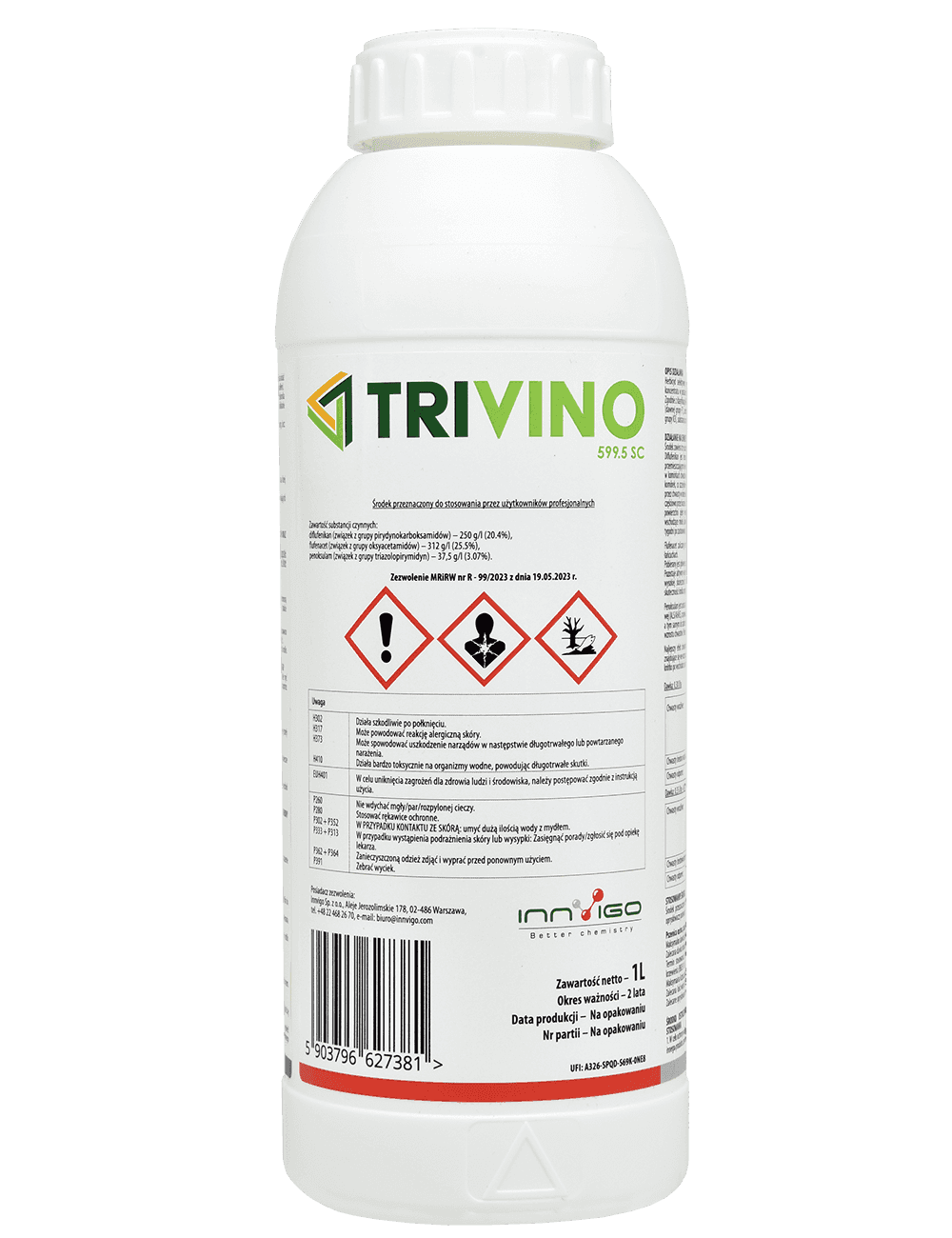
 SKU 24355-c
Trinity 590 SC (chlorotoluron, diflufenican, pendimethalin) - herbicide
Trinity 590 SC is a selective systemic herbicide containing three active substances: chlorotoluron, diflufenican and pendimethalin. Thanks to this, the product is exceptionally effective in controlling weeds both in the soil and on the leaves.
Description
Trinity 590 SC - a herbicide with the power of three active substances
What are the benefits of using the plant protection product Trinity for weed control?
- Effectively controls unwanted weeds,
- Contains three active substances: chlorotoluron, diflufenican and pendimethalin, which complement each other, making Trinity even more effective,
- Has a fast action, so you will quickly get rid of the problem,
- Does not limit the choice of succeeding crops,
- Does not require mixing with other products,
- Acts both in the soil and on the leaves - broad spectrum of action,
- Convenience - Trinity is available as a concentrate.
Trinity 590 SC is a plant protection product manufactured by Adama from the herbicide group. It is available as a concentrate of a suspension concentrate for dilution with water (SC).
It is a selective product. It has systemic action.
It is intended for herbicidal use.
The product is intended for use with self-propelled or tractor-mounted field sprayers.
What is the content of active substances in the herbicide Trinity 590 SC?
- Chlorotoluron - (a compound from the urea derivatives group) - 250 g/l (21.7%),
- Diflufenican - (a compound from the phenoxynicotinanilide group) - 40 g/l (3.5%),
- Pendimethalin - (a compound from the dinitroaniline group) - 300 g/l (26.1%).
How does the herbicide Trinity work?
As you already know, the weed control product Trinity contains three active substances: chlorotoluron, diflufenican and pendimethalin.
Each of these substances has a different mode of action, which makes these substances complement each other. Thanks to this, regardless of which weed species attack your plants - they stand no chance against this trio!
Diflufenican is absorbed by weeds during germination, and when applied after emergence, it is also absorbed through the leaves; it inhibits the biosynthesis of plant pigments (carotenoids) necessary for photosynthesis. The lack of these structures causes bleaching of leaf tissues and cell breakdown, which is especially visible in new tissues.
Pendimethalin is absorbed by the roots and above-ground parts of weeds, inhibiting microtubule formation, resulting in the inhibition of cell division and elongation processes. It is most effective against weeds during their germination and emergence. Monocotyledonous weeds are controlled up to the first or early second leaf stage, and dicotyledonous weeds up to the two true leaves stage.
It maintains long-lasting effectiveness in the autumn period also against later emerging weeds.
Chlorotoluron is absorbed through the roots and leaves of weeds, inhibiting photosynthesis. The best herbicidal effect is achieved by applying the herbicide in the early developmental stages of weeds, i.e. during germination or shortly after emergence, at the seedling stage.
Which weeds does the plant protection product Trinity control?
- Sensitive weeds: field pansy, common chickweed, field forget-me-not (dose 2.5 l/ha), scentless mayweed, common chamomile, loose silky-bent, Persian speedwell, cleavers, volunteer oilseed rape, shepherd's purse, field pennycress, annual meadow-grass (dose 2.5 l/ha),
- Resistant weeds: common poppy.
How to apply the herbicide Trinity 590 SC?
Detailed information regarding dosing and application of Trinity can be found in the "Dosage" section and in the plant protection product label attached in the downloadable files.
In which crops can the herbicide Trinity be used?
- Winter wheat,
- Winter triticale,
- Winter rye,
- Winter barley,
- Seed plantations of winter grasses (small areas).
What is the pre-harvest interval and withholding period when using Trinity 590 SC in winter cereals?
The pre-harvest interval, i.e. the period from the last application to the day of crop harvest, does not apply to Trinity.
Can Trinity be used for weed control without risk to succeeding crops?
The product does not pose a threat to succeeding crops if ploughing to a depth of 10 cm is performed. Temporary leaf discoloration of cereals and the first leaves of oilseed rape may occur, which does not affect later plant condition. If winter oilseed rape is sown without prior ploughing, phytotoxicity symptoms may appear, especially on light soils with low organic matter content.
If it is necessary to destroy the plantation earlier due to frost damage, all crops can be grown after ploughing to a depth of 20 cm. In no-till cultivation, the following can be grown: spring barley, spring wheat, potato, pea, bean (except runner bean).
If it is necessary to destroy the plantation earlier in autumn, only winter wheat can be sown again after ploughing to a depth of 20 cm.
What are the recommendations for using the spray liquid prepared with Trinity 590 SC?
- Apply the product to well-cultivated soil (without clods).
- Sow cereal grain at an even depth (3-4 cm), covering the grain thoroughly with soil.
- Use the lower recommended dose on light soils with lower weed infestation.
- Resistance management strategy
- To minimise the risk of weed resistance development, the product should be
used according to Good Agricultural Practice:
– follow the recommendations on the plant protection product label - apply the product at the recommended dose at the timing ensuring the best weed control,
– adjust cultivation practices to field conditions, especially to weed species and infestation level,
– use various weed control methods including crop rotation, etc.,
– rotate herbicides with different modes of action,
– use herbicide mixtures with herbicides of different modes of action,
– use herbicides acting on several weed life processes in rotation and/or mixtures,
– apply a herbicide with a given mode of action only once per growing season of the crop,
– inform the authorisation holder about unsatisfactory weed control,
– for detailed information contact an advisor or the authorisation holder of the plant protection product. - Do not use the product:
– in cereals with legume undersowing,
– on plants weakened or damaged by diseases, pests, frost or drought,
– on flowering weeds. - During application, avoid:
– drift of spray liquid onto neighbouring crop plantations,
– overlapping spray liquid on treatment strip edges and headlands.
More information can be found in the attached label in the downloadable files.
We invite you to learn more about using the plant protection product Trinity on the Agricultural Advisor website:
- Expand your knowledge about herbicides,
- Learn more about weeds.
- Read agricultural announcements.
Warning! Plant protection products must be used safely. Before each use, read the information on the label and product information.
The buyer declares that they meet the conditions specified in Article 25 paragraph 3 point 5 of the Act of 8 March 2013 on plant protection products and has training in the use of plant protection products in the case of products for professional users. Before each use, read the information on the label and product information. Pay attention to detailed risk indications. Follow the safety rules contained in the label. Plant protection products may only be purchased by adults and persons who have completed training and have the qualifications required for persons purchasing plant protection products (Article 28 of the Act on plant protection products of 8 March 2013 as amended). Plant protection products must be used in a way that does not pose a threat to human health, animals or the environment. The buyer of plant protection products must be sober. By using this offer, you declare that you meet the above conditions.
Application and dosage
Crop | Weed Control | How to apply? Dosage | When to apply? |
|---|---|---|---|
seed grass plantations | field pansy, common chickweed, field forget-me-not, scentless mayweed, common chamomile, blackgrass, Persian speedwell, cleavers, volunteer oilseed rape, shepherd's purse, field pennycress, annual meadow-grass | Maximum dose for single application: 2.5 l/ha.
| Apply the product at the 2-4 leaf stage of cereals (BBCH 12-14). |
winter barley | field pansy, common chickweed, field forget-me-not, scentless mayweed, common chamomile, blackgrass, Persian speedwell, cleavers, volunteer oilseed rape, shepherd's purse, field pennycress, annual meadow-grass | Maximum dose for single application: 2.5 l/ha.
| |
winter wheat, rye, winter triticale | field pansy, common chickweed, field forget-me-not, scentless mayweed, common chamomile, blackgrass, Persian speedwell, cleavers, volunteer oilseed rape, shepherd's purse, field pennycress, annual meadow-grass | Maximum dose for single application: 2.5 l/ha
| Application timing: Apply the product at the 2-4 leaf stage of cereals (BBCH 12-14).
|