Taxes included.
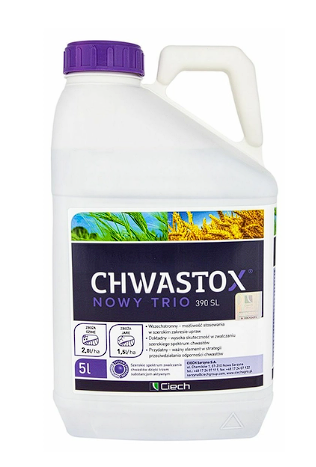
CHWASTOX NOWY TRIO 390 SL is a selective herbicide with systemic action for application to foliage. It is available in liquid form for preparing an aqueous solution. The active ingredients contained in the product are MCPA (200 g/l, 16.7%), Mecoprop-P (150 g/l, 12.5%) and Dicamba (40 g/l, 3.3%), all as potassium salts.
The herbicide is intended for field application using self-propelled, tractor-mounted or hand-held sprayers. Note: When using this product, follow the safety instructions provided on the label. The product is intended exclusively for trained professional users.
🌱 How does Chwastox® Nowy Trio work?
The active ingredients in the herbicide are selectively transported through the tissues of weed plants to their roots, causing them to deform and die. Chwastox® Nowy Trio 390 SL is particularly suitable for controlling problem weeds such as cornflower, small-flowered cranesbill, ribwort plantain, common sorrel, volunteer oilseed rape and white clover suitable. The product is an important part of a strategy to prevent herbicide resistance and offers a comprehensive solution without requiring additional support from other products.
The favorable application period, from the seedling stage of weeds to the 9-leaf or 9-whorl stage (BBCH 11–19), provides ample time to decide on the optimal spraying date. In addition, favorable weather conditions for plant growth enhance the herbicidal effect of the product.
🌱 Chwastox® Nowy Trio for amateur use, too
Chwastox® Nowy Trio 390 SL is also ideal for amateur use. Owners or operators of golf courses, sports fields and lawns appreciate the product’s ease of application and strong efficacy, and can enjoy areas that remain weed-free for longer.
The option to use the product from spring to early autumn offers great flexibility in application. The best weed control results are achieved when the product is applied from the stage of a few leaves until the beginning of weed flowering. A repeat application may be necessary where weeds are already well established or areas are heavily infested.
🧪 Chwastox® Nowy Trio – Composition
MCPA as a potassium salt (a compound from the phenoxycarboxylic acid group) – 200 g/l (16.7%)
Mecoprop-P as a potassium salt (a compound from the phenoxycarboxylic acid group) – 150 g/l (12.5%)
Dicamba as a potassium salt (a compound from the benzoic acid derivative group) – 40 g/l (3.3%)
🔬 Synergistic action of the active ingredients
MCPA
A selective, systemic herbicide that is transported within plants. It acts similarly to the auxin indole-3-acetic acid (IAA) and disrupts the hormonal balance of plants.
The first visible sign of its effect is plant deformation. Leaves and stems twist, while the edges of the leaf blades may curl upward. This is followed by growth inhibition, chlorosis, and necrosis. Symptoms first appear on the youngest parts of the plant. Susceptible species die slowly, usually 3–5 weeks after treatment.
The minimum temperature for MCPA to be effective is in the range of 8–12 °C, the optimal temperature is 20 °C, and the maximum temperature is 25 °C.
Mecoprop-P
An active ingredient from the phenoxycarboxylic acid group, used as a selective herbicide to control broadleaf weeds. It is used mainly in cereal cultivation, on lawns, and among ornamental plants.
Mecoprop-P works by disrupting the hormonal functions of broadleaf weeds. The active ingredient mimics natural auxins, or plant hormones, causing uncontrolled cell growth.
This results in deformities, tissue splitting, and eventually plant death. The product penetrates weeds through their leaves and is transported throughout the plant, allowing it to control extensive root systems as well.
Dicamba
A selective, systemic herbicide for controlling annual and perennial broadleaf weeds. Dicamba is absorbed by weeds through both their roots and leaves.
Dicamba acts similarly to indole-3-acetic acid (IAA), an auxin produced by plants. At a suitable concentration, dicamba disrupts vital plant processes, inhibits growth, causes deformities, and ultimately kills the plants.
The minimum air temperature for dicamba to be effective is 8 °C, the optimal temperature is 15–20 °C, and the maximum temperature is 22 °C.
⚠️ What should you consider when applying Chwastox Trio 390 SL?
🔄 Rotation and diversity of active ingredients
Use herbicides with different modes of action, alternately and/or in mixtures – this reduces the risk of weeds developing resistance.
Select products that act on different life processes in weeds – this can increase the effectiveness of the treatment.
Do not use the same active ingredient more than once during the growing season of the crop in question.
🌦️ Suitable weather conditions and plant condition
Do not apply herbicides:
during drought,
on diseased, damaged, or wet plants,
at temperatures below 10 °C or above 25 °C,
immediately before frost or precipitation,
in strong winds, as there is a risk of spray drift.
🌍 Protecting neighboring crops and the environment
Prevent spray drift onto neighboring crops, especially in areas with dicotyledonous plants.
Avoid overlapping spray solution where treated spray passes meet and at headlands, to prevent overdosing.
Protect surface water and water used for domestic purposes – the product must not enter bodies of water, water reservoirs or irrigation systems.
🌾 Application, dosage and timing
🌾 Winter wheat, winter triticale, winter rye, winter barley
Weeds to be controlled
Cornflower, common fumitory, charlock, chickweed, common stork's-bill, white goosefoot, common poppy, scentless mayweed, field forget-me-not, rough bugloss, cleavers, black-bindweed, knotgrass, stinking chamomile, German chamomile, volunteer oilseed rape, shepherd's-purse and field pennycress.
Maximum / recommended application rate for a single application: 2.0 l/ha.
Recommended water volume: 200–300 l/ha.
Recommended spray volume: medium droplet size.
Apply the product in spring after the start of vegetation, from the beginning to the end of the cereal tillering phase (BBCH 21–29).
Maximum number of applications during the growing season: 1.
🌾 Spring barley, spring wheat, oats, spring triticale
Weeds to be controlled
Common fumitory, charlock, chickweed, red dead-nettle, white goosefoot, common poppy, scentless mayweed, rough bugloss, cleavers, black-bindweed, knotgrass, stinking chamomile, redroot pigweed, shepherd's-purse, field pennycress and gallant soldier.
Maximum / recommended application rate for a single application: 1.5 l/ha.
Recommended water volume: 200–300 l/ha.
Recommended spray volume: medium droplet size.
Apply the product from the beginning to the end of the cereal tillering phase (BBCH 21–29).
Maximum number of applications during the growing season: 1.
⚽ Lawns, sports fields and golf courses
Weeds to be controlled
Creeping buttercup, common dandelion, smooth cat's-ear, common mouse-ear, common sorrel, ribwort plantain, broadleaf plantain, dove's-foot crane's-bill, white clover, common yarrow, wall speedwell, common mouse-ear and common sorrel.
Maximum / recommended application rate for a single application: 2.0 l/ha.
Recommended water volume: 500 l/ha.
Recommended spray volume: medium droplet size.
Apply the product from spring to early autumn, when weeds are at the stage of a few leaves through flowering (BBCH 14–40). The product can be applied over the entire area of a lawn, sports field or golf course, or only on weed-infested areas.
In cases of severe weed infestation, repeat treatment may be necessary.
Maximum number of applications during the growing season: 2.
Interval between applications: at least 56 days.
🌱 Lawns
Weeds to be controlled
Creeping buttercup, common dandelion, smooth cat's-ear, common mouse-ear, common sorrel, ribwort plantain, broadleaf plantain, dove's-foot crane's-bill, white clover, common yarrow, wall speedwell, common mouse-ear and common sorrel.
Maximum / recommended application rate for a single application: 20 ml/100 m².
This corresponds to the following application rates:
4 ml of product in 1.0 l of water per 20 m²
or
20 ml of product in 5.0 l of water per 100 m²
or
100 ml of product in 25.0 l of water per 500 m².
Recommended water volume: 5.0 l/100 m².
Recommended spray volume: medium droplet size.
Apply the product from spring to early autumn, when weeds are at the stage of a few leaves through flowering (BBCH 14–40), over the entire lawn or only on weed-infested areas.
In cases of severe weed infestation, repeat treatment may be necessary.
Maximum number of applications during the growing season: 2.
Interval between applications: at least 56 days.