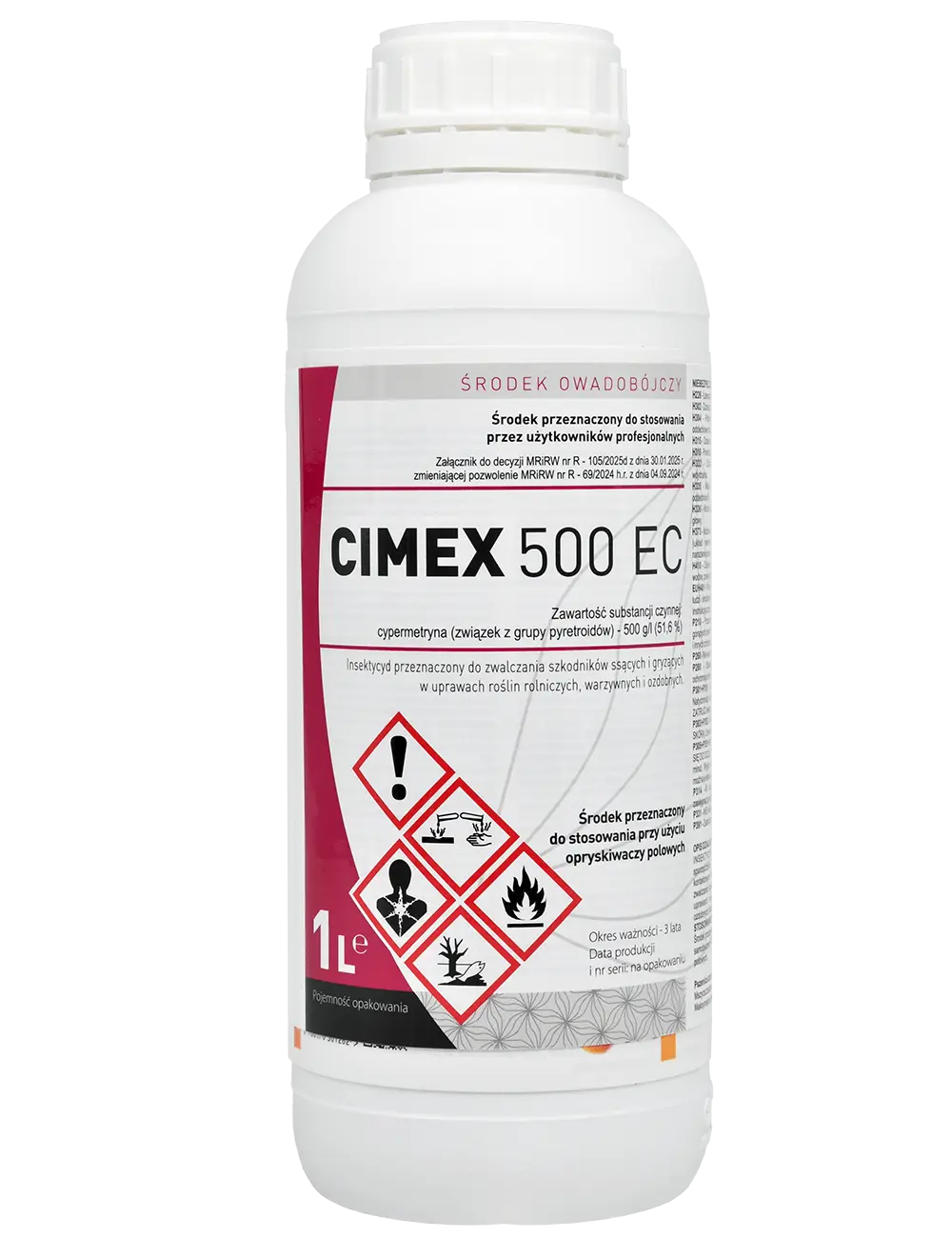
Cimex 500 EC
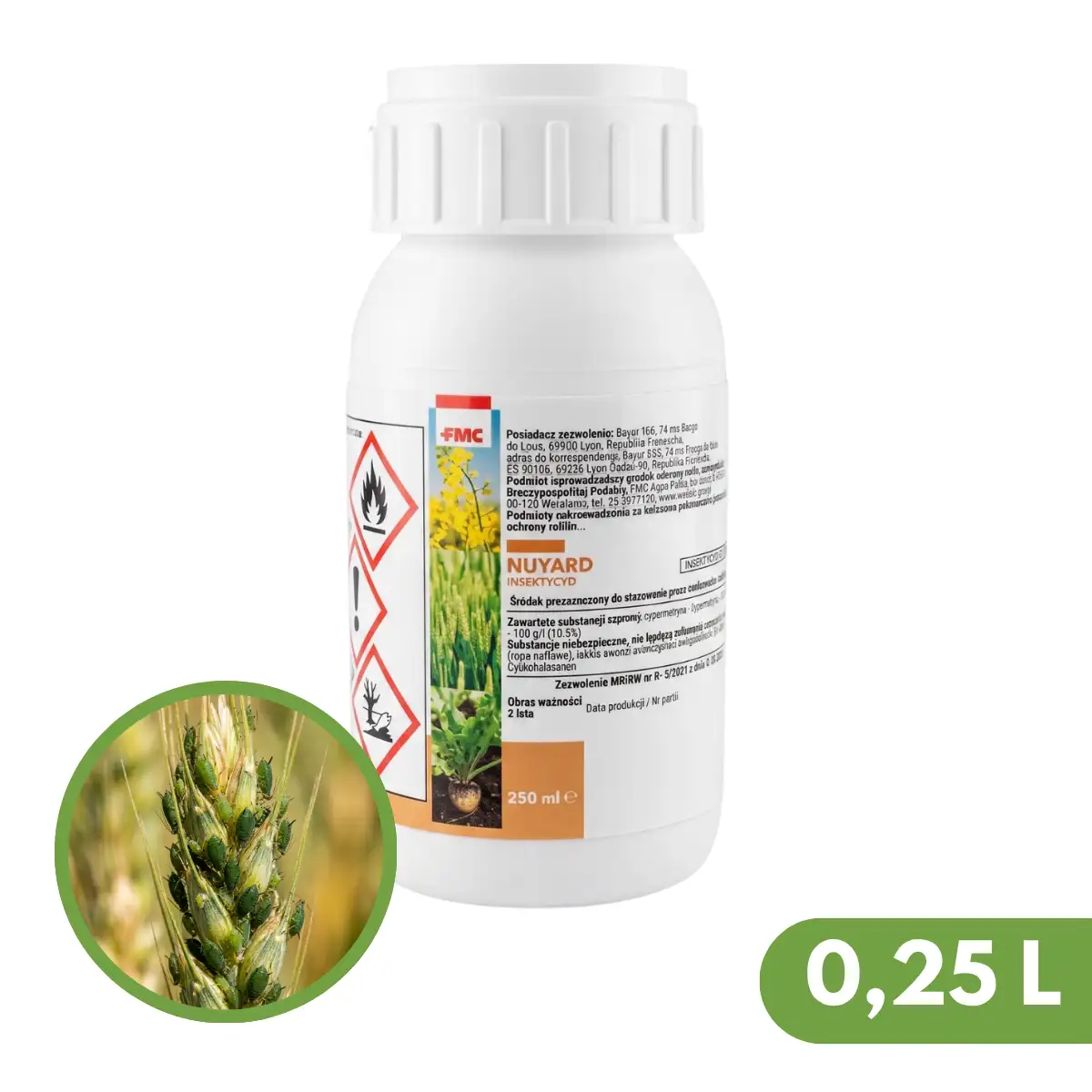
Cimex 500 EC is an effective contact and stomach insecticide designed to protect agricultural, vegetable and ornamental plant crops against sucking and chewing pests. ACTIVE SUBSTANCE: cypermethrin - 500 g/l (51.6 %)
- Pack
- 1 l
Description
MODE OF ACTION OF CIMEX 500 EC
Cimex 500 EC is an insecticide in the form of a concentrate for preparing an aqueous emulsion, acting by contact and stomach action. It effectively controls sucking and chewing pests in agricultural, vegetable and ornamental plant crops. It acts on the plant surface, providing a rapid protective effect. The product is applied using field sprayers – self-propelled or tractor-mounted, ensuring convenient and effective application.
CIMEX 500 EC ACTIVE SUBSTANCE CONTENT
cypermethrin (a compound from the pyrethroid group) - 500 g/l (51.6 %).
CIMEX 500 EC SCOPE OF USE, TIMING AND DOSES:
Winter wheat, spring wheat
Cereal aphid
Maximum/recommended dose for single application: 0.05 l/ha.
Application timing: treatment to be performed after heading, no later than the milk ripeness stage of the grain (BBCH 59-73).
Number of treatments: 2.
Interval between treatments: at least 14 days.
Leafhoppers
Maximum/recommended dose for single application: 0.05 l/ha.
Application timing: treatment to be performed from the beginning of larval hatching, from the flag leaf stage to full flowering of wheat (BBCH39-65).
Number of treatments: 2
Interval between treatments: at least 14 days.
Maximum number of treatments per growing season: 2.
Spring barley
Leafhoppers
Maximum/recommended dose for single application: 0.05 l/ha.
Application timing: treatment to be performed from the beginning of larval hatching, from the flag leaf stage to full flowering of barley (BBCH39-65).
Maximum number of treatments per growing season: 2.
Interval between treatments: at least 14 days.
Potato
Larvae and beetles of Colorado potato beetle
Maximum/recommended dose for single application: 0.06 l/ha.
Application timing: treatment to be performed after the appearance of beetles and larvae of Colorado potato beetle, from the beginning of leaf development to the stage of visible first flower buds on the main stem (BBCH10-51).
Maximum number of treatments per growing season: 2.
Interval between treatments: at least 10 days.
Winter oilseed rape
Pollen beetle
Four-toothed weevil – population control
Maximum/recommended dose for single application: 0.05 l/ha.
Application timing: treatment to be performed according to monitoring, after beetle appearance, from the stage of visible 9 internodes to the stage when first flower petals are visible but buds are still closed (BBCH39-59).
Number of treatments: 2.
Interval between treatments: at least 14 days.
Seed weevil
Maximum/recommended dose for single application: 0.05 l/ha
Application timing: treatment to be performed from full flowering to the stage when most petals fall (BBCH65-67).
Number of treatments: 2.
Interval between treatments: at least 14 days.
Recommended water volume: 300-400 l/ha.
Recommended spraying type: medium droplet.
Maximum number of treatments per growing season: 2.
Head cabbage
Cabbage moth caterpillars
Maximum/recommended dose for single application: 0.05 l/ha.
Application timing: treatment to be performed during mass caterpillar hatch, from the stage of fully developed cotyledons to the stage when the head reaches 60% of typical size (BBCH10-46).
Maximum number of treatments per growing season: 2.
Interval between treatments: at least 10 days.
Sugar pea grown for pods
Pea aphid
Maximum/recommended dose for single application: 0.05 l/ha
Application timing: treatment to be performed after numerous aphid colonies appear, from the 9-leaf stage to the stage when first but still closed flower buds are visible (BBCH 19-55).
Maximum number of treatments per growing season: 2.
Interval between treatments: at least 10 days.
Leek
Thrips
Maximum/recommended dose for single application: 0.05 l/ha.
Application timing: treatment to be performed after first pests appear, from the visible first leaf stage to the stage when leek reaches length and stem diameter typical for the variety (BBCH 11-47).
Maximum number of treatments per growing season: 2.
Interval between treatments: at least 10 days.
Recommended water volume: 200-600 l/ha.
Recommended spraying type: medium droplet.
Sugar beet
Grey weevil, misty shield bug, golden-striped shield bug
Maximum/recommended dose for single application: 0.05 l/ha.
Application timing: treatment to be performed after beetle appearance, from the stage of 2 fully developed true leaves to the stage when leaves cover 50% of soil surface (BBCH 12 - 35).
Number of treatments per growing season: 2.
Interval between treatments: at least 10 days.
Recommended water volume: 200-600 l/ha.
Recommended spraying type: medium droplet.
Beetroot for root, fodder beet
Beet flea beetle, aphids, beet flea beetle, misty shield bug, grey weevil
Maximum/recommended dose for single application: 0.05l/ha.
Application timing: treatment to be performed according to monitoring, after pest appearance, from the stage of 2 fully developed true leaves to the stage when leaves cover 50% of soil surface (BBCH 12 - 35).
Maximum number of treatments per growing season: 2.
Interval between treatments: at least 10 days.
Recommended water volume: 200-600 l/ha.
Recommended spraying type: medium droplet.
Rutabaga, turnip
Aphids, flea beetles, leaf-eating caterpillars
Maximum/recommended dose for single application: 0.05 l/ha.
Application timing: treatment to be performed according to monitoring, after pest appearance, from the stage of 2 fully developed true leaves to the stage when root reaches harvest maturity (BBCH 12 - 49).
Maximum number of treatments per growing season: 2.
Interval between treatments: at least 10 days.
Recommended water volume: 200-600 l/ha.
Recommended spraying type: medium droplet.
Asparagus
Asparagus beetle, twelve-spotted asparagus beetle, aphids
Maximum/recommended dose for single application: 0.05 l/ha.
Application timing: treatment to be performed after harvest of shoots, after pest appearance.
Maximum number of treatments per growing season: 2.
Interval between treatments: at least 10 days.
Recommended water volume: 200-600 l/ha.
Recommended spraying type: medium droplet.
Beetroot for leaf harvest, chives, leaf parsley, sorrel, spinach
Aphids, leafminers, leaf-eating caterpillars
Maximum/recommended dose for single application: 0.05 l/ha
Application timing: treatment to be performed according to monitoring, after pest appearance, from the stage of two true leaves to the stage when leaves reach 60% of typical mass for the variety (BBCH12 - 46).
Maximum number of treatments per growing season: 2.
Interval between treatments: at least 10 days.
Recommended water volume: 200-400 l/ha.
Recommended spraying type: medium droplet.
Dill
Aphids
Maximum/recommended dose for single application: 0.05 l/ha.
Application timing: treatment to be performed according to monitoring, after pest appearance, from the stage of two true leaves to the stage when 60% of leaf mass typical for the variety is reached (BBCH12 - 46).
Maximum number of treatments per growing season: 2.
Interval between treatments: 10 days.
Recommended water volume: 200-400 l/ha.
Recommended spraying type: medium droplet.
Industrial hemp grown for fibre
Aphids, flea beetles, thrips
Maximum/recommended dose for single application: 0.05 l/ha.
Application timing: treatment to be performed after first pests appear, from the stage of visible 9
internodes to the stage when first flower petals are visible but buds are still closed (BBCH 39-59).
Maximum number of treatments per growing season: 2.
Interval between treatments: at least 14 days.
Recommended water volume: 200-600 l/ha.
Recommended spraying type: medium droplet.
Common flax grown for fibre
Flea beetles, thrips
Maximum/recommended dose for single application: 0.05 l/ha.
Application timing: treatment to be performed after first pests appear, from the stage of visible 9 internodes to the stage when first flower petals are visible but buds are still closed (BBCH 39-59).
Maximum number of treatments per growing season: 2.
Interval between treatments: at least 14 days.
Recommended water volume: 200-600 l/ha.
Recommended spraying type: medium droplet.
Common flax grown for seed
Flea beetles, thrips
Maximum/recommended dose for single application: 0.05 l/ha.
Application timing: treatment to be performed after first pests appear, from the stage of visible 9 internodes to the stage when first flower petals are visible but buds are still closed (BBCH 39-59) or from full to final flowering stage when most petals have fallen (BBCH 65-67).
Maximum number of treatments per growing season: 2.
Interval between treatments: at least 14 days.
Recommended water volume: 300-400 l/ha.
Recommended spraying type: medium droplet.
White mustard, black mustard, Sarepta mustard, spring oilseed rape
Flea beetles, pollen beetle
Four-toothed weevil – population control
Maximum/recommended dose for single application: 0.05 l/ha.
Application timing: treatment to be performed according to monitoring, after beetle appearance, from the stage of visible 9 internodes to the stage when first flower petals are visible but buds are still closed (BBCH39-59).
Seed weevil, flea beetles
Maximum/recommended dose for single application: 0.05 l/ha.
Application timing: treatment to be performed from full to final flowering stage when most petals have fallen (BBCH 65-67).
Maximum number of treatments per growing season: 2.
Interval between treatments: at least 14 days.
Recommended water volume: 300-400 l/ha.
Recommended spraying type: medium droplet.
Faba bean, narrow-leafed lupin, white lupin, yellow lupin, forage pea (field pea), soybean, common bean grown for dry seed, dry pea, edible lentil
Aphids, leafminers
Maximum/recommended dose for single application: 0.05 l/ha.
Application timing: treatment to be performed according to monitoring, after pest appearance, from the 9-leaf stage to the stage when first but still closed flower buds are visible (BBCH19-55).
Maximum number of treatments per growing season: 2.
Interval between treatments: at least 10 days.
Recommended water volume: 200-400 l/ha.
Recommended spraying type: medium droplet.
Broad bean, green bean, common bean grown for fresh seed, fresh pea
Aphids, leafminers
Maximum/recommended dose for single application: 0.05 l/ha
Application timing: treatment to be performed according to monitoring, after pest appearance, from the 9-leaf stage to the stage when first but still closed flower buds are visible (BBCH19-55).
Maximum number of treatments per growing season: 2.
Interval between treatments: at least 10 days.
Recommended water volume: 200-600 l/ha.
Recommended spraying type: medium droplet.
Brussels sprouts, red cabbage, savoy cabbage
Cabbage white butterfly, small white butterfly, cabbage moth, aphids, flea beetles, diamondback moth, cabbage moth, cabbage moth caterpillars, thrips
Maximum/recommended dose for single application: 0.05 l/ha
Application timing: treatment to be performed according to monitoring after pest appearance, from the stage of fully developed cotyledons to the moment when the head reaches 60% of typical size (red cabbage, savoy cabbage) / 60% of strongly closed branches (Brussels sprouts) (BBCH10-46).
Maximum number of treatments per growing season: 2.
Interval between treatments: at least 10 days.
Recommended water volume: 200-600 l/ha.
Recommended spraying type: medium droplet.
Broccoli, cauliflower
Cabbage white butterfly, small white butterfly, cabbage moth, aphids, flea beetles, diamondback moth, cabbage moth, cabbage moth caterpillars, thrips
Maximum/recommended dose for single application: 0.05 l/ha.
Application timing: treatment to be performed according to monitoring after pest appearance, from the stage of fully developed cotyledons to the moment when the head reaches 60% of typical size (BBCH10-46).
Maximum number of treatments per growing season: 2.
Interval between treatments: at least 10 days.
Recommended water volume: 200-400 l/ha.
Recommended spraying type: medium droplet.
Lettuce
Aphids, leafminers
Maximum/recommended dose for single application: 0.06 l/ha
Application timing: treatment to be performed according to monitoring, after pest appearance, from the stage of two true leaves to the stage when leaves reach 60% of typical mass for the variety (BBCH12-46).
Maximum number of treatments per growing season: 2.
Interval between treatments: at least 10 days.
Recommended water volume: 300-400 l/ha.
Recommended spraying type: medium droplet.
Onion, garlic, shallot
Thrips
Maximum/recommended dose for single application: 0.05 l/ha.
Application timing: treatment to be performed after first pests appear, from the clearly visible first leaf stage to the stage when onion reaches 50% of typical diameter (BBCH 11-45).
Maximum number of treatments per growing season: 2.
Interval between treatments: at least 10 days.
Recommended water volume: 200 l/ha.
Recommended spraying type: medium droplet.
Ornamental plants (shrubs, perennials, annual plants)
Hymenoptera (larvae), aphids, leafminers, butterfly caterpillars
Maximum/recommended dose for single application: 0.05 l/ha.
Application timing: treatment to be performed after first pests appear from the stage of two true leaves to the end of the growing season (from BBCH 12).
Maximum number of treatments per growing season: 2.
Interval between treatments: at least 14 days.
Recommended water volume: 200-600 l/ha.
Recommended spraying type: medium droplet
CIMEX 500 EC PRE-HARVEST INTERVAL
Period from last application of the product to the day of crop harvest (pre-harvest interval):
- Winter oilseed rape, spring oilseed rape, white mustard, black mustard, Sarepta mustard, common flax grown for seed – 49 days
- Winter wheat, spring wheat, spring barley, potatoes, common bean grown for dry seed, dry pea, edible lentil, forage pea (field pea), narrow-leafed lupin, white lupin, yellow lupin, faba bean, soybean, sugar beet, beetroot for root, fodder beet, rutabaga, turnip – 14 days
- Head cabbage, Brussels sprouts, red cabbage, savoy cabbage, lettuce, broccoli, cauliflower, onion, garlic, shallot, leek, common bean grown for fresh seed, green bean, sugar pea grown for pods, fresh pea, broad bean, beetroot for leaf harvest, chives, leaf parsley, sorrel, spinach, dill – 7 days
- Industrial hemp grown for fibre, common flax grown for fibre, ornamental plants, asparagus – not applicable
Period from last application of the product on plants intended for fodder to the day when animals can be fed with these plants (pre-harvest interval for fodder):
Not applicable