 SKU 14162-c
First Aid Lawn Fertiliser Healthy Green Turf Twój Ogród
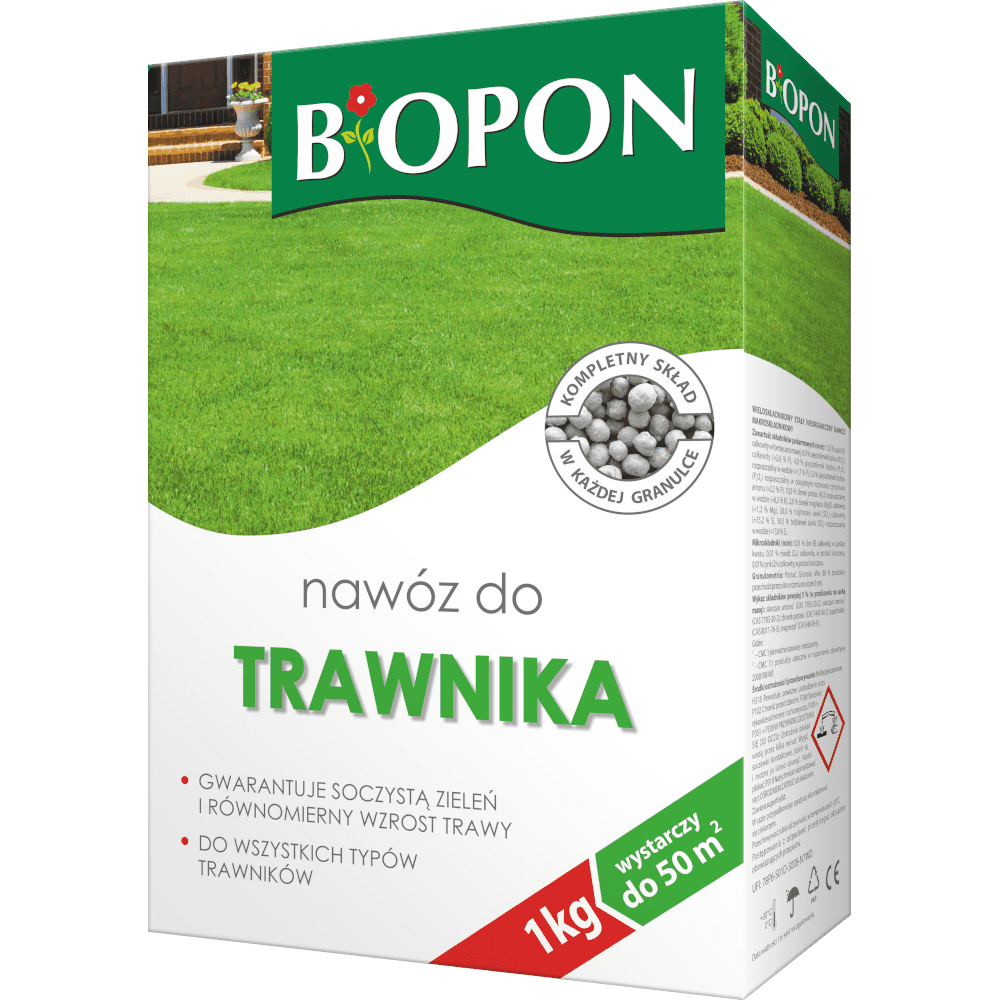
First Aid Healthy Green Turf Twój Ogród is a granular NPK fertiliser with micronutrients. Ideal for lawns sensitive to chlorides and salt. Efficient, 1 kg of fertiliser covers 33 m².
Description
First Aid Lawn Fertiliser Twój Ogród - healthy green turf
- Long-lasting effect,
- Efficient - 1kg of product is enough to fertilise approximately 33m2 of lawn,
- Chloride-free fertiliser,
- Perfectly balanced nutrient composition,
- Contains micro and macro elements,
- Popular among professionals,
- Easy to apply - thanks to appropriate granulation.
First Aid Healthy Green Turf Twój Ogród is a granular NPK fertiliser with micronutrients. It is dedicated to basic and supplementary fertilisation in crops sensitive to chlorides and on soils sensitive to salt effects. A specially composed gentle formula and appropriately balanced composition provide balanced nutrition for delicate plants. The lawn is one of the garden's decorative features, serving as an ideal backdrop for shrubs, ornamental trees, and flowers. Proper lawn care positively affects the garden's microclimate by improving air humidity. A professional, comprehensive fertiliser for lawn fertilisation to achieve healthy and green turf. It supplies plants with all necessary nutrients that stimulate tillering and rooting. A well-chosen amount of nitrogen ensures the turf is well nourished, and the high phosphorus content accelerates and strengthens root system development.
First Aid Lawn Fertiliser Healthy Green Turf Twój Ogród - information and composition:
Fertiliser information:
- EU FERTILISER
- Mineral fertiliser N-P2O5-K2O (+MgO+S) 12-8-16 (+3+10) with nitrification inhibitor DMPP (3,4-Dimethylpyrazolphosphate) and micronutrients.
Composition:
- 12 % total nitrogen (N), including: 5.0 % nitrate nitrogen (NO₃-N), 7.0 % ammonium nitrogen (NH₄-N);
- 8 % phosphorus pentoxide (P₂O₅) soluble in neutral ammonium citrate and water, including: 6.4 % phosphorus pentoxide (P₂O₅) soluble in water;
- 16 % potassium oxide (K₂O) soluble in water;
- 3 % total magnesium oxide (MgO), including: 2.4 % magnesium oxide soluble in water (MgO);
- 10 % total sulphur (S), including: 8.0 % sulphur (S) soluble in water;
- 0.02 % total boron (B), including: 0.016 % boron (B) soluble in water;
- 0.06 % total iron (Fe);
- 0.010 % total zinc (Zn);
- 0.8 % DMPP (3,4-Dimethylpyrazolphosphate) – relative to ammonium nitrogen content.
Lawn fertilisation with First Aid Healthy Green Turf Twój Ogród - step-by-step instructions:
1. Mow the grass at least 1 day before treatment.
2. Loosen the soil before applying the fertiliser.
3. Apply the fertiliser to the lawn using a cross pattern.
4. Water the lawn after fertilisation.
5. Reapply after 4 weeks.
Recommended lawn fertilisation period with First Aid Healthy Green Turf Twój Ogród:
Lawn cultivation conditions:
The lawn is one of the garden's decorations, serving as an ideal backdrop for shrubs, ornamental trees, and flowers. A well-maintained lawn is the showcase of every garden. Well-rooted grass strengthens the growing medium against erosion and reduces soil leaching.
The pH of the growing medium under the lawn should be between 5.5 and 6.5. Higher pH creates ideal conditions for the growth of weeds, mosses, and undesirable fungi that cause the lawn to become diseased, and their strong expansion can lead to complete grass destruction. The frequency of mowing depends on many factors, including the grass species sown, fertilisation intensity, regular watering, season, and weather. To have a decorative lawn, mow at least once a week. Frequent mowing will make the lawn look perfect. To achieve a "green carpet" effect, mow several times a week. The first mowing should be done when the grass reaches 6 to 8 cm, cutting it back by 1-1.5 cm. The next two to three mowings should be similar, then gradually lower to the planned height. Usually, this is 3-6 cm, but during heat, it is better to mow higher.
To achieve a beautiful lawn, it must be continuously nourished, as grass quickly uses up nutrient reserves. The lawn should be fertilised 3 times a year. Fertilisation should be done after mowing when leaves are dry. Spread the fertiliser evenly. Note that where too much fertiliser falls, overgrown grass may be "burnt", and where there is a deficiency, poorly nourished grass will yellow. Lawns should not be fertilised when wet, as granules stick to leaves, reducing treatment effectiveness. Drought and strong sunlight also negatively affect fertiliser use, which may "burn" the grass during these periods.
The lawn should be watered frequently, every 2-3 days, preferably early in the morning before strong sun, using sprinklers. The soil should be moist to a depth of about 15 cm. Well-watered growing medium allows grass seeds to develop their root system, making the lawn resistant to adverse weather conditions.
First Aid Lawn Fertiliser Healthy Green Turf Twój Ogród - safe use guidelines:
- Store fertiliser in closed, original packaging, in dry rooms, away from food and feed, out of reach of children. Protect from heat, direct sunlight, moisture, and mechanical damage during storage and transport.
- In case of accidental ingestion, seek medical advice immediately. Rinse areas contaminated with fertiliser thoroughly with water.
- The fertiliser may be harmful if swallowed.
- For prolonged manual work with fertiliser, use protective gloves, and in case of dust, use respiratory and eye protection.
- Keep out of reach of children.
- Use fertiliser in a balanced manner, and fertilisation should be based on plant needs and growing medium fertility.
- Prevent fertiliser from reaching surfaces not intended for fertilisation.
- Shelf life - unlimited if storage conditions are met.
Application and dosage
|
Crop |
How to apply? Dosage |
When to apply? |
|---|---|---|
|
Lawns |
Apply the fertiliser evenly by broadcasting over the entire area to be fertilised. Watering helps achieve immediate effect. Use a dose of 30-100 g/m². 1kg of fertiliser covers 33m². |
Repeat fertilisation 2-3 times at intervals of about 4-10 weeks. Application is possible throughout the growing season. |