Taxes included.
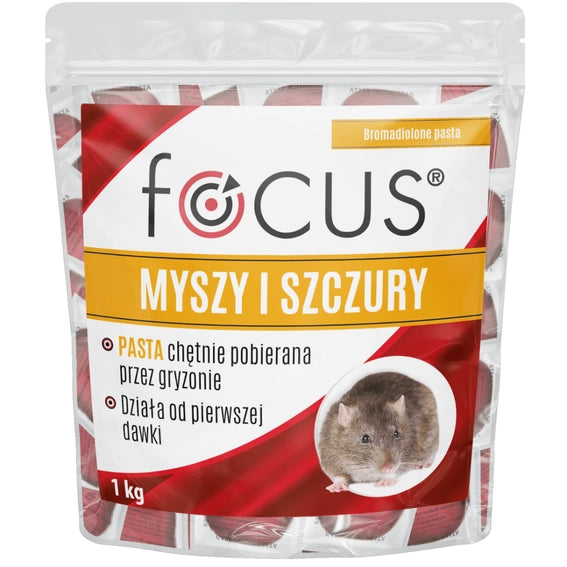
🐭 Focus Paste – Bait paste against rats, mice, and other rodents
✅ Effective against rats, mice, and other rodents – so you can get rid of the annoying problem.
✅ The paste form is consumed by rodents the fastest.
✅ Effective after the first intake.
✅ Eaten very willingly by rodents.
✅ For the control of rats and mice indoors, around buildings, and in sewage systems.
✅ The most attractive bait form for rodents.
✅ Recommended for use in places with a high attractiveness of other food sources (landfills, animal stables, feed stores, catering facilities, etc.).
Focus Paste is a modern preparation – a bait paste – in the field of rat and mouse control. The product is ready to use. It is intended for the control of rats and mice indoors, around buildings, and in sewage systems.
The paste is the most attractive bait form for rodents. It is consumed by them the fastest, which is why it is recommended for use in places with a high attractiveness of other food sources (landfills, animal stables, feed stores, catering facilities, etc.).
🏭 Focus bait paste against mice and rats – Active ingredient:
👉 Bromadiolone 0.005%
🪤 Which pests does the Focus bait paste control?
Inside and around buildings:
🐁 House mouse (Mus musculus)
🐀 Brown rat (Rattus norvegicus)
📘 Focus – Bait paste against mice and rats – Instructions for use
🐁 Control of mice indoors
Low infestation level (small number of pests):
👉 Up to 40 g of bait per bait station.
👉 If more than one bait station is required, the minimum distance between stations should be 5 m.
High infestation level (large number of pests):
👉 Up to 40 g of bait per bait station.
👉 If more than one bait station is required, the minimum distance between stations should be 2 m.
Regular inspections of the bait stations must be carried out (at least every 2–3 days at the beginning of the control period and at least once a week in the later phase) to:
👉 to determine the effectiveness of the product,
👉 to assess the condition of the bait stations
👉 as well as removing dead rodents.
The bait eaten by rodents must be replenished.
🐀 Control of rats indoors
Low infestation level (small number of pests):
👉 Up to 200 g of bait per bait station.
👉 If more than one bait station is required, the minimum distance between stations should be 10 m.
High infestation level (large number of pests):
👉 Up to 200 g of bait per bait station.
👉 If more than one bait station is required, the minimum distance between stations should be 5 m.
Regular inspections of the bait stations must be carried out (at least every 5–7 days at the beginning of the control period and at least once a week in the later phase) to:
👉 to determine the effectiveness of the product,
👉 to assess the condition of the bait stations
👉 as well as removing dead rodents.
The bait eaten by rodents must be replenished.
🏠 General principles for the use of bait blocks indoors
👉 Follow the principles of integrated pest management (IPM).
👉 When placing bait stations near drainage systems, ensure that the bait does not come into contact with water.
🌳 Control of mice around buildings
Low infestation level (small number of pests):
👉 Up to 40 g of bait per bait station.
👉 If more than one bait station is required, the minimum distance between stations should be 5 m.
High infestation level (large number of pests):
👉 Up to 40 g of bait per bait station.
👉 If more than one bait station is required, the minimum distance between stations should be 2 m.
🌳 Control of Rats Around Buildings
Low infestation level (small number of pests):
👉 Up to 200 g of bait per bait station.
👉 If more than one bait station is required, the minimum distance between stations should be 10 m.
High infestation level (large number of pests):
👉 Up to 200 g of bait per bait station.
👉 If more than one bait station is required, the minimum distance between stations should be 5 m.
🏡 General Principles for Using Bait Blocks Around Buildings
👉 Bait stations should protect the bait from weather influences (rain, snow, etc.).
👉 Place bait stations in locations protected from flooding.
👉 Conduct regular inspections of the bait stations (at the start of mouse control at least every 2–3 days, for rats at least every 5–7 days, and in the later phase at least once a week) to:
-
determine the effectiveness of the product,
-
assess the condition of the bait stations,
-
remove dead rodents.
👉 Replenish bait eaten by rodents.
👉 Replace any bait that has been damaged or contaminated by water.
👉 Follow the principles of integrated pest management (IPM).
👉 Do not place the product directly into rodent burrows.
👉 When placing bait stations near surface waters (e.g., rivers, ponds, streams, dikes, irrigation ditches) or drainage systems, ensure that the bait does not come into contact with water.
📎 Focus Pasta against Mice and Rats – Application Instructions
👉 Before using the product, read and follow the instructions in the product's accompanying information materials or the information provided at the point of sale.
👉 Before use, an on-site inspection of the area to be treated should be conducted to correctly identify the rodent species, activity locations, as well as the likely cause and extent of the infestation.
👉 Before starting treatment, other potential food sources for rodents should be removed (e.g., spilled grain or food scraps).
👉 Before using the product, the living environment of the rodents should not be disturbed, as this can affect their behavior and bait intake.
👉 The product should be used according to the principles of integrated pest management (IPM), good hygienic practice, and – where possible – using non-chemical control methods.
👉 To increase bait uptake and reduce the risk of reinfestation, appropriate preventive measures should be taken (e.g., sealing openings, eliminating potential food sources for rodents).
👉 Bait stations should be placed in close proximity to areas where rodent activity has been observed (e.g., runways, nesting sites, livestock feeding areas, openings, burrows, etc.).
👉 Where possible, bait stations should be fixed to the ground or other structures.
👉 Bait stations should be clearly labeled to indicate that they contain rodenticide products and must not be tampered with.
👉 Public areas where the product is used must be appropriately marked.
👉 Near the bait placement points, a notice should be posted stating that contact with the product or dead rodents is harmful to health and providing first aid information in case of poisoning.
👉 Where possible, secure the bait so that it cannot be carried away.
👉 Bait stations must be placed in locations inaccessible to children, birds, pets, livestock, and other non-target animals.
👉 Bait stations must be placed away from food, drinks, and feed as well as away from kitchen utensils and surfaces in contact with them.
👉 Wear suitable protective gloves (EN 374).
👉 Do not eat, drink, or smoke while using the product.
👉 After use, wash hands and skin areas that have come into contact with the product.
👉 If bait uptake is too low compared to the estimated infestation level, consider relocating the bait stations or using a different form of the product.
👉 If bait is still being consumed 35 days after the start of control and rodent activity is still detectable, the cause of the measure's ineffectiveness must be determined.
👉 If resistance to bromadiolone is detected or suspected, a product with a different active ingredient from the rodenticide group should be used. Non-chemical methods (e.g., traps) should also be considered.
👉 After completion of the control measure, bait stations and baits found outside the stations must be removed.
👉 The bait must not be removed from the bags. To minimize contact of the product with hands, the paste should be applied and removed using a spatula; do not touch the contents of the packaging with your hands.
👉 Clean the spatula with a dry or damp paper towel.
👉 Where possible, uninvolved persons (e.g., users of the treated area and adjacent spaces) should be informed about the start of the procedure before rodent control begins (according to the principles of integrated pest management (IPM)).
👉 To reduce the risk of secondary poisoning, dead rodents should be searched for and removed frequently and regularly throughout the entire procedure (e.g., at least twice a week or more often if necessary).
👉 The product must not be used for more than 35 days without first assessing the infestation level and effectiveness of control.
👉 The product must not be used as part of continuous baiting measures (e.g., for prevention or early detection of an infestation).
👉 The use of this product should eradicate the rodent population within 35 days. If at the end of the control period there is suspicion that the product is not sufficiently effective (e.g., further rodent activity), the user should consult the supplier/vendor or a professional pest control company.
👉 During the procedure, bait stations must not be cleaned with water.
👉 Dead rodents must be removed safely and handed over to a company authorized for the recovery and disposal of hazardous waste (e.g., incineration plant).
👉 Do not dispose of together with household waste.
⚠️ Toxicological information and first aid
The product contains an active ingredient from the group of anticoagulants.
👉 In case of ingestion, symptoms may appear delayed and include nosebleeds and gum bleeding.
👉 In severe cases, bruising as well as blood in stool and urine may occur.
Antidote: Vitamin K1, which may only be administered by medical or veterinary personnel.
🩺 First aid in case of:
👉 Contact with skin: Rinse skin with water and then wash with water and soap.
👉 Contact with eyes: Rinse eyes with an eye wash solution or water, keeping the eyelids open for at least 10 minutes.
👉 Contact with the mouth: Rinse mouth carefully with water. Never give anything orally to an unconscious person. Do not induce vomiting. If swallowed, seek medical advice immediately and show the packaging or label. If the product is ingested by a pet, consult a veterinarian.
🌍 Environmental protection measures
👉 In case of accidental release of the product into the environment, it must be (mechanically) collected, direct skin contact avoided, and handed over to a company authorized for the recovery and disposal of hazardous waste (e.g., incineration plant).
👉 The product is dangerous to wildlife.
👉 Due to the mode of action of anticoagulants, the effects of using rodenticidal products with these active substances may become visible 4–10 days after bait ingestion.
👉 Rodents can transmit diseases.
👉 Dead rodents and bait must be removed using protective gloves or tools (e.g., tongs).
👉 The product contains a bittering agent to deter accidental ingestion as well as a dye.
👉 Packaging and product residues after use (including bait found outside bait stations) must be safely collected in a labeled container and handed over to a company authorized for the recovery and disposal of hazardous waste (e.g., incineration plant).
📦 Storage
👉 Store the product in the original, labeled, and tightly closed packaging, in a cool, dry, and well-ventilated place, out of reach of children, birds, pets, and livestock.
👉 Store away from sunlight.
👉 For professional users only.
❗ Hazard and safety instructions
👉 May harm the unborn child.
👉 Causes damage to organs (blood) through prolonged or repeated exposure.
👉 Contains 1,2-Benzisothiazol-3(2H)-one. May cause allergic reactions.
👉 Read and observe special precautions before use.
👉 Do not use before all safety instructions have been read and understood.
👉 Wash hands thoroughly after use.
👉 Do not eat, drink, or smoke when handling the product.
👉 Wear protective gloves.
👉 In case of exposure or if affected persons feel unwell: seek medical advice/attention.
👉 Keep locked up.
👉 Dispose of contents/container at an approved disposal facility.