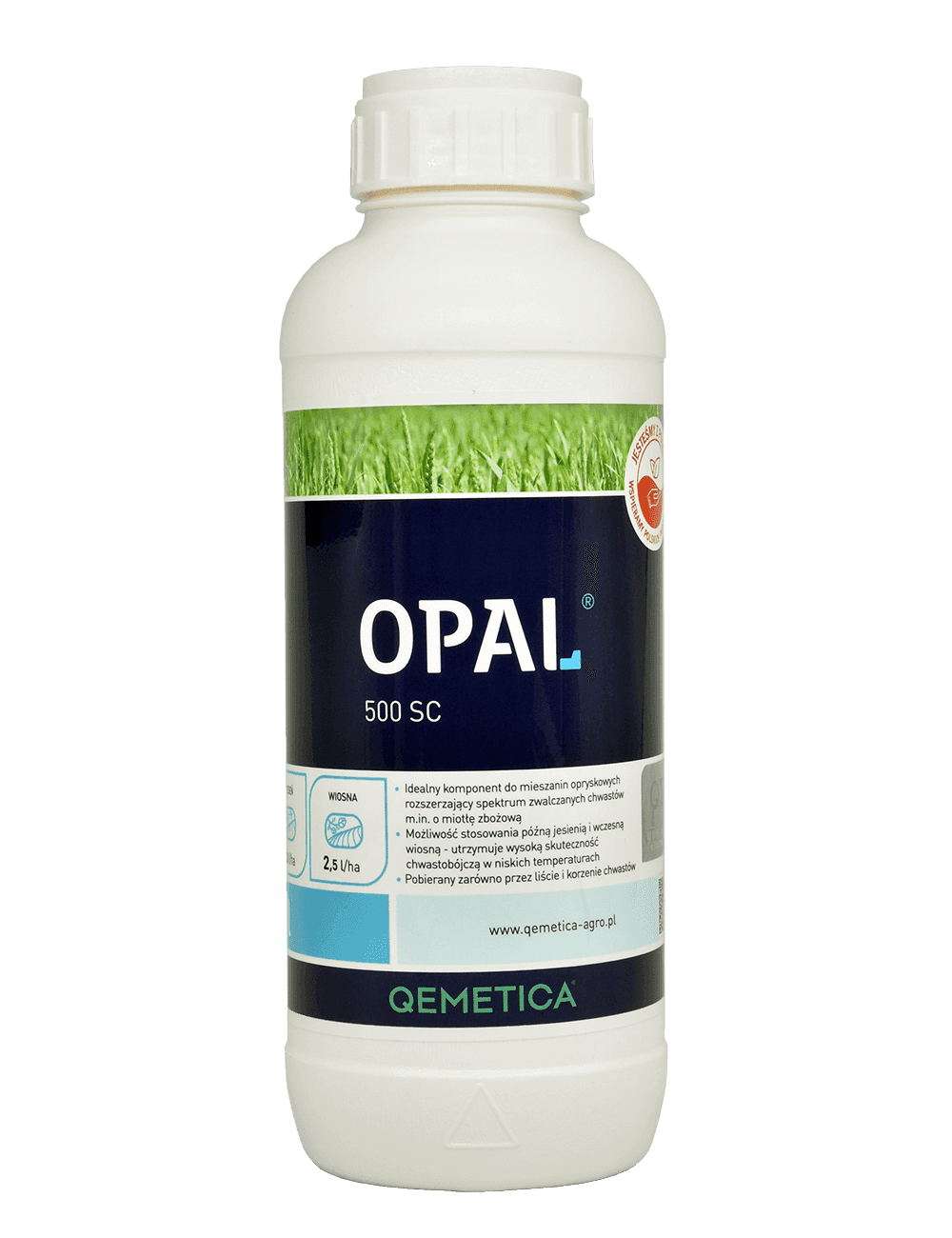
 SKU 14717-c
Snajper 600 SC (chlorotoluron, diflufenican) - herbicide for winter cereals
Snajper 600 SC is a herbicide concentrate designed for the control of monocotyledonous and dicotyledonous weeds in winter cereal crops: wheat, triticale and barley. The product is applied in autumn. It acts quickly and effectively.
Description
Snajper 600 SC - herbicide for weed control in agricultural crops
What are the benefits of using the Snajper herbicide?
- The product has high efficacy against monocotyledonous and dicotyledonous weeds in winter cereal cultivation,
- Controls even very troublesome weeds such as blackgrass and field pansy,
- Fast action,
- For use in winter wheat, winter triticale and winter barley crops,
- Applied in autumn,
- Available in a convenient concentrate form.
Snajper 600 SC is a plant protection product, specifically a herbicide. It is available as a concentrated suspension for dilution with water (SC). Intended for autumn application. It controls certain annual monocotyledonous and dicotyledonous weeds in agricultural crops: winter wheat, winter triticale and winter barley.
The product is intended for professional users and is approved for application using field sprayers.
How does the Snajper herbicide from Nufarm work?
Snajper 600 SC contains two active substances with complementary modes of action.
Diflufenican is absorbed by weeds during germination, and when applied after emergence, it is also absorbed through the leaves, inhibiting the biosynthesis of essential plant pigments (carotenoids).
Chlorotoluron is absorbed through the roots and leaves of weeds and inhibits the photosynthesis process.
The best weed control effect is achieved by applying the product at early weed growth stages, i.e. during germination or shortly after emergence, at the seedling stage. It maintains long-lasting efficacy also against later emerging weeds.
Mild winters accelerate the breakdown of active substances, which shortens the product's activity period in spring.
What is the content of active substances in the Snajper preparation from Nufarm?
Active substance content:
- Chlorotoluron (a urea derivative) - 500g/l (42.71%)
- Diflufenican (a phenoxynicotinanilide) - 100g/l (8.54%)
Which weeds does the Snajper herbicide control in winter cereals?
Sensitive weeds: common geranium, common fumitory, field pansy, common chickweed, purple dead-nettle, pink dead-nettle, scentless mayweed, blackgrass, field speedwell, cleavers, common chamomile, shepherd's purse,
Moderately sensitive weeds: field poppy
In which crops can weeds be controlled with Snajper herbicide?
- Winter wheat,
- Winter barley,
- Winter triticale.
What are the crop rotations after using the Snajper herbicide from Nufarm?
Snajper 600 SC does not pose a risk to succeeding crops if ploughing to a depth of 10 cm has been performed. Temporary leaf discoloration may occur on cereals and the first leaves of oilseed rape, without affecting later plant condition. If winter oilseed rape is sown without prior ploughing, phytotoxicity symptoms may appear, especially on light soils with low organic matter content. If it is necessary to destroy the crop early due to frost, pests or diseases, spring barley, spring wheat, maize, sunflower, potato, leguminous plants, spring oilseed rape and flax can be grown on that field in spring after ploughing to 20 cm. Temporary discoloration may occur on leaves of spring barley, spring wheat, spring oilseed rape, peas or flax. Do not grow sugar beet.
What are the safety intervals and pre-harvest intervals when using Snajper herbicide?
Prevention period, i.e. the period from application until people and animals can enter the treated area:
- Do not enter until the spray liquid has completely dried on the plant surfaces.
Pre-harvest interval, i.e. the period from the last application until crop harvest:
- Not applicable.
Pre-harvest interval for feed, i.e. the period from the last application on plants intended for feed until animals can be fed with these plants:
- Not applicable.
Period from the last application until sowing or planting succeeding crops:
- Not applicable.
How to prepare the spray liquid from Snajper herbicide?
Before preparing the spray liquid, accurately determine the required amount. Shake the container before use. Pour the measured amount of product into the sprayer tank partially filled with water (with the agitator on) and fill up with water to the required volume. If the sprayer tank is not equipped with a hydraulic agitator, mechanically mix the spray liquid after adding the product. Triple rinse empty containers with water and pour the rinsate into the sprayer tank with the spray liquid. If spraying is interrupted, mix the spray liquid thoroughly before resuming work.
What are the recommendations for weed control with Snajper spray liquid (herbicide)?
- Do not use the product:
- in cereals undersown with leguminous plants
- on plants weakened or damaged by diseases, pests, frost or drought. - Apply the product on well-cultivated soil (free of clods).
- Sow cereal seed at an even depth (3-4 cm), covering the seed thoroughly with soil.
- Use the lower recommended dose on light soils and under conditions of lower weed infestation.
- During application, avoid:
- drift of spray liquid onto neighbouring crops,
- overlapping spray liquid on the edges of treated strips and headlands. - Do not eat, drink or smoke while using the product.
- Wear protective gloves/protective clothing.
- Keep out of reach of children.
- Store the plant protection product:
- in places or facilities with appropriate measures to prevent environmental contamination and access by unauthorized persons,
- in original packaging, preventing contact with food, beverages or feed,
- at temperatures between 0°C and 30°C, away from heat sources. - Keep the container tightly closed.
Warning! Plant protection products must be used safely. Before each use, read the information on the label and product information.
The buyer declares that they meet the conditions specified in Article 25 paragraph 3 point 5 of the Act of 8 March 2013 on plant protection products and have received training in the use of plant protection products for professional users. Before each use, read the information on the label and product information. Pay attention to detailed risk indications. Follow the safety rules contained on the label. Plant protection products may only be purchased by adults and persons who have completed training and possess the qualifications required for persons purchasing plant protection products (Article 28 of the Act on plant protection products of 8 March 2013, as amended). Plant protection products must be used in a way that does not pose a risk to human health, animals or the environment. The buyer of plant protection products must be sober. By using this offer, you declare that you meet the above conditions.
Application and dosage
|
Crop |
Weed control |
How to apply? Dosage |
|---|---|---|
|
Winter wheat |
certain monocotyledonous and dicotyledonous weeds |
Maximum dose for single application: 1.5 l/ha. |
|
Winter barley |
certain monocotyledonous and dicotyledonous weeds |
Maximum dose for single application: 1.5 l/ha. |
|
Winter triticale |
certain monocotyledonous and dicotyledonous weeds |
Maximum dose for single application: 1.5 l/ha. Application timing: apply from the 3-leaf stage of cereals to the end of tillering (BBCH |