Taxes included.
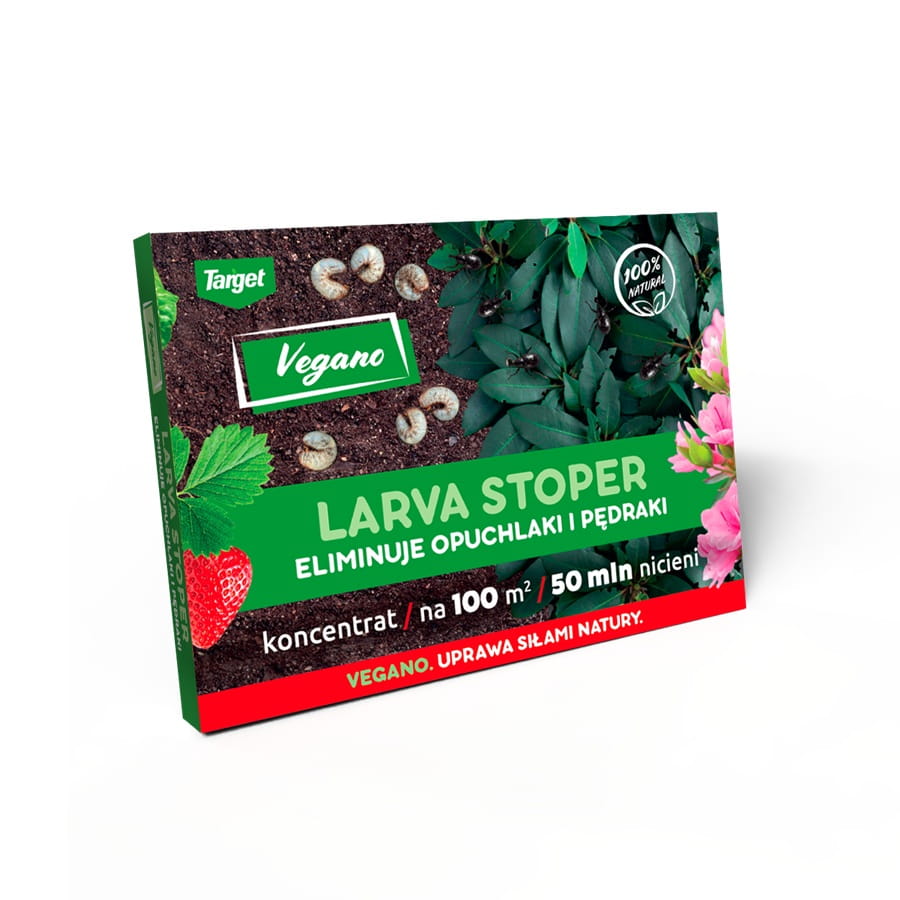
What to do against weevils and grubs?
Beneficial nematodes = insect-disease-causing.
They are contained in the preparation Larva Stoper together with the carrier material.
Simply add to water when it is warm.
⚠️ Orders containing the product Larva Stoper are only shipped from Monday to Wednesday, as the preparation requires special storage conditions.
Application
By watering or spraying. Works effectively against larvae of various beetle species, including the rough strawberry root weevil (Otiorhynchus sulcatus).
Natural and completely safe for plants, people, and animals – an environmentally friendly solution against plant pests.
Nematodes occur worldwide in the soil, and the selected species feeds exclusively on pests.
This preparation contains specially selected insect-disease-causing nematodes (which parasitize insects). These are beneficial nematodes.
There are also disease-causing nematodes in nature – against these we use Larva Stoper.
Since beneficial nematodes usually do not survive the winter, treatment must be repeated the following year if pests reappear.
Controls pests such as: weevils, grubs, wireworms, flea beetles, moth caterpillars.
Mode of action
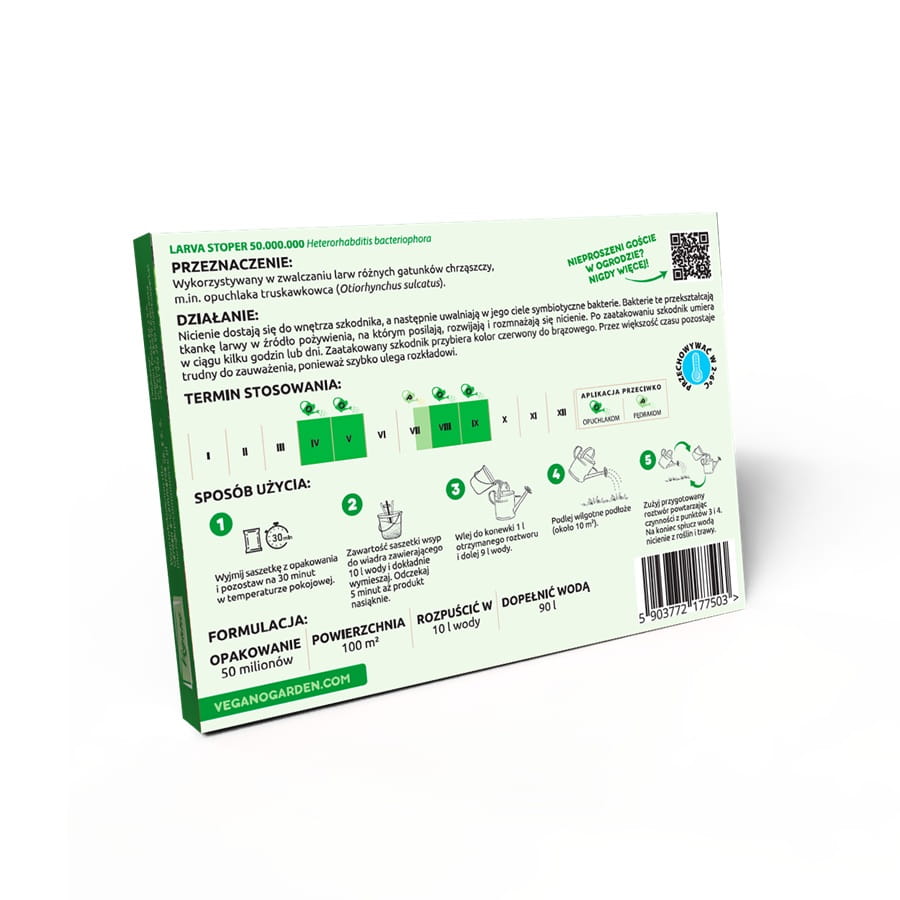
The nematodes enter the pest and release symbiotic bacteria there. These bacteria turn the larva’s tissue into a food source on which the nematodes feed, develop, and multiply. After infection, the pest dies within a few hours or days. The pest changes color from red to brown and decomposes quickly, making it hard to notice.
Time of use
This product works best when the pests are still in the larval stage. Effectiveness may be limited in other developmental stages.
Weevils: usually two treatments per season. First at the end of April/beginning of May, second at the end of August/beginning of September.
Grubs: one treatment per year, in the second half of July. Depending on the species, repetition in following years may be necessary:
Garden chafer – 1 year
June beetle – 2 years
May beetle – 3 years
⚠️ Note: The given dates are guidelines, as weather conditions vary. It is best to observe soil temperature (at least 12°C) and the presence of larvae. Depth is also important: if grubs lie deeper than 30–40 cm, the nematodes cannot reach them.
In greenhouses or under foil, treatment may be needed earlier, as the development cycle is faster.
Application steps
-
Remove the bag from the packaging and let it rest for 30 minutes at room temperature.
-
Put the contents into 10 liters of water (15–20°C).
-
Stir thoroughly, let stand for 5 minutes. Take 1 liter of the solution.
-
Pour into a watering can, fill up with water to 10 liters. Treats 10 m².
-
Then water the area again to wash off the nematodes.
Application with a sprayer is also possible: remove filter <0.3 mm, pressure max. 20 bar.
Storage
Store in the refrigerator at 2–6°C.
Shelf life: about 6 weeks (see packaging).
Keep in the original container, tightly closed, protected from light.
Important notes 🌱
Optimal use at 19–31°C.
Effectiveness decreases below 5°C or above 35°C.
Soil must be moist and remain moist for 2 weeks.
Do not apply in strong sunlight. Best in the evening or on a cloudy day.
Composition
Heterorhabditis bacteriophora, carrier material
Yield
1 pack = 50 million nematodes = sufficient for 100 m²
⚠️ Please note! This product cannot be returned due to its short shelf life (Art. 38 Consumer Protection Act, para. 1, no. 4).