 SKU 633-c
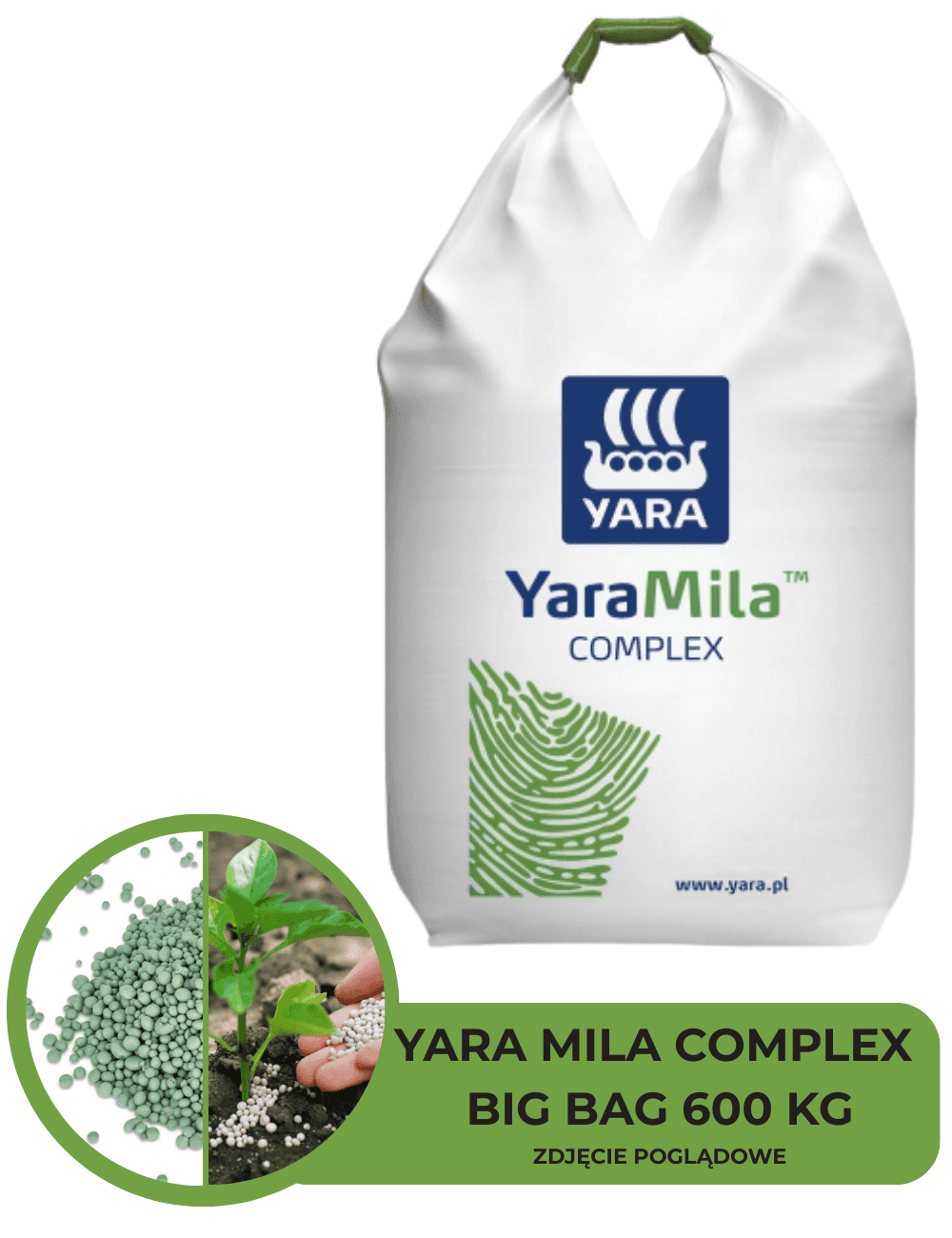
YaraMila Complex Hydrocomplex 12-11-18 Yara - compound fertiliser
The YaraMila Hydrocomplex 12-11-18 compound fertiliser is designed for fertilising plants sensitive to chlorides. It features a properly balanced and rich composition containing macronutrients (12% nitrogen, 11% phosphorus, 18% potassium…
Description
Yara Mila Hydrocomplex 12-11-18 compound fertiliser - for fertilising plants sensitive to chlorides
What distinguishes Yaramila Complex fertiliser:
- Properly balanced, universal, rich composition,
- Appropriately selected forms of nutrients,
- High content of sulphur, magnesium and micronutrients, improving the utilisation of main nutrients – nitrogen, phosphorus and potassium,
- Very good solubility, promoting rapid nutrient uptake,
- Chloride-free fertiliser - ideal for soil fertilisation in crops sensitive to chlorides,
- Excellent physical parameters – appropriate granulation, hardness, bulk density, low dust content makes the fertiliser easy and precise to spread, delivering an even amount of nutrient across the entire crop area,
- High production technology standards ensuring high consistency of fertiliser performance - correct nutrient proportions, uniform in every granule,
- Safe to use.
YaraMila Complex (Hydrocomplex) is a compound fertiliser in granule form, coloured green. It contains both macronutrients and micronutrients. Intended for top dressing to prepare soil before sowing or planting, as well as for side dressing and top dressing. Used in crops: field vegetables, vegetables grown under covers in soil, perennial orchard crops (pome, stone, berry fruits) and on green areas and in nursery production, as well as for preparing growing media and substrates for ornamental plants and vegetables cultivation.
Delivers nutrients in appropriate proportions (properly balanced composition). Contains nitrogen in two forms, released evenly during vegetation. The composition also includes a unique form of phosphorus with an addition of polyphosphate form, improving the utilisation of this nutrient in difficult soil conditions. This form is active and does not strongly bind to the soil. It also contains potassium in sulphate form, improving yield quality in all plant groups, especially important for crops sensitive to chlorides. Thanks to the presence of nitrate form, which initiates water uptake, and the physical properties of "prill" type granules, the fertiliser dissolves quickly, releasing nutrients.
Yara Mila Hydrocomplex NPK fertiliser - nutrient content:
- Total nitrogen – 12% N (including: 5% N-NO3 and 7% N-NH4);
- Phosphorus – 11% P2O5;
- Potassium – 18% K2O;
- Magnesium – 2.7% MgO;
- Sulphur – 20% SO3;
- Boron – 0.015% B;
- Iron – 0.20% Fe;
- Manganese – 0.02% Mn;
- Zinc 0.02% Zn.
Role of individual nutrients contained in YaraMila Complex fertiliser:
- Nitrogen (12N) in two forms (nitrate and ammonium), released evenly during vegetation,
- Potassium (18K2O) in chloride-free form, preferred by most horticultural plant species,
- Phosphorus (11P2O5) with an addition of polyphosphate form, active and not strongly bound by soil, thus better penetrating the soil profile and regenerating and stimulating the root system,
- Content of magnesium and micronutrients – to improve photosynthetic capacity of plants and proper biochemical processes in the plant,
- High sulphur content – a macronutrient that improves nitrogen utilisation, thereby positively affecting yield size.
Why use the granulated chloride-free YaraMila Hydrocomplex fertiliser in crops sensitive to chlorides?
Crops sensitive to chlorides (most field and covered vegetables, most stone and pome fruit trees, and practically all berry crops and ornamental plants) lack natural defence mechanisms against excessive chloride presence in the environment. Regular use of chloride-free fertiliser in these crops is one of the basic conditions for optimising fertilisation because:
- It positively affects yield size and quality (taste properties of vegetables and fruits, vitamin content),
- Increases dry matter content in tissues (which improves storage properties, post-harvest durability and resistance to damage during transport),
- Reduces levels of low-molecular-weight organic acids, which in turn increases the content of reserve substances: fats, proteins and sugars,
- Increases the rate of assimilate transport to their destinations, resulting in more uniform fruit ripening,
- Supports natural defence mechanisms against fungal and bacterial pathogen infections.
For plants with higher tolerance to chloride, we speak not of "preference" for chloride form but only of "tolerance", which in practice means that very high chloride levels will also negatively affect their yield, although to a lesser extent than in sensitive crops.
Application and dosage
|
Crop |
How to apply? Dosage |
When to apply |
|---|---|---|
|
Orchard plants |
Dose: 150-300 kg/ha, depending on crop type, fertilisation system and soil fertility. |
Application timing: during the plant vegetation period. |
|
Field vegetables |
Dose: 300-800 kg/ha, depending on species, soil fertility, fertilisation system and weather conditions. |
Application timing: during the plant vegetation period. |
|
Preparation of peat substrates and other horticultural growing media |
Dose: 0.5-2 kg per 1 m3 of growing medium. |
Application timing: before laying the growing medium or substrate. |
|
Soil preparation in greenhouse/tunnel |
Dose: on average 5-15 kg fertiliser per 100 m2, spread evenly and mixed with 20 cm layer of growing medium. |
Application timing: not applicable. |
|
Side dressing under covers |
Dose: apply by hand in single doses not exceeding 2-4 kg per 100 m2 depending on soil fertility and plant requirements. |
Application timing: during the plant vegetation period. |
|
Green areas (lawns, sports fields, etc.) |
Dose: 200-400 kg/ha (2-4 kg per 100 m2) depending on fertility, soil type and cultivation intensity. |
Application timing: during the plant vegetation period. |