

 SKU 44248-c
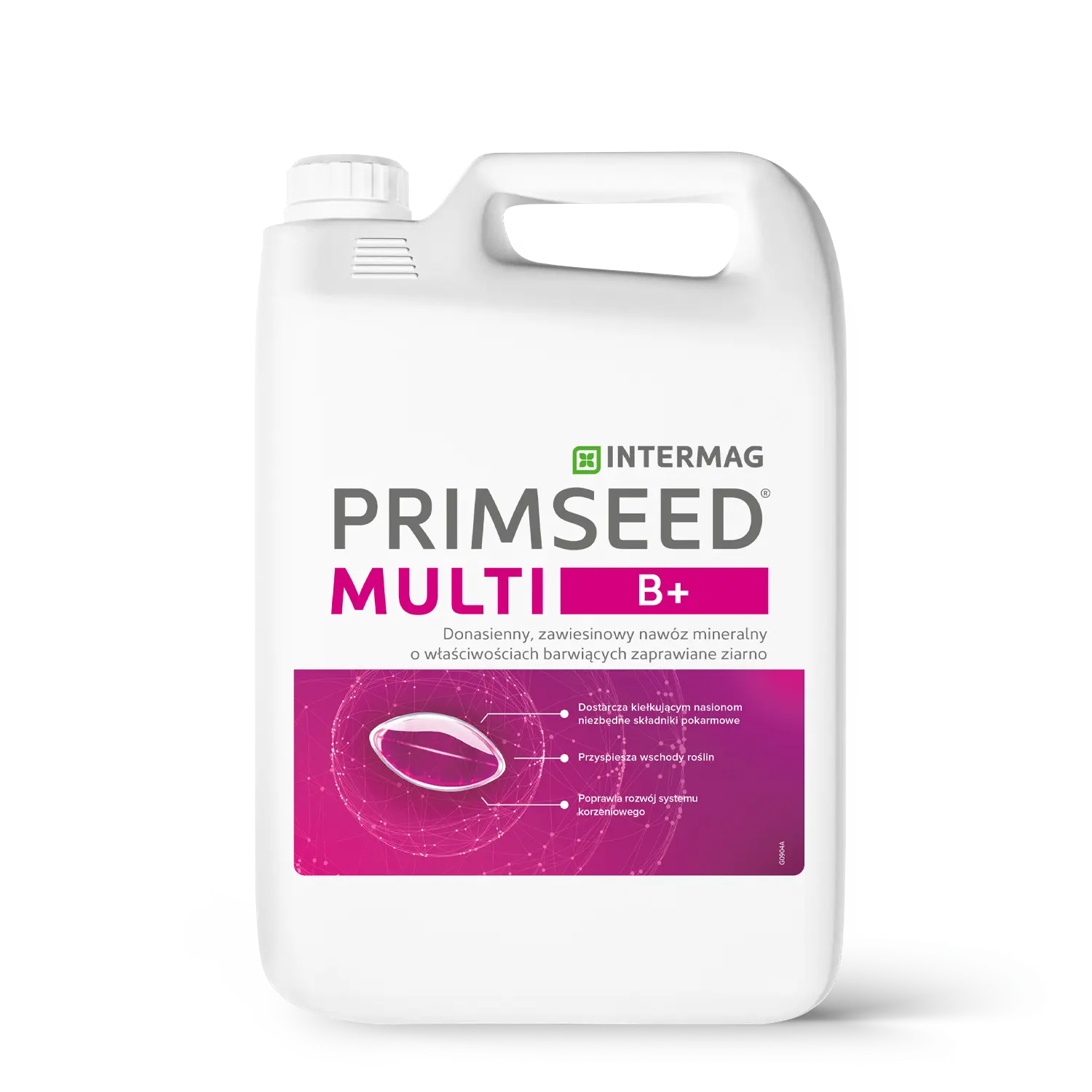
Primseed Multi B+ – fertiliser used during seed treatment
Primseed Multi B+ is a starter fertiliser used during seed treatment. It enables easy access to nutrients, supports the growth of seedlings and roots, and improves plant resistance to drought.
Description
Primseed Multi B+ starter fertiliser used during seed treatment
Benefits of using the Primseed Multi B+ seed-applied fertiliser:
- Enables the plant easy access to nutrients,
- Nutrients become more available to the root system,
- Supports the growth of seedlings and roots,
- Positive effect on plant resistance to drought,
- Seeds treated with Primseed Multi B+ are less dusty when poured into the seed drill,
- Seeds after treatment have a more intense colour,
- Stable suspension,
- For seed treatment,
- Stimulates the emergence of new plants,
- Provides essential nutrients,
- Protects plants against soil-borne or seed-borne pathogens and pests that attack plants,
- Enhances treated seeds,
- Supports early plant development,
- Allows plants to root quickly and well.
Primseed Multi B+ is a seed-applied fertiliser (more precisely a fertiliser used in seed treatment) intended for application on seeds during their preparation.
It is an improved and enriched mineral suspension containing nutrients. Applied on seeds during their preparation, it enables plants easy access to nutrients. Minerals become more available to the plant's root system, especially during germination and early plant growth.
Additionally, Primseed Multi B+ colours treated seeds, which allows better identification of the seed material.
Moreover, seeds are less dusty when poured into the seed drill and after treatment have a more intense colour.
The suspension is more stable.
A key part of the seed preparation process is the use of seed treatments to protect plants against soil-borne or seed-borne pathogens and pests that attack plants. Seed producing and preparing companies (or farmers themselves) additionally use Primseed Multi B+ fertiliser to enhance treated seeds.
The germination process of seeds in the soil depends on water availability and the current temperature. During germination, plants use nutrients and energy stored in the seed reserves. As a result of enzymatic processes and transformations of additional substances, the embryonic root emerges from the seed. At this point, the plant begins to form the root system, while the shoot (coleoptile) elongates and breaks through the soil to its surface.
For proper development during plant emergence, plants must receive nutrients in an assimilable form in the immediate vicinity of their young roots. For this reason, it is recommended to use "starter doses" of macronutrients and micronutrients in the form of seed fertiliser. An excellent solution is Primseed Multi B+ fertiliser, which supplies germinating seeds with essential nutrients. Moreover, it stimulates the emergence of new plants and ensures their early development at an appropriate level. It allows plants to root quickly and well.
Composition of the Primseed Multi B+ starter fertiliser:
- Total nitrogen (N) - 9.5 g/l
- Amide nitrogen (N) (NH2) - 9.5 g/l
- Total phosphorus pentoxide (P2O5) - 13.0 g/l
- Water-soluble phosphorus pentoxide (P2O5) - 13.0 g/l
- Phosphorus pentoxide (P2O5) soluble in neutral ammonium citrate solution - 13.0 g/l
- Water-soluble potassium oxide (K2O) - 17.7 g/l
- Water-soluble magnesium oxide (MgO) - 20 g/l
- Water-soluble sulphur trioxide (SO3) - 47.2 g/l
- Water-soluble sodium oxide (Na2O) - 11.8 g/l
- Boron (B) as sodium salt - 2.4 g/l
- Copper (Cu) as sulphate - 2.4 g/l
- Iron (Fe) as sulphate - 9.6 g/l
- Manganese (Mn) as chloride - 3.5 g/l
- Molybdenum (Mo) as ammonium salt - 0.7 g/l
- Zinc (Zn) as sulphate - 5.9 g/l
Application of Primseed Multi B+ fertiliser in crops:
Primseed Multi B+ seed preparation fertiliser can be used in the cultivation of:
- wheat,
- barley,
- triticale,
- rye,
- oats,
- maize,
- beet,
- oilseed rape,
- cabbage seeds,
- small-seeded leguminous plants,
- large-seeded leguminous plants,
- seed potatoes.
Application and dosage
|
Crop - place of application |
Method of application |
How to apply? Single dose |
|---|---|---|
|
Wheat, barley, triticale, rye |
Before use, mix the fertiliser thoroughly to homogenise the suspension throughout the container. The fertiliser should be applied as an aqueous suspension. It can be used together with a seed treatment product. It is important to evenly coat the entire surface of the seeds with the solution. |
Fertiliser dose per 100kg of seeds: 0.2 litres, Recommended amount of water per 100kg of seeds: 0.8 litres |
|
Oats |
Before use, mix the fertiliser thoroughly to homogenise the suspension throughout the container. The fertiliser should be applied as an aqueous suspension. It can be used together with a seed treatment product. It is important to evenly coat the entire surface of the seeds with the solution. |
Fertiliser dose per 100kg of seeds: 0.3 litres, Recommended amount of water per 100kg of seeds: 1.2 litres. . |
|
Maize, beet |
Before use, mix the fertiliser thoroughly to homogenise the suspension throughout the container. The fertiliser should be applied as an aqueous suspension. It can be used together with a seed treatment product. It is important to evenly coat the entire surface of the seeds with the solution. |
Fertiliser dose per 100kg of seeds: 0.3 litres, Recommended amount of water per 100kg of seeds: 0.9 litres. |
|
Small-seeded leguminous plants |
Before use, mix the fertiliser thoroughly to homogenise the suspension throughout the container. The fertiliser should be applied as an aqueous suspension. It can be used together with a seed treatment product. It is important to evenly coat the entire surface of the seeds with the solution. |
Fertiliser dose per 100kg of seeds: 0.2 litres, Recommended amount of water per 100kg of seeds: 0.5 litres. |
|
Large-seeded leguminous plants |
Before use, mix the fertiliser thoroughly to homogenise the suspension throughout the container. The fertiliser should be applied as an aqueous suspension. It can be used together with a seed treatment product. It is important to evenly coat the entire surface of the seeds with the solution. |
Fertiliser dose per 100kg of seeds: 0.3 litres, Recommended amount of water per 100kg of seeds: 0.8 litres. |
|
Oilseed rape and other cabbage seeds |
Before use, mix the fertiliser thoroughly to homogenise the suspension throughout the container. The fertiliser should be applied as an aqueous suspension. It can be used together with a seed treatment product. It is important to evenly coat the entire surface of the seeds with the solution. |
Fertiliser dose per 100kg of seeds: 0.2 litres, Recommended amount of water per 100kg of seeds: 0.5 litres. |
|
Seed potatoes |
Before use, mix the fertiliser thoroughly to homogenise the suspension throughout the container. The fertiliser should be applied as an aqueous suspension. It can be used together with a seed treatment product. It is important to evenly coat the entire surface of the seeds with the solution. |
Fertiliser dose per 1 tonne of seed potatoes: 1.5 litres, Recommended amount of water per 1 tonne of seed potatoes: 10-50 litres of water. |