 SKU CH-15106
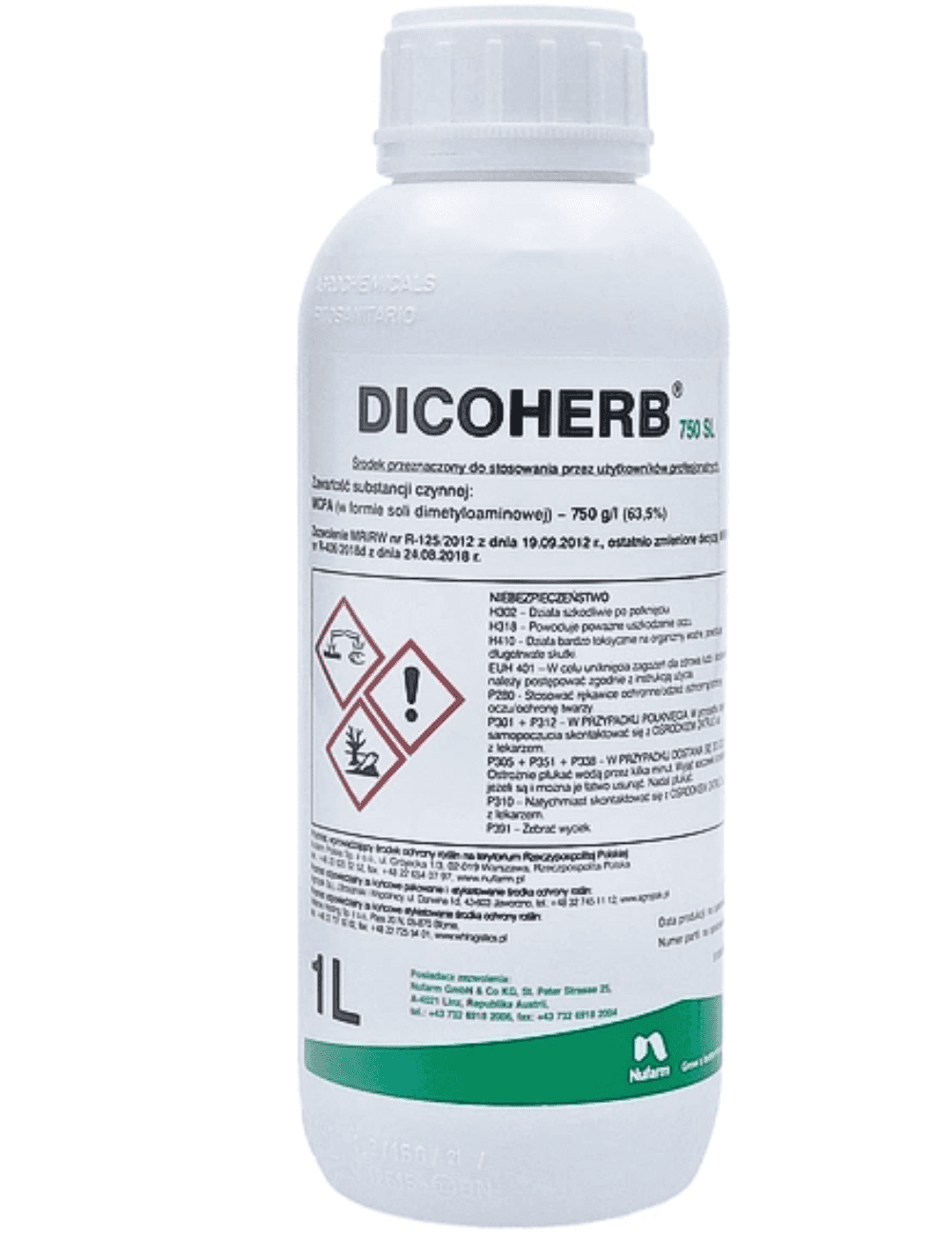
Dicopur 600 SL
DICOPUR 600 SL is an effective selective herbicide in concentrate form for preparing an aqueous solution, intended for post-emergence control of annual dicotyledonous weeds.
Description
MODE OF ACTION OF DICOPUR 600 SL:
Dicopur 600 SL is a foliar herbicide with systemic action. The active substance is rapidly absorbed through the leaves of weeds and then transported to meristematic tissues. The mode of action involves disruption of cell division, leading to characteristic deformities of leaves and stems, growth inhibition, and ultimately complete weed death. The highest effectiveness is achieved by applying the product to weeds at the 2-6 leaf stage.
SPECTRUM OF CONTROLLED WEEDS:
Sensitive weeds: white goosefoot, volunteer oilseed rape, shepherd's purse, field pennycress, field mustard, small geranium, knotweed, black nightshade.
Moderately sensitive weeds: common poppy, field thistle, bindweed, rough amaranth, white goosefoot, speedwells.
Advantages of using DICOPUR 600 SL:
- High concentration: A dose of 600 g/l active substance allows for the use of smaller product doses per hectare.
- Rapid effect: The first symptoms of action (deformities) are visible shortly after treatment.
- Wide application window: Can be applied in cereals from the 4-leaf stage up to the end of tillering.
- Ideal for mixtures: Often used as a component to enhance control of difficult dicotyledonous weeds.
Pre-harvest interval:
Not applicable – safe use within the recommended agronomic timings.
DICOPUR 600 SL SCOPE OF USE AND DOSES:
Cereals (Winter and spring wheat, Winter and spring barley)
| Recommended dose: | 0.8 - 1.0 l/ha |
| Application timing: | Winter cereals: in spring from the start of vegetation to the end of tillering (up to BBCH 29). Spring cereals: from the 4-5 leaf stage to the end of tillering (BBCH 14-29). |
| Water volume / droplet size: | 200-300 l/ha | Medium droplet spraying. |
Maize
| Recommended dose: | 0.8 - 1.0 l/ha |
| Application timing: | Maize 5-6 leaf stage (BBCH 15-16). |
| Technical notes: | Use the higher dose in cases of heavy weed infestation or older weeds. Some varieties may show temporary phytotoxicity at low temperatures. |
Note: Product is absorbed through leaves – avoid drift onto neighbouring dicotyledonous crops. Maximum number of treatments per season: 1.