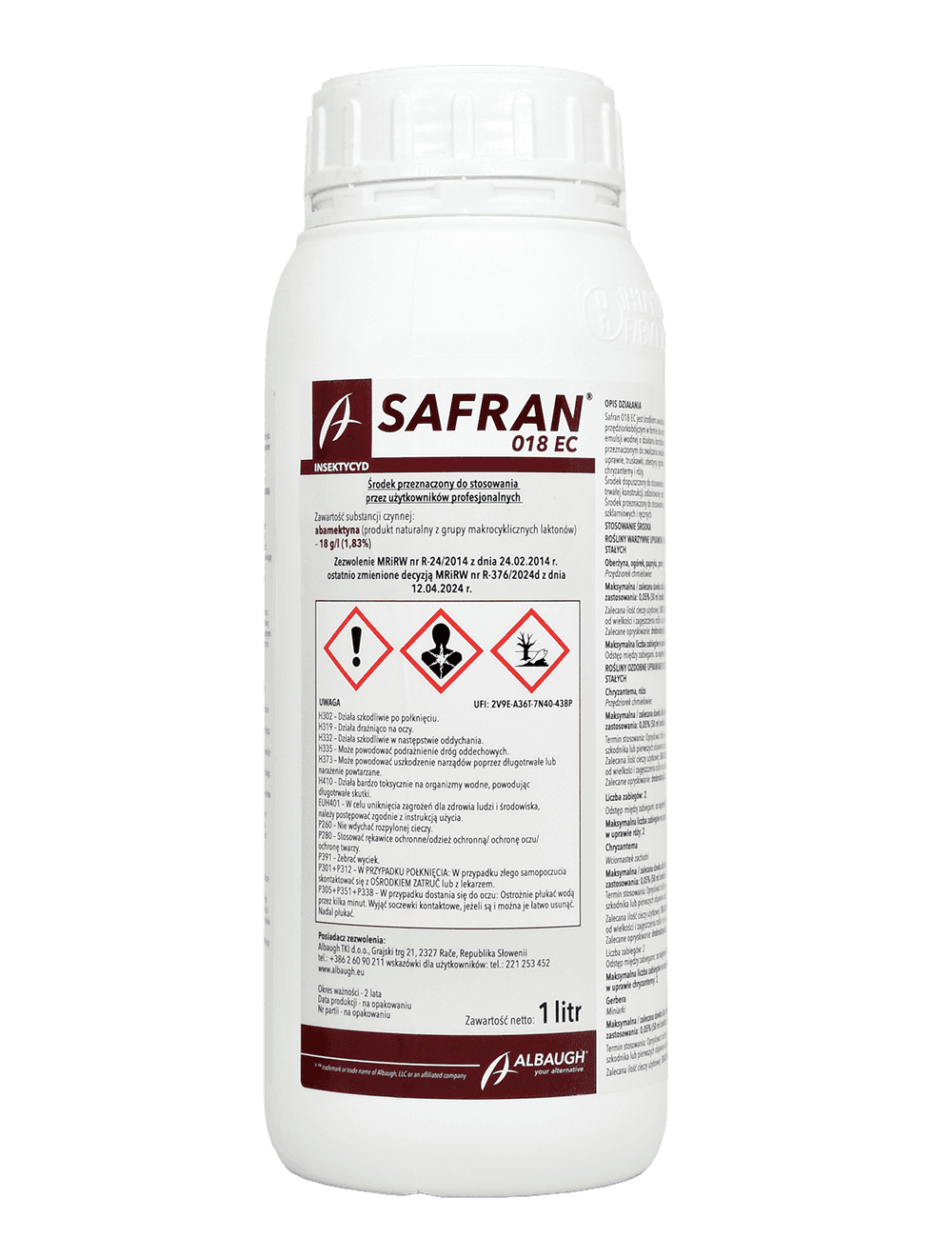
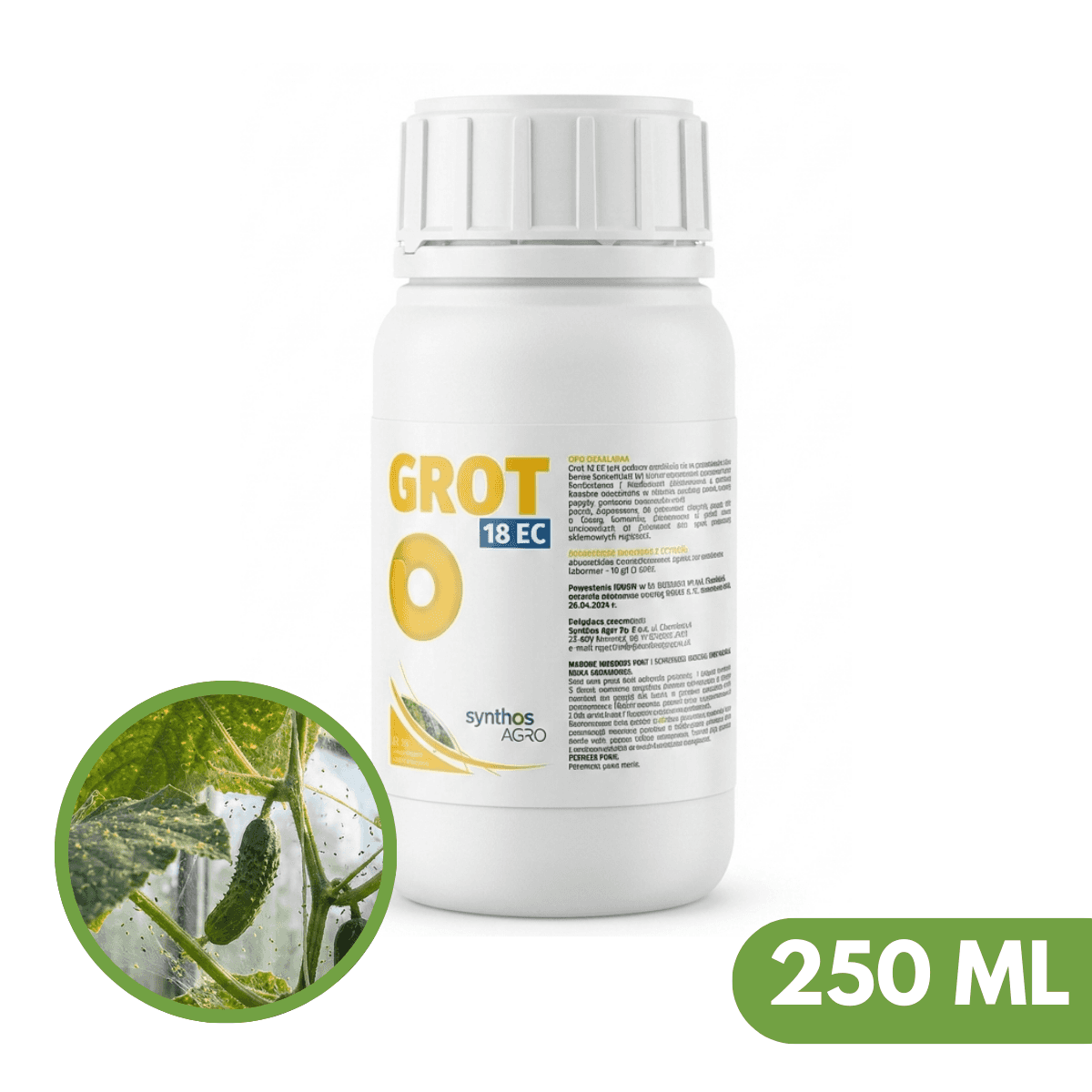
Safran 018 EC (abamectin) Albaugh - insecticide
Safran 018 EC - advanced insecticidal plant protection product for use in greenhouses. It features an innovative formula based on abamectin (18 g/l), providing a broad spectrum of activity and effectiveness even in small amounts.
Description
Safran 018 EC - effective plant protection in the greenhouse
- Innovative Formula: Safran 018 EC is based on a novel formula that ensures effective plant protection.
- Broad Spectrum of Activity: The product effectively controls a variety of pests, providing comprehensive crop protection.
- Environmentally Safe: Safran 018 EC is designed to minimise environmental impact while maintaining its effectiveness.
- Easy Application: Thanks to its easy-to-use formula, product application is quick and convenient.
- Long-lasting Effect: Safran 018 EC guarantees prolonged protection, maintaining high efficacy over an extended period.
Safran 018 EC is an advanced insecticidal plant protection product created especially for professionals growing plants in greenhouses. It is a reliable ally in crop protection. Its innovative formula, developed by experienced specialists, effectively eliminates pests, protecting plants from harmful effects. This formula is based on a natural compound (abamectin) effective in controlling harmful insects. It acts both by contact and ingestion, eliminating pests at various stages of their development. Thanks to its broad spectrum of activity and easy application, Safran 018 EC guarantees not only effective but also convenient protection.
Mode of action of Safran 018 EC insecticide:
Safran 018 EC acts in two ways - by contact and ingestion. After application, it effectively eliminates harmful insects on vegetable and ornamental plants in greenhouses. Its activity includes spider mites, thrips, and other insects that threaten yields.
Content of active substance:
Contains abamectin at a concentration of 18 g/l (1.83%), making it effective even in small amounts.
Safran 018 EC insecticide - controlled pests:
- Hop spider mite
- Western flower thrips,
- Leaf miners.
Safran 018 EC insecticidal plant protection product - use in crops:
- Aubergine, cucumber, sweet pepper, tomato;
- Chrysanthemum, rose, gerbera;
- Small-scale crops: strawberries in permanent greenhouses.
Safran 018 EC Albaugh - pre-harvest interval, withdrawal period, crop rotation:
- Pre-harvest interval (period from last application to harvest date): 3 days for aubergine, cucumber, sweet pepper, tomato, strawberry; not applicable to chrysanthemum, gerbera, rose.
- Withdrawal period for fodder (period from last application on plants intended for fodder to the day animals can be fed with these plants): not applicable.
- Prevention period (period from application until people and animals can enter the treated area): do not enter until the spray liquid on the plant surfaces is completely dry.
- Prevention period for bees: 96 hours.
- There are no restrictions regarding sowing or planting subsequent crops after product application.
Safran 018 EC Albaugh insecticidal plant protection product - preparation of spray liquid:
Before preparing the spray liquid, accurately determine the required amount. Pour the measured amount of product into the sprayer tank partially filled with water, with the agitator on. Rinse empty containers three times with water and pour the rinsate into the sprayer tank with the spray liquid, top up with water to the required volume and mix thoroughly. Then fill the sprayer tank with water to the required volume. If the sprayer tank is not equipped with a hydraulic agitator, mechanically mix the liquid after adding the product. In case of breaks during spraying, mix the spray liquid thoroughly before resuming work. Recommended working pressure is 2-3 bar. During operation, when the spray liquid is in the sprayer tank, ensure the tank is fully vented. Use the spray liquid immediately after preparation.
Safran 018 EC - application guidelines:
- Use alternately with other products having a different mode of action.
- Spray entire plants, paying special attention to the undersides of leaves.
- Before applying to ornamental and cucurbit plants of any newly grown variety, perform a test treatment to check for any phytotoxic symptoms within 7 days.
- Keep out of reach of children.
- Store the plant protection product:
- in places or facilities with appropriate measures to prevent environmental contamination and access by unauthorized persons,
- in original packaging, preventing contact with food, beverages or fodder,
- at temperatures between 0°C and 30°C, away from heat sources. - Keep the container tightly closed.
Warning! Plant protection products must be used safely. Before each use, read the information on the label and product details.
The purchaser declares that they meet the conditions specified in Article 25 paragraph 3 point 5 of the Act of 8 March 2013 on plant protection products and have training in the use of plant protection products in the case of products for professional users. Before each use, read the information on the label and product details. Pay attention to detailed risk indications. Follow safety rules contained on the label. Plant protection products may only be purchased by adults and persons who have completed training and possess the qualifications required for persons acquiring plant protection products (Article 28 of the Act on plant protection products of 8 March 2013 as amended). Plant protection products must be used in a manner that does not pose a risk to human health, animals or the environment. The purchaser of plant protection products must be sober. By using this offer, you declare that you meet the above conditions.
Application and dosage
|
Crop |
Pest control |
How to apply? Dosage |
When to apply? |
|---|---|---|---|
|
Aubergine, cucumber, sweet pepper, tomato |
Hop spider mite |
Maximum / recommended dose for single application: 0.05% (50 ml of product in 100 litres of water). Recommended spray liquid volume: 500-1500 l/ha (depending on plant size and density in the plantation). Recommended spraying: fine droplets. Maximum number of treatments per growing season: 2. Interval between treatments: at least 7 days. |
Application timing: Spray plants after noticing the pest or first symptoms of damage. |
|
Chrysanthemum, rose |
Hop spider mite |
Maximum / recommended dose for single application: 0.05% (50 ml of product in 100 litres of water). Recommended spray liquid volume: 500-2000 l/ha (depending on plant size and density in the plantation). Recommended spraying: fine droplets. Number of treatments: 2. Interval between treatments: at least 7 days. Maximum number of treatments per growing season in rose cultivation: 2. |
Application timing: Spray plants after noticing the pest or first symptoms of damage. |
|
Chrysanthemum |
Western flower thrips |
Maximum / recommended dose for single application: 0.05% (50 ml of product in 100 litres of water). Recommended spray liquid volume: 500-2000 l/ha (depending on plant size and density in the plantation). Recommended spraying: fine droplets. Number of treatments: 2. Interval between treatments: at least 7 days. Maximum number of treatments per growing season in chrysanthemum cultivation: 2. |
Application timing: Spray plants after noticing the pest or first symptoms of damage. |
|
Gerbera |
Leaf miners |
Maximum / recommended dose for single application: 0.05% (50 ml of product in 100 litres of water). Recommended spray liquid volume: 500-2000 l/ha (depending on plant size and density in the plantation). Recommended spraying: fine droplets. Maximum number of treatments per growing season: 2. Interval between treatments: at least 7 days. |
Application timing: Spray plants after noticing the pest or first symptoms of damage. |
|
Strawberry grown in permanent greenhouses |
Hop spider mite |
Maximum / recommended dose for single application: 1.2 l/ha. Recommended water volume: 500 - 1200 l/ha. Recommended spraying: fine droplets. Maximum number of treatments per growing season: 1. |
Application timing: Spray plants after noticing the pest or first symptoms of damage before flowering (BBCH 00-49) or after flowering (BBCH 71-99). |