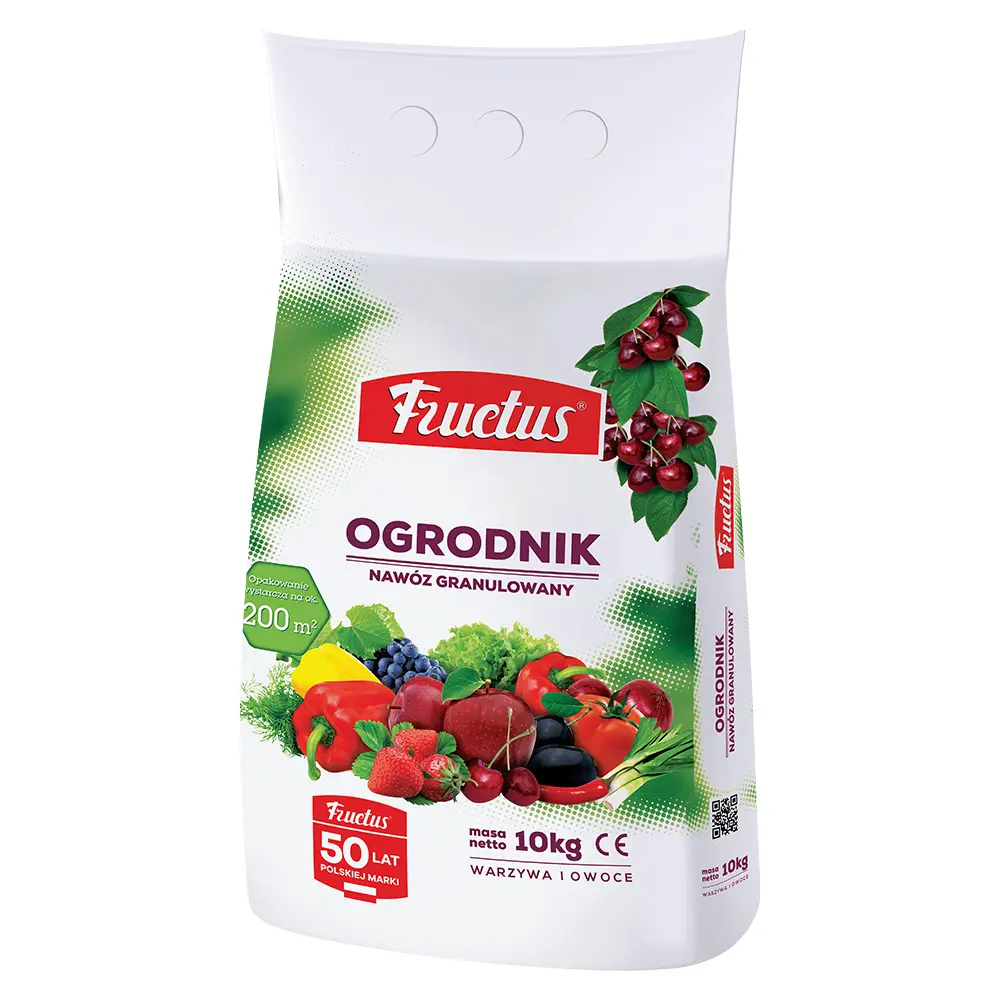
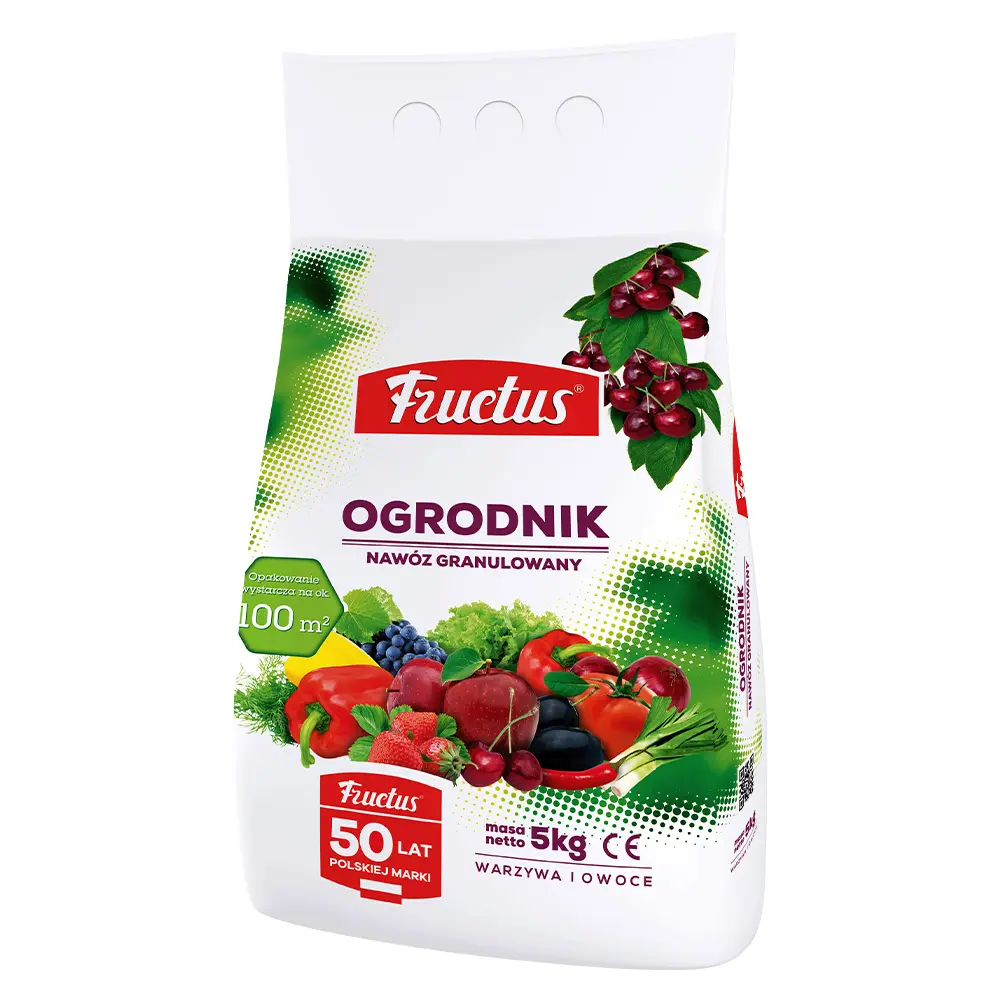
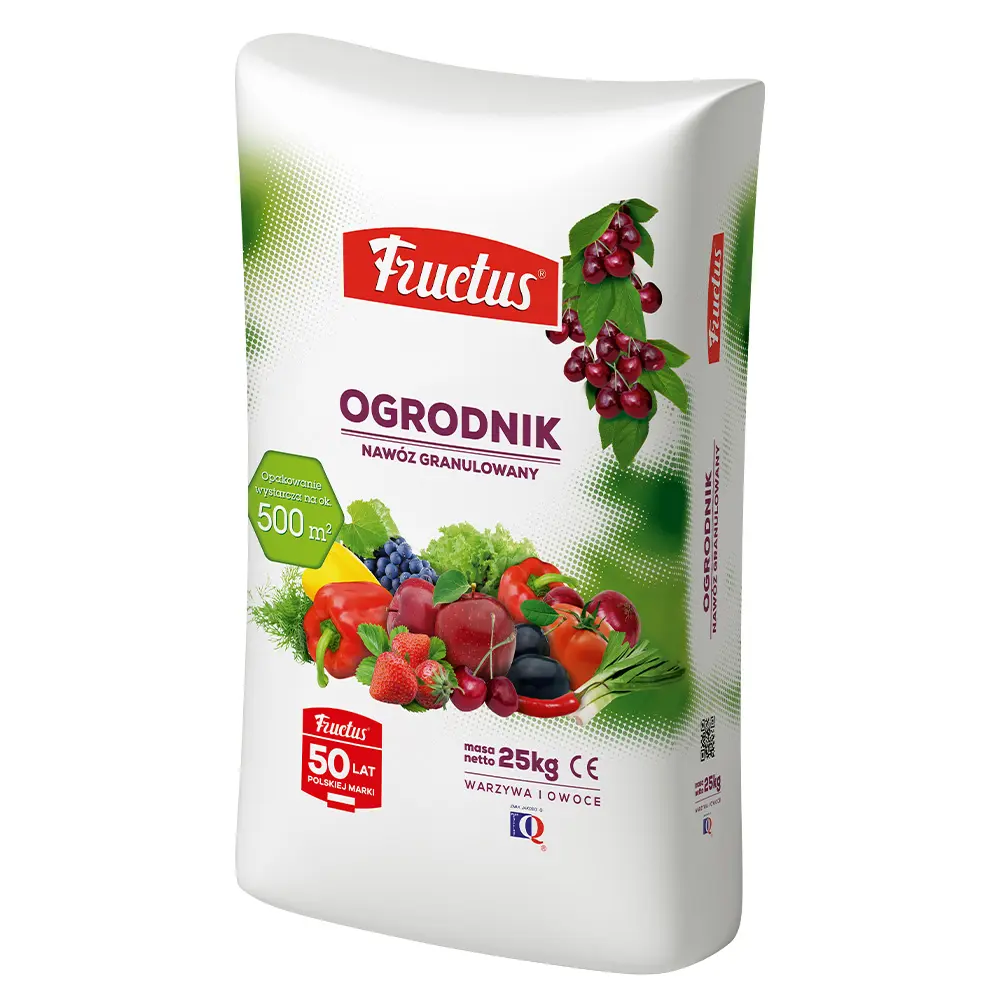
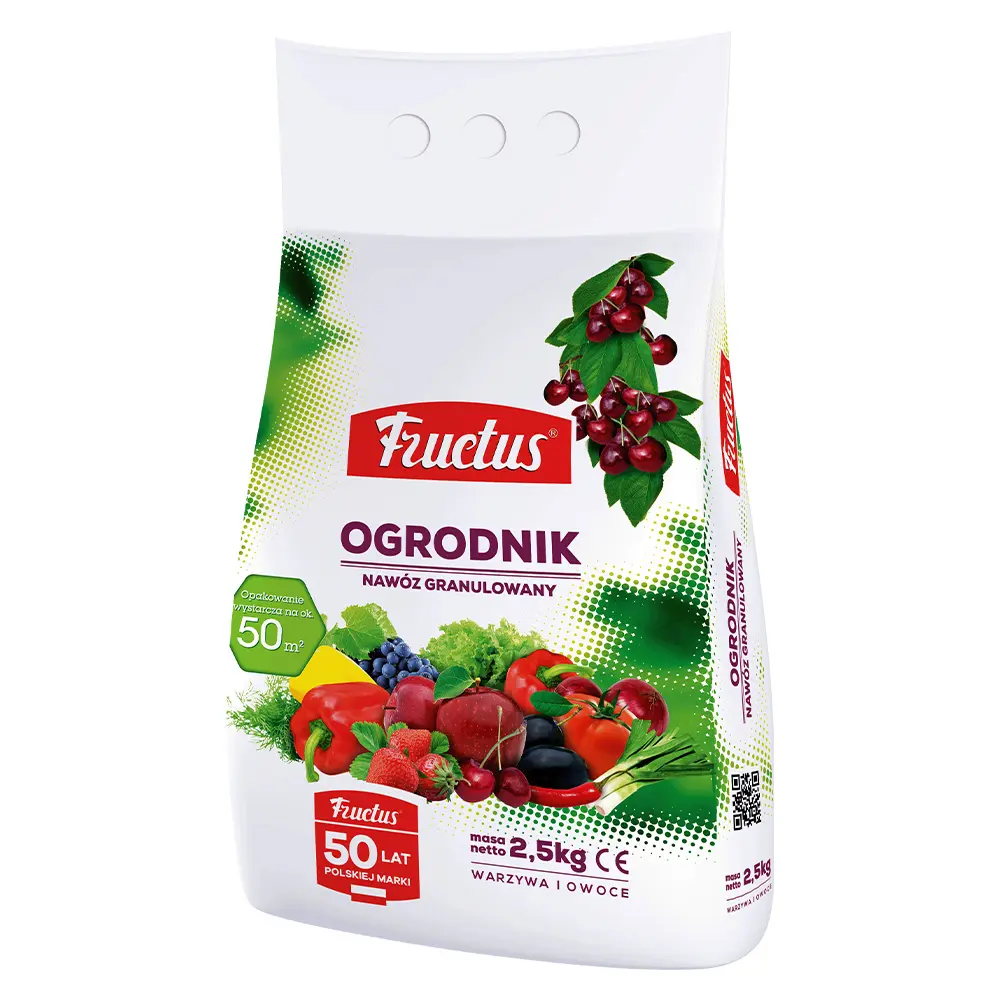


Universal garden fertiliser Fructus Ogrodnik
Fructus Ogrodnik universal garden granulated fertiliser is a compound NPK fertiliser with added micronutrients, intended for various garden plants, vegetables, fruits, lawns and conifers.
Description
Fructus Ogrodnik compound NPK granulated fertiliser with micronutrients (multicomponent)
Advantages of using Fructus Ogrodnik compound fertiliser:
- Fertiliser with low chloride content.
- Ensures obtaining healthy vegetables and fruits and abundant yield.
- Convenient application - in supergranule form.
- Comprehensive (contains all nutrients necessary for proper plant development - both macro and micronutrients).
- Contains dolomite, which improves the biological and chemical properties of soil and growing media.
Fructus Ogrodnik is a multicomponent granulated fertiliser with low chloride content. It is intended for fertilising vegetables (beans, peas, broad beans, dill, lettuce, kohlrabi, radish, broccoli, cauliflower, cabbage, leek, celery, tomato, cucumber, sweet pepper), ornamental shrubs and trees, lawns, flowering plants, as well as coniferous and fruit trees and shrubs. The appropriately selected composition of bioelements in the fertiliser positively affects the quantity and quality of the yield, ensures uniform plant growth, abundant flowering and fruiting. The fertiliser contains dolomite, which improves the biological and chemical properties of soil and growing media.
Fructus Ogrodnik - fertiliser components:
Fertiliser type: NPK (Mg, S) 10 : 5 : 10 (5 : 27) with boron (B), copper (Cu), manganese (Mn), molybdenum (Mo), zinc (Zn).
Macronutrients:
- total nitrogen (N): 10 % in ammonium form,
- phosphorus pentoxide (P2O5): 5 % soluble in neutral ammonium citrate solution and water,
- phosphorus pentoxide (P2O5): min. 2.5 % water soluble,
- potassium oxide (K2O): 10 % water soluble in sulphate form,
- magnesium oxide (MgO): 5 % total,
- sulphur trioxide (SO3): min. 27 % total.
Micronutrients:
- boron (B): 0.01 % total in boric acid form,
- copper (Cu): 0.01 % total in sulphate form,
- manganese (Mn): 0.1 % total in sulphate form,
- molybdenum (Mo): 0.001 % total in ammonium salt form,
- zinc (Zn): 0.01 % total in sulphate form.
Fructus Ogrodnik fertiliser - application timing:
The fertiliser can be applied:
- before sowing or planting plants, mixing evenly with the growing medium or cultivated soil layer to a depth of about 15 cm,
- during the growing season, preferably when loosening the soil, and in the case of lawns after mowing. When applying fertiliser under trees and shrubs, it should be spread in a radius slightly larger than the crown outline. Repeat treatments every 8–10 weeks. The last fertilisation should be applied no later than the end of August. Spread the fertiliser evenly, not exceeding a single dose of 5 kg/100m2*. Apply when plants are dry.
Possible application months:
- March, September.
Recommended application months:
- April, May, June, July, August.
Application and dosage
|
Crop |
How to apply? Dosage |
|---|---|
|
Strawberry, wild strawberry, raspberry, grapevine, ornamental shrubs, trees before fruiting |
Dose: 3–6 kg/100 m2 |
|
Beans, peas, broad beans, dill, lettuce, kohlrabi, radish, parsley |
Dose: 3–8 kg/100 m2 |
|
Broccoli, cauliflower, cabbage (white, savoy, red, Brussels sprouts, Chinese), leek, root celery, tomato, cucumber, sweet pepper, rhubarb |
Dose: 10–15 kg/100 m2 |
|
Stock, surfinia, pelargonium, wallflower, aster, chrysanthemum, nasturtium, verbena and other annual flowers |
Dose: 4–8 kg/100 m2 |
|
Tulip, daffodil, hyacinth and other bulb flowers, rose, azalea, rhododendron |
Dose: 5–8 kg/100 m2 |
|
Coniferous trees and shrubs |
Dose: 3–5 kg/100 m2 |
|
Fruit trees, currants, gooseberries |
Dose: 8–15 kg/100 m2 |
|
Lawns |
Dose: 8–15 kg/100 m2 |
|
Other plants |
Dose: according to the principles of rational fertilisation |
|
Protected crops - growing media containing peat and bark |
Seedling and pricking dose: 1–1.5 kg/m3. Seedling dose: 1–2 kg/m3. |
|
Protected crops - soil |
Dose: 1–2 kg/10 m2. Plant development stage: Seedlings, pricking, seedlings |