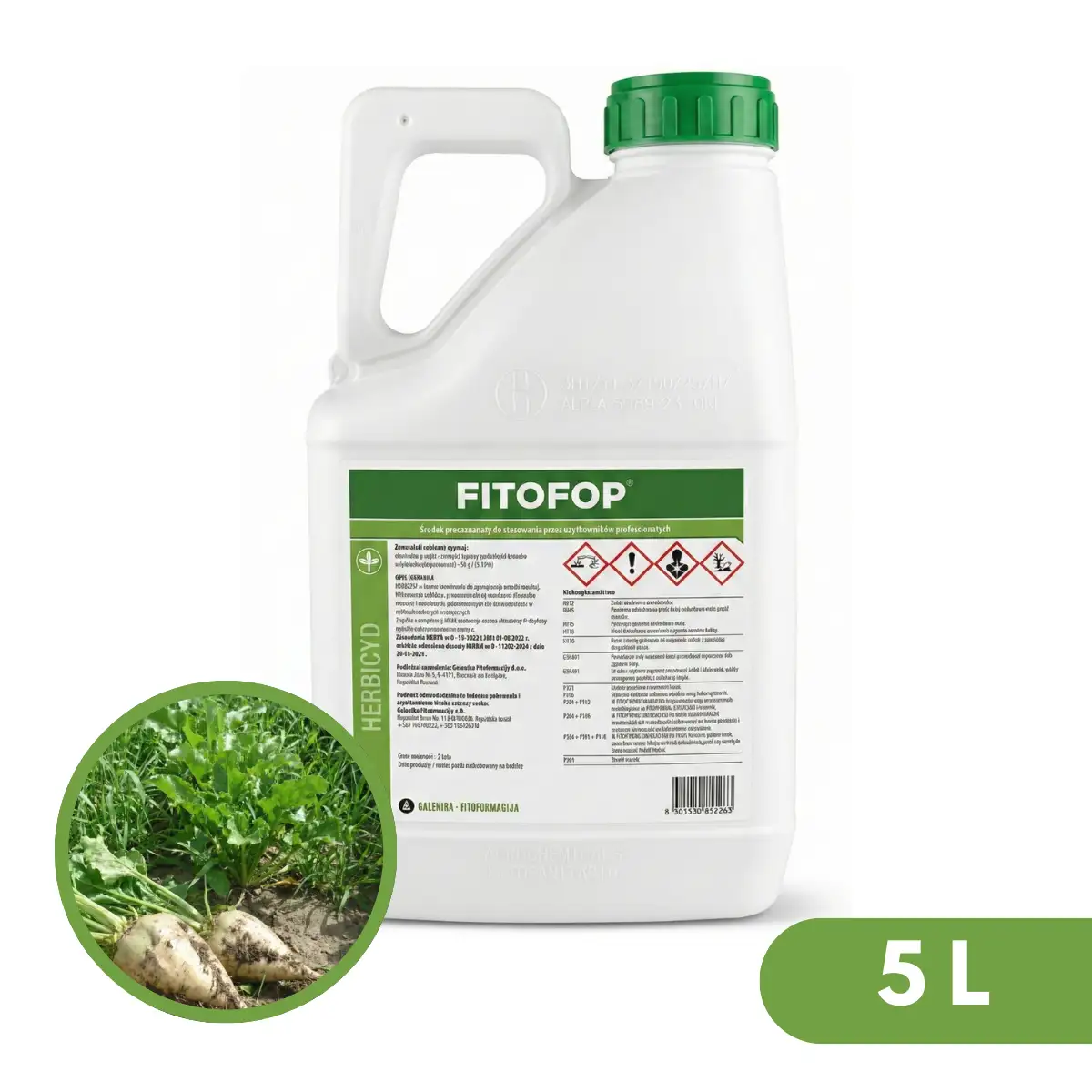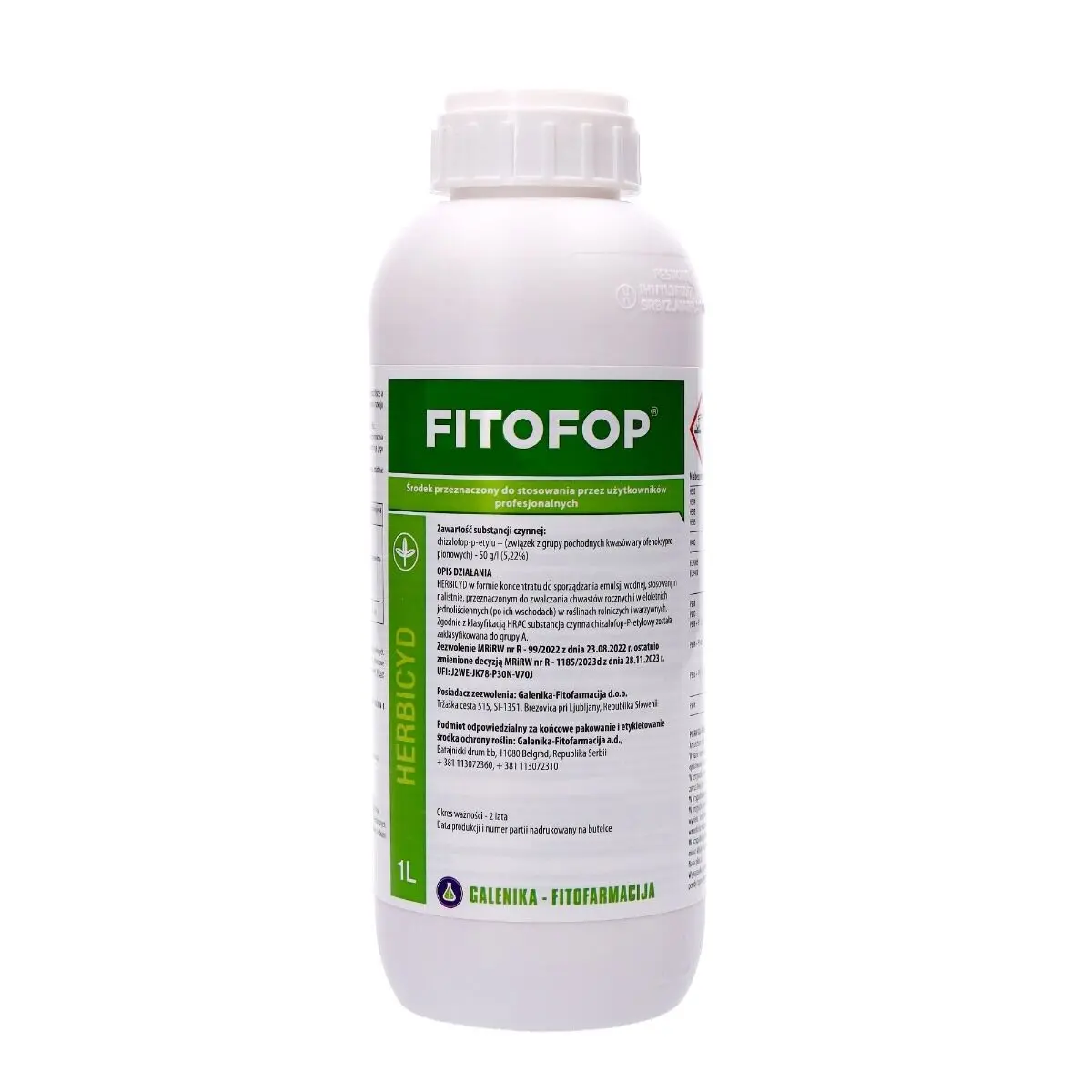
Fitofop (quizalofop) Galenika - herbicide
FITOFOP is a selective herbicide with systemic action designed for effective control of annual and perennial monocotyledonous weeds in many arable and vegetable crops.
- Volume
- 1l
Description
FITOFOP – effective elimination of monocotyledonous weeds
FITOFOP is a selective herbicide intended for the control of annual and perennial monocotyledonous weeds in many arable and vegetable crops. The product contains the active substance quizalofop-P-ethyl (50 g/l), belonging to the aryloxyphenoxypropionic acid derivatives group.
The product is applied post-emergence and acts systemically, providing effective weed control even in well-developed plants. FITOFOP supports proper crop development by eliminating competition for water, nutrients and light.
Mode of action
FITOFOP is a systemic herbicide, rapidly absorbed through the leaves of weeds and then translocated to the growing points, roots and rhizomes.
The active substance quizalofop-P-ethyl inhibits the activity of the ACCase enzyme, leading to the inhibition of lipid synthesis and consequently to the suppression of weed growth. Symptoms appear as yellowing followed by drying of the youngest leaves.
The full herbicidal effect is usually achieved 2–3 weeks after application, and cooler weather conditions may delay the action rate without reducing the product's effectiveness.
Application and controlled weeds
FITOFOP is intended for the control of monocotyledonous weeds across a wide range of arable and vegetable crops.
Annual monocotyledonous weeds
- volunteer cereals
- side-oats grama
- broom grass
- wild oats
- bluegrass
- barnyard grass
- perennial ryegrass
Perennial monocotyledonous weeds
- couch grass
The product is applied post-emergence when weeds are most susceptible to the herbicide. Annual weeds are best controlled at the 2–3 leaf stage, while couch grass at the 4–6 leaf stage.
Application recommendations
The product should be applied using field sprayers, observing appropriate weather and agrotechnical conditions.
- apply post-emergence
- adjust the dose according to weed species and growth stage
- perform a maximum of one treatment per growing season
- ensure thorough coverage of weeds with spray liquid
- do not apply other herbicides during the protection period after treatment
FITOFOP is characterised by good rainfastness; rainfall occurring about 2 hours after application does not negatively affect its effectiveness.
Benefits of using FITOFOP
- effective control of annual and perennial monocotyledonous weeds
- systemic action – elimination of root systems as well
- rapid uptake through weed leaves
- flexible use in many crops
- supports ACCase herbicide resistance management strategies
Notes
FITOFOP should be used in accordance with the plant protection product label recommendations and integrated pest management principles.
To reduce the risk of weed resistance development, it is recommended to rotate herbicides with different modes of action, adhere to recommended doses and avoid repeated use of herbicides from the same group within one season.
Required pre-harvest intervals, withholding periods and crop rotation rules specified on the product label must also be observed.
Application and dosage
| Crop | Controlled weeds | Product dose | Application timing | Maximum number of treatments |
|---|---|---|---|---|
| Sugar beet, fodder beet | Annual monocotyledonous weeds and couch grass | up to 2.5 l/ha | From the first pair of leaves stage to 90% soil coverage (BBCH 11–39) | 1 |
| Potato | Annual monocotyledonous weeds and couch grass | up to 2.0 l/ha | From leaf development beginning to before row closure (BBCH 10–39) | 1 |
| Winter oilseed rape | Annual monocotyledonous weeds and couch grass | up to 2.5 l/ha | From cotyledon stage to 9 or more internodes stage (BBCH 10–39) | 1 |
| Carrot | Annual monocotyledonous weeds and couch grass | up to 2.5 l/ha | From cotyledon stage to typical root size (BBCH 10–49) | 1 |