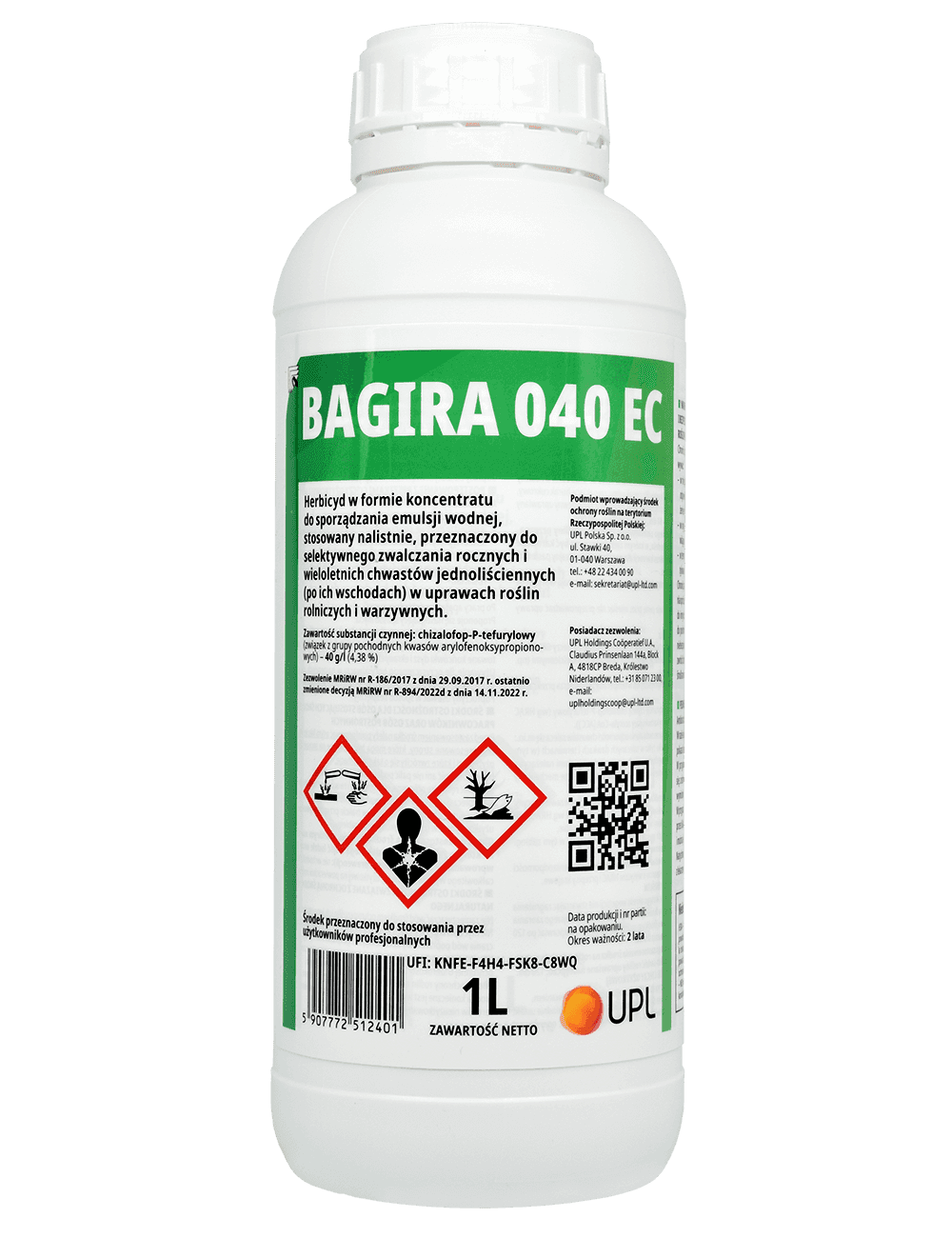
SKU CH-14540
Cabramatta 100 EC
CABRAMATTA 100 EC is a selective herbicide with systemic action, designed for effective control of monocotyledonous weeds (including couch grass, blackgrass and annual grass).
- Pack
- 5 l
Description
MODE OF ACTION OF CABRAMATTA 100 EC: SELECTIVE CONTROL OF MONOCOTYLEDONOUS WEEDS
CABRAMATTA 100 EC is a selective herbicide with systemic action, applied foliar as a concentrate for preparing an emulsifiable concentrate (EC). The active substance, propachizafop, is rapidly absorbed through the leaves of weeds. It then moves to the roots and rhizomes, causing complete inhibition of growth and development of the plants. The effect is visible already 3 days after treatment, manifested by yellowing and then dying of the youngest leaves. Light rainfall occurring even one hour after treatment does not affect the efficacy of the product.
Advantages of using CABRAMATTA 100 EC:
- Systemic and rapid action: Rapid absorption and translocation of the active substance to the roots, ensuring lasting weed control.
- Effectiveness against couch grass: Possibility to control couch grass with single or split doses.
- Wide spectrum of controlled weeds: Includes troublesome species such as annual grass, blackgrass, oats, and perennial ryegrass.
- Rainfastness: Rainfall within one hour after application does not reduce its effectiveness.
- Versatile use: Registered for use in arable crops, vegetables, orchards and a wide range of minor crops.
CABRAMATTA 100 EC ACTIVE SUBSTANCE:
Active substance:
propachizafop (a compound from the aryloxyphenoxypropionate acid derivatives group) - 100 g/l (9.61%).
CABRAMATTA 100 EC SCOPE OF USE AND DOSES:
The product is intended for use with self-propelled or tractor-mounted field sprayers or self-propelled or tractor-mounted orchard sprayers equipped with a herbicide boom.
Cabramatta 100 EC - effect on weeds:
Sensitive weeds: annual grass, blackgrass, oats, redshank, couch grass, volunteer cereals, slender foxtail, green foxtail, perennial ryegrass.
Cabramatta 100EC - dosing:
Sugar beet, winter oilseed rape, potato, onion, green pea, dry pea, bean, cabbage, carrot, parsley, strawberry.
The dose depends on the species of weed controlled, and the effectiveness depends on the growth stage at which the product is applied.
a) control of annual grass, oats, redshank, slender foxtail, green foxtail, perennial ryegrass.
Maximum/recommended dose for single application: 0.6 l/ha.
Apply from the three-leaf stage to the end of tillering of weeds (BBCH 13-29).
b) control of volunteer cereals and blackgrass
Maximum dose for single application: 0.7 l/ha.
Recommended dose for single application: 0.5-0.7 l/ha.
The lower recommended dose should be applied from the 3-leaf stage to the beginning of tillering of weeds (BBCH 13-21), while the higher dose when weeds are from full tillering to the beginning of stem elongation (BBCH 25-30).
c) control of couch grass.
Maximum dose for single application: 1.5 l/ha.
Recommended dose for single application: 1.25 – 1.5 l/ha.
For control of couch grass, the product can be applied in split doses:
First treatment
Maximum/recommended dose for single application: 0.6 l/ha.
Second treatment
Maximum/recommended dose for single application: 0.6 l/ha.
Interval between treatments: at least 12 days.
Apply when couch grass plants have developed 3-6 leaves (reached 15-20 cm height) (BBCH 13-16).
After couch grass control treatment, do not perform mechanical soil cultivation for one month.
NOTE: Dicotyledonous weeds can be controlled at least three days before or within three days after application of the product.
Sugar beet
Application timing: apply when sugar beet plants have formed the first pair of leaves up to when they cover no more than 50% of the inter-row space (BBCH 12-35).
Maximum number of treatments per growing season: 1.
Recommended water volume: 200-300 l/ha.
Recommended spraying: medium droplets.
Note: On plantations where thinning of beets is performed, apply the product 10 days before thinning or 10 days after thinning (if annual grass or couch grass reappear).
Winter oilseed rape
Application timing: apply in autumn when oilseed rape plants have developed at least the first pair of leaves or in spring, no later than the beginning of stem elongation, absence of internodes (rosette) (BBCH 12-30).
To increase the speed of action in autumn, the product can be used in a mixture with the adjuvant Olejan 85 EC or Olemix 84 EC:
Maximum dose for single application: CABRAMATTA 100 EC 0.7 l/ha + Olejan 85 EC/Olemix 84 EC 1.5 l/ha.
Recommended dose for single application: CABRAMATTA 100 EC 0.5 - 0.7 l/ha + Olejan 85 EC/Olemix 84 EC 1.5 l/ha.
Note: The mixture of the product with the adjuvant Olejan 85 EC or Olemix 84 EC controls only annual weeds and volunteer cereals.
Maximum number of treatments per growing season: 1.
Recommended water volume: 200-300 l/ha.
Recommended spraying: medium droplets.
Potato
Application timing: apply after inter-row cultivation from the beginning of the first leaf development stage to the stage of covering the inter-row space, when 50% of the soil surface is covered (BBCH 10-35).
Maximum number of treatments per growing season: 1.
Recommended water volume: 200-300 l/ha.
Recommended spraying: medium droplets.
Pea grown for fresh seeds, pea grown for dry seeds
Application timing: apply no earlier than after the crop plants have developed 2-3 leaves (BBCH>12).
Maximum number of treatments per growing season: 1.
Recommended water volume: 200-300 l/ha.
Recommended spraying: medium droplets.
Onion
Application timing: spray onions from seed from the 1-2 leaf stage (BBCH 11-12). Seed plantations should be sprayed after emergence until seed stalks reach 10-15 cm height (BBCH 09-53).
Maximum number of treatments per growing season: 1.
Recommended water volume: 200-300 l/ha.
Recommended spraying: medium droplets.
Cabbage
Application timing: apply after transplant establishment and after emergence of monocotyledonous weeds (BBCH>13).
Maximum number of treatments per growing season: 1.
Recommended water volume: 200-300 l/ha.
Recommended spraying: medium droplets.
Carrot, parsley
Application timing: apply from the two true leaf stage of the crop plant (BBCH>12)
Maximum number of treatments per growing season: 1.
Recommended water volume: 200-300 l/ha.
Recommended spraying: medium droplets.
Bean
Application timing: apply after bean emergence, from the first pair of trifoliate leaves (BBCH>13).
Maximum number of treatments per growing season: 1.
Recommended water volume: 200-300 l/ha.
Recommended spraying: medium droplets.
Strawberry
Application timing: apply after fruit harvest (BBCH 91-92).
Maximum number of treatments per growing season: 1.
Recommended water volume: 200-300 l/ha.
Recommended spraying: medium droplets.
USE OF THE PLANT PROTECTION PRODUCT IN CROPS AND MINOR USES
The user alone is responsible for the efficacy and phytotoxicity of the plant protection product used in minor crops.
Spring oilseed rape, opium poppy, flax, blue flax, celeriac, parsnip, rutabaga, common garlic, shallot, broccoli, Brussels sprouts, broad bean, field bean, fenugreek, white lupin, yellow lupin, narrow-leafed lupin, fodder beet, red beet, Jerusalem artichoke, horseradish, black radish, Japanese radish (daikon), radish, salsify, white turnip, black turnip, alfalfa, sickle alfalfa, kidney vetch, red clover, white clover, crimson clover (incarnate clover), esparcet, vetch, serradella, lentil, white sweet clover, yellow sweet clover, sainfoin
Application timing:
– Spring oilseed rape - apply from the 2-leaf stage to the beginning of stem elongation (BBCH 12 – 30),
– Opium poppy - apply from the 3-leaf stage (from BBCH 13),
– Flax, blue flax - apply from the 3-leaf stage (from BBCH 13),
– Celeriac - apply from the 2-leaf stage (from BBCH 12),
– Parsnip - apply from the 2-leaf stage (from BBCH 12),
– Rutabaga - apply from the 2-leaf stage (from BBCH 12),
– Common garlic - apply after the 1-2 leaf stage (from BBCH 11-12),
– Shallot - apply at the 1-2 leaf stage (BBCH 11-12),
– Broccoli - apply from the 3-leaf stage (from BBCH 13),
– Brussels sprouts - apply from the 3-leaf stage (from BBCH 13),
– Broad bean - apply from the 3-leaf stage (from BBCH 13),
– White lupin, yellow lupin, narrow-leafed lupin, fenugreek, field bean - apply from the 3-leaf stage of the crop plant (from BBCH 13),
– Fodder beet, red beet - apply from the 2 true leaf stage (first pair of leaves) to the stage when leaves cover 50% of the soil surface (from BBCH 12-35),
– Jerusalem artichoke, horseradish, black radish, Japanese radish (daikon), radish, salsify, white turnip, black turnip - apply from the two true leaf stage of the crop plant (BBCH>12),
– Alfalfa, sickle alfalfa, kidney vetch, red clover, white clover, crimson clover (incarnate clover), esparcet, vetch, serradella, lentil, white sweet clover, yellow sweet clover, sainfoin - apply from the 3-leaf stage of the crop plant (BBCH 13).
The dose depends on the species of weed controlled, and the effectiveness depends on the growth stage at which the product is applied.
a) control of annual grass, oats, redshank, slender foxtail, green foxtail, perennial ryegrass
Maximum/recommended dose for single application: 0.6 l/ha.
Apply from the three-leaf stage to the end of tillering of weeds (BBCH 13-29).
b) control of volunteer cereals and blackgrass
Maximum dose for single application: 0.7 l/ha.
Recommended dose for single application: 0.5-0.7 l/ha.
The lower recommended dose should be applied from the 3-leaf stage to the beginning of tillering of weeds (BBCH 13-21), while the higher dose when weeds are from full tillering to the beginning of stem elongation (BBCH 25-30).
c) control of couch grass
Maximum dose for single application: 1.5 l/ha.
Recommended dose for single application: 1.25 – 1.5 l/ha.
The product for control of couch grass can be applied in split doses.
First treatment
Maximum/recommended dose for single application: 0.6 l/ha.
Second treatment
Maximum/recommended dose for single application: 0.6 l/ha.
Interval between treatments: at least 12 days.
Apply when couch grass plants have developed 3-6 leaves (reached 15-20 cm height) (BBCH 13-16).
After couch grass control treatment, do not perform mechanical soil cultivation for one month.
Recommended water volume: 200-300 l/ha.
Recommended spraying: medium droplets.
Maximum number of treatments per growing season: 1 or 2 (split doses).
NOTE: Dicotyledonous weeds can be controlled at least three days before or within three days after application of the product.
CABRAMATTA PRE-HARVEST INTERVAL:
Sugar beet, cabbage, bean, carrot, parsley, celeriac, parsnip, broccoli, Brussels sprouts, fodder beet, red beet, Jerusalem artichoke, horseradish, black radish, Japanese radish (daikon), radish, salsify, white turnip, black turnip – 28 days.
Winter oilseed rape – 42 days.
Potato – 40 days.
Green pea, dry pea, broad bean, white lupin, yellow lupin, narrow-leafed lupin, fenugreek, field bean, alfalfa, sickle alfalfa, kidney vetch, clover, red clover, white clover, crimson clover (incarnate clover), esparcet, vetch, serradella, lentil, white sweet clover, yellow sweet clover, sainfoin – 45 days.
Onion, common garlic, shallot, rutabaga – 30 days.
Spring oilseed rape, opium poppy, flax, blue flax – 90 days.
Strawberry – not required.