MODE OF ACTION OF PANTERA 040 EC:
PANTERA 040 EC is a highly selective herbicide with rapid systemic action. Immediately after foliar application, the active substance is quickly absorbed through the leaf surface, from where it freely circulates with the sap, reaching deeply to the roots and underground rhizomes. This means the product not only destroys the above-ground parts but comprehensively eliminates the entire weed organism, preventing regrowth. Spectacular effects, manifested by yellowing and drying of the youngest leaves, are visible after 6-10 days, with complete destruction occurring after 2-3 weeks.
The preparation is characterised by exceptional resistance to weather conditions. Rainfall occurring as little as one hour after proper spraying does not negatively affect its overwhelming effectiveness. Moreover, while warm weather accelerates the herbicidal action, cooler conditions do not reduce the final efficacy of the product in any way. This makes it an extremely flexible and safe solution for use in dynamically changing, unpredictable weather windows.
CONTENT OF ACTIVE SUBSTANCES:
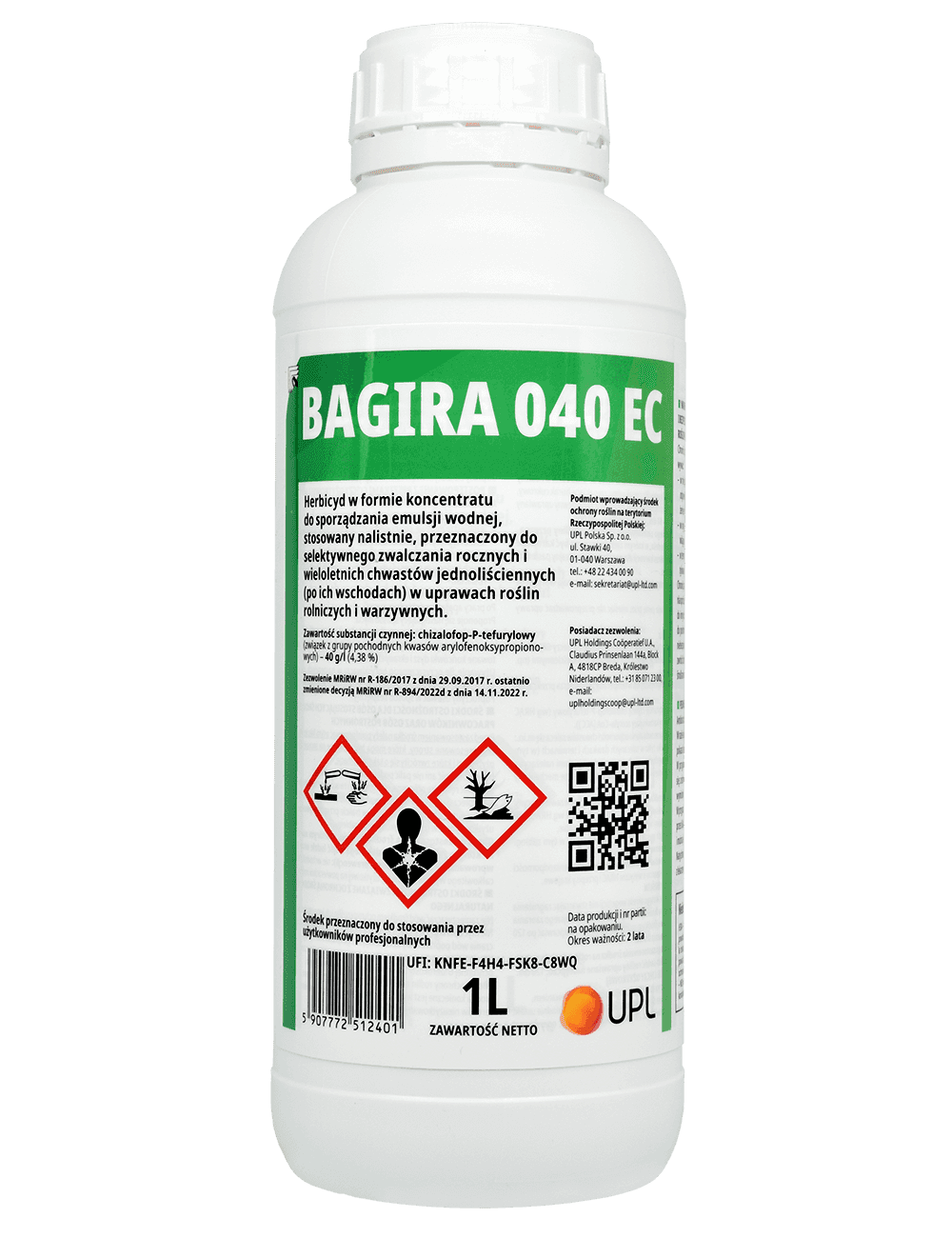
chizalofop-P-tefuryl (a compound from the aryloxyphenoxypropionic acid derivatives group) - 40 g/l (4.38 %)
Advantages of using PANTERA 040 EC:
- Excellent systemic action: The product quickly reaches the deepest roots and rhizomes, radically destroying, among others, the very troublesome couch grass.
- Rapid rainfastness: The product secures the effectiveness of the treatment – it is fully rainfast just 1 hour after application.
- Full weather flexibility: Low temperatures and lack of rainfall may slow symptoms but do not reduce the ultimate weed control efficacy at all.
Pre-harvest interval:
- Winter oilseed rape, spring oilseed rape, sugar beet, common fodder pea (field pea), common sowing pea (dry seeds) - 60 days
- Onion, carrot - 30 days
PANTERA 040 EC - SCOPE OF USE, TIMING AND DOSES:
Spectrum of controlled weeds:
- Complete crop range:
Sensitive weeds: grass weeds, volunteer cereals, couch grass, green foxtail, blue foxtail, redshank.
Resistant weeds: dicotyledonous plants.
Sugar beet
| Controlled pests: |
grass weeds |
| Maximum / recommended dose: |
0.8 - 1.5 l/ha (Maximum: 1.5 l/ha) |
| Controlled pests: |
couch grass |
| Maximum / recommended dose: |
1.5 - 2.0 l/ha (Maximum: 2.0 l/ha) |
| Application timing: |
From the formation of the first pair of leaves until the sugar beet covers no more than 50% of the inter-row space (BBCH 12-35). Control couch grass at the 4-6 leaf stage. Use lower doses for grass weeds before tillering, higher during and after. |
| Maximum number of treatments: |
1 |
| Recommended water volume: |
200 - 400 l/ha (medium droplet spraying) |
Winter oilseed rape
| Controlled pests: |
volunteer cereals |
| Maximum / recommended dose: |
0.6 - 1.0 l/ha (Maximum: 1.0 l/ha) |
| Controlled pests: |
couch grass |
| Maximum / recommended dose: |
1.5 - 2.0 l/ha (Maximum: 2.0 l/ha) |
| Application timing: |
In autumn (from the stage of at least the 1st pair of oilseed rape leaves - BBCH 12) or in spring (no later than the beginning of stem elongation - BBCH 30). Use the lower dose on volunteer cereals (2-4 leaf stage) in autumn. Couch grass at 4-6 leaf stage. |
| Maximum number of treatments: |
1 |
| Recommended water volume: |
200 - 400 l/ha (medium droplet spraying) |
Spring oilseed rape
| Controlled pests: |
couch grass |
| Maximum / recommended dose: |
1.5 - 2.0 l/ha (Maximum: 2.0 l/ha) |
| Application timing: |
In spring, no later than the beginning of stem elongation (BBCH 30). Treatment should be done when couch grass is at the 4-6 leaf stage. |
| Maximum number of treatments: |
1 |
| Recommended water volume: |
200 - 400 l/ha (medium droplet spraying) |
Common fodder pea, common sowing pea (dry seeds)
| Controlled pests: |
couch grass |
| Maximum / recommended dose: |
1.5 - 2.0 l/ha (Maximum: 2.0 l/ha) |
| Application timing: |
Not earlier than after the formation of the 2nd true leaf (BBCH 12) until the 4th leaf stage (BBCH 14). Treat couch grass at the 4-6 leaf stage. |
| Maximum number of treatments: |
1 |
| Recommended water volume: |
200 - 400 l/ha (medium droplet spraying) |
SMALL-AREA APPLICATIONS:
The responsibility for the effectiveness and phytotoxicity of the plant protection product used in small-area crops lies solely with its user.
Common fodder pea (field pea), common sowing pea (dry seeds)
| Controlled pests: |
grass weeds, green foxtail, blue foxtail, redshank |
| Maximum / recommended dose: |
0.8 - 1.5 l/ha (Maximum: 1.5 l/ha) |
| Application timing: |
Not earlier than after the formation of the 2nd true leaf of pea (BBCH 12) until the 4th leaf stage (BBCH 14). Lower dose (0.8-1.0) before weed tillering, higher during and after. |
| Maximum number of treatments: |
1 (total in the crop) |
| Recommended water volume: |
200 - 400 l/ha (medium droplet spraying) |
Onion
| Controlled pests: |
grass weeds, green foxtail, blue foxtail, redshank |
| Maximum / recommended dose: |
0.8 - 1.5 l/ha (Maximum: 1.5 l/ha) |
| Controlled pests: |
couch grass |
| Maximum / recommended dose: |
1.5 - 2.0 l/ha (Maximum: 2.0 l/ha) |
| Application timing: |
Treatment should be done at the 3-4 leaf stage of onion (BBCH 13-14). Couch grass at the 4-6 leaf stage. Lower dose for grass weeds before tillering. |
| Maximum number of treatments: |
1 |
| Recommended water volume: |
200 - 400 l/ha (medium droplet spraying) |
Carrot
| Controlled pests: |
grass weeds, green foxtail, blue foxtail, redshank |
| Maximum / recommended dose: |
0.8 - 1.5 l/ha (Maximum: 1.5 l/ha) |
| Controlled pests: |
couch grass |
| Maximum / recommended dose: |
1.5 - 2.0 l/ha (Maximum: 2.0 l/ha) |
| Application timing: |
Treatment should be done at the 2-3 leaf stage of carrot (BBCH 12-13). Couch grass at the 4-6 leaf stage. Lower dose for grass weeds before tillering. |
| Maximum number of treatments: |
1 |
| Recommended water volume: |
200 - 400 l/ha (medium droplet spraying) |
 SKU CH-15280