 SKU 40246-c
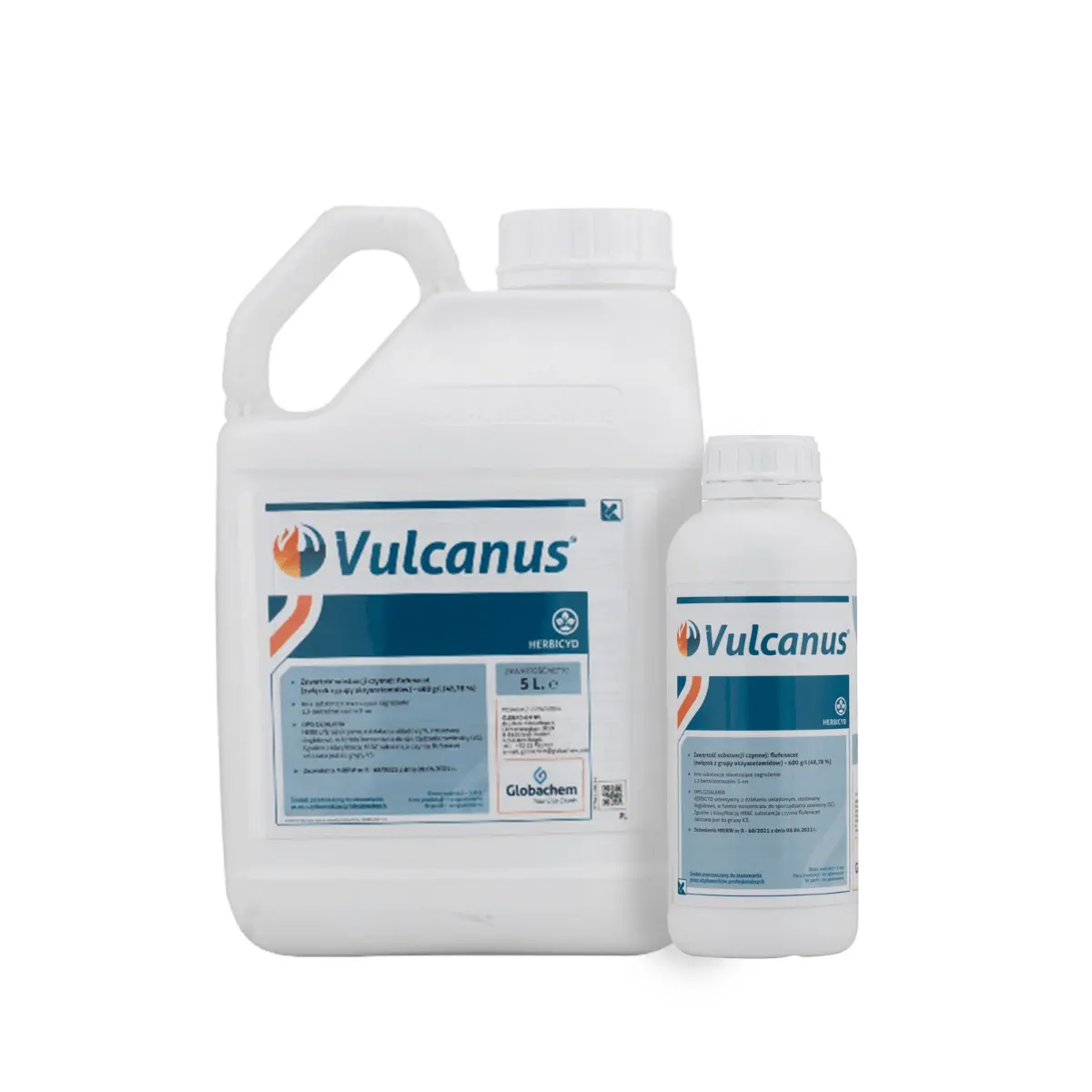
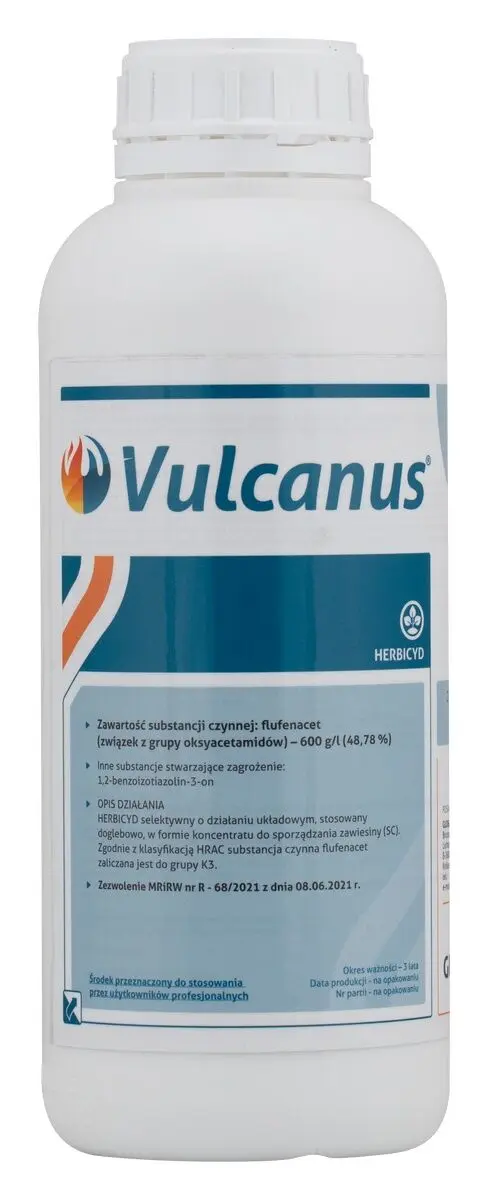
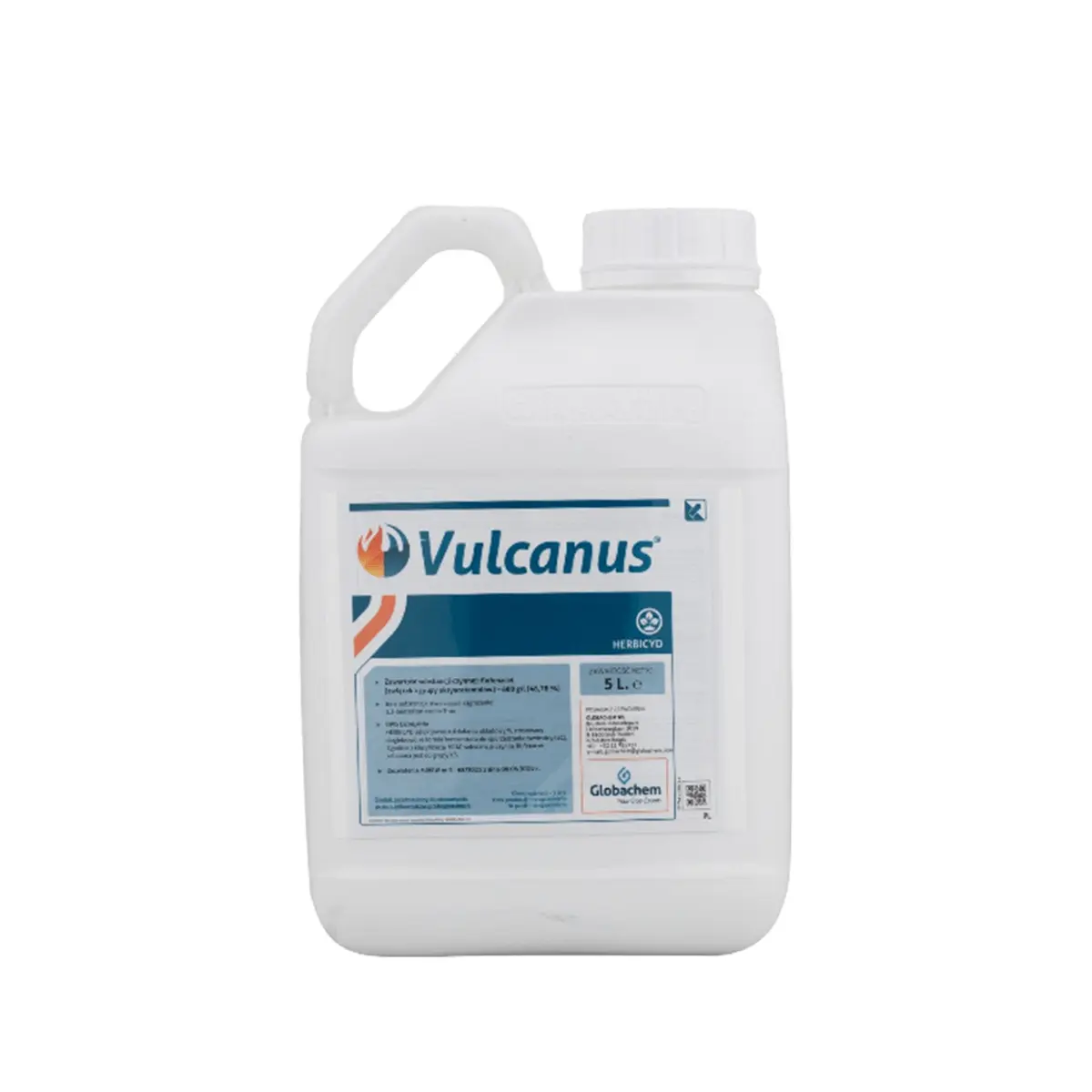
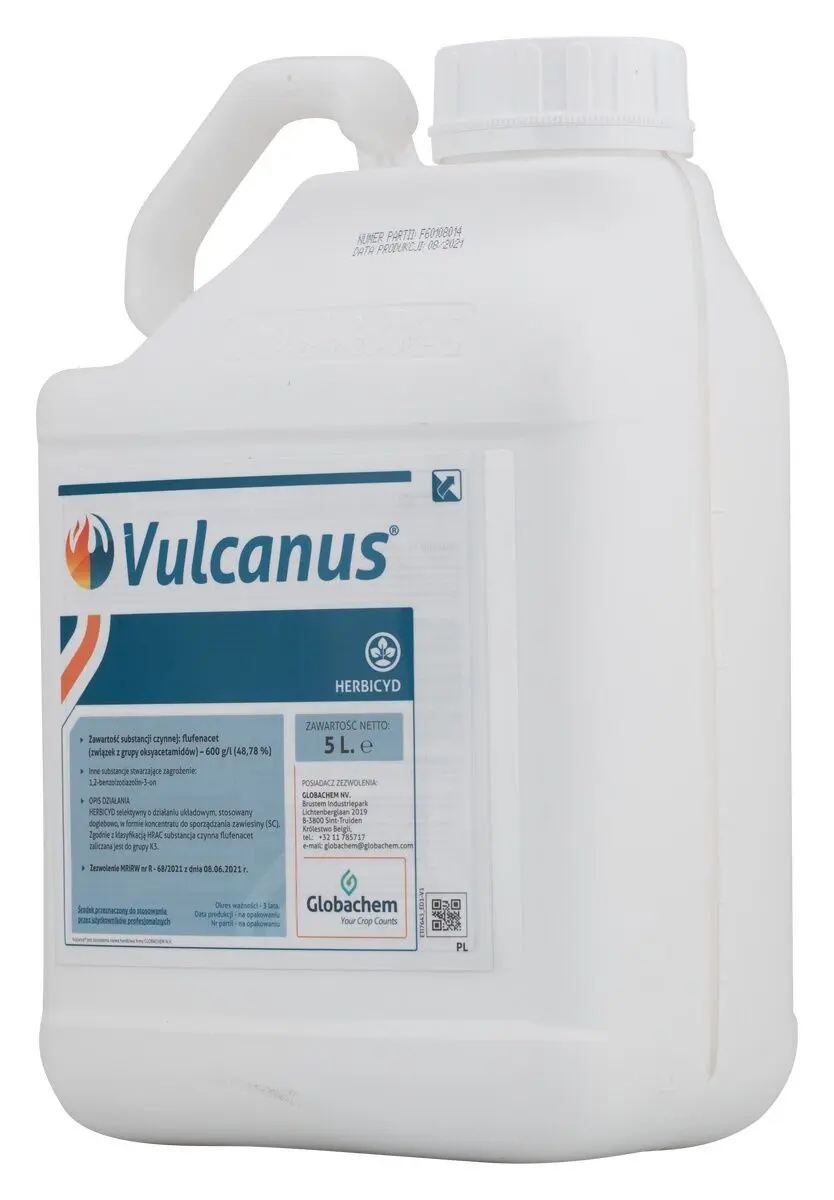
VULCANUS (flufenacet)
Vulcanus is a selective herbicide with systemic action, applied to the soil, in the form of a suspension concentrate. Intended for the control of weeds in winter cereals, used with field sprayers.
Description
Vulcanus is a selective herbicide with systemic action, applied to the soil, in the form of a suspension concentrate. Intended for the control of weeds in winter cereals. To achieve effective weed control after application, avoid performing agrotechnical treatments that disturb the topsoil layer.
The product is intended for use with field sprayers.
Vulcanus active substance content: flufenacet (compound from the oxyacetamide group) – 600 g/l (48.78%)
Vulcanus PRECAUTIONS, PRE-HARVEST INTERVALS AND SPECIAL CONDITIONS OF USE
Interval from last application to crop harvest (pre-harvest interval): Not required
- Do not mix Vulcanus with soil.
- Do not perform agrotechnical treatments that disturb the structure of the topsoil layer after application to avoid reducing herbicidal efficacy and prevent movement of the product to deeper soil layers.
- Cereal seeds must be covered with a 3 cm layer of soil.
- Resistance management strategy:
To minimise the risk of occurrence and development of weed resistance to herbicides, follow Good Agricultural Practice:
- strictly follow the instructions on the plant protection product label – use the product at the recommended dose and application timing to ensure optimal weed control,
- adapt the choice of herbicide and decision to apply based on the current (or potential) weed infestation, considering dominant species and damage thresholds,
- use herbicide rotation (active substances) with different modes of action,
- use mixtures of herbicides (active substances) with different modes of action,
- use in rotation and/or mixtures herbicides acting on several weed life processes (with different modes of action),
- use a herbicide with a given mode of action only once per crop growing season,
- adapt cultivation practices to field conditions, especially weed type and intensity,
- use various weed control methods, including crop rotation, etc.,
- use certified seed material,
- clean agricultural machinery to prevent transfer of weed propagules to other sites,
- inform the authorisation holder about unsatisfactory weed control,
- for detailed information, contact an advisor, the authorisation holder or their representative.
- Do not use the product:
- on waterlogged soils,
- in cereals with legume undersowing,
- on plants under stress, attacked by diseases or pests, or damaged by frost,
- during large daily temperature fluctuations, as temporary yellowing of plants may occur.
- During application, avoid:
- drift of spray liquid onto neighbouring crops,
- overlapping of spray liquid at the edges of treatment strips and headlands.
Vulcanus CROP SEQUENCE
The product does not pose a risk to succeeding crops.
If it is necessary to destroy a treated crop earlier due to frost damage, pests or diseases, after autumn ploughing the field, winter cereals can be sown immediately. Cultivation of dicotyledonous plants is possible only after ploughing to a depth of at least 20 cm.
Vulcanus PREPARATION OF SPRAY LIQUID
Prepare the spray liquid immediately before use.
Shake the contents of the package before use.
Before preparing the spray liquid, accurately determine the required volume and amount of product. When filling the sprayer, follow the sprayer manufacturer's instructions. If no instructions are available, add the measured amount of product to the sprayer tank partially filled with water (with the agitator on).
Rinse empty containers three times with water, pour the rinsate into the sprayer tank with the spray liquid, top up with water to the required volume and mix thoroughly. If the sprayer tank is not equipped with a hydraulic agitator, mechanically mix the liquid after adding the product.
In case of interruptions during spraying, mix the spray liquid thoroughly before resuming work.
DISPOSAL OF SPRAY LIQUID REMAINS
Spray liquid remains and water used for equipment cleaning should be:
- if possible, after prior dilution, used on the treated area, or
- disposed of using technical solutions ensuring biological degradation of active substances of plant protection products, or
- disposed of in another manner compliant with waste regulations.
After use, wash and rinse the equipment thoroughly with water at least three times.
Warning! Plant protection products must be used safely. Read the label and product information before each use.
The buyer declares that they meet the conditions specified in Article 25 paragraph 3 point 5 of the Act of 8 March 2013 on plant protection products and have training in the use of plant protection products in the case of products for professional users. Read the label and product information before each use. Pay attention to detailed risk indications. Follow safety rules contained on the label. Plant protection products may only be purchased by adults and persons who have completed training and have the qualifications required for persons purchasing plant protection products (Article 28 of the Act on plant protection products of 8 March 2013 as amended). Plant protection products must be used in a way that does not pose a threat to human health, animals or the environment. The buyer of plant protection products must be sober. By using this offer, you declare that you meet the above conditions.
Application and dosage
Crop | Target Pest Control | How to apply? Dosage | When to apply? |
|---|---|---|---|
winter wheat, winter barley, winter triticale, winter rye | brome grass, annual meadow-grass, blackgrass, ground ivy, cleavers | Maximum dose for single application: 0.4 l/ha.
| Apply after sowing but before cereal emergence, i.e. until the leaf sheath breaks through the soil surface (BBCH 00-09). |
winter wheat, winter barley, winter triticale, winter rye | brome grass, annual meadow-grass, cleavers, blackgrass | Maximum dose for single application: 0.4 l/ha.
| Apply from the stage when the first leaf emerges from the cereal leaf sheath (shooting) to the 3-leaf stage (BBCH 10-13) |