Butisan Duo X 6 + Comandor 20 HA
Professional herbicide package designed for oilseed rape cultivation, effectively controlling monocotyledonous and dicotyledonous weeds, directly supporting healthy plant growth and contributing to higher yields.
- Pack
- 5 l
Description
BUTISAN DUO + COMANDOR 20 HA HERBICIDE PACKAGE
The specialist herbicide package has been composed with the aim of effectively controlling monocotyledonous and dicotyledonous weeds in oilseed rape cultivation, which directly translates into healthier plants and higher yields.
The package intended for an area of 20 hectares contains:
- Butisan Duo 400 EC 5l - 6 pcs.
- Comandor 480 EC 5l - 1 pc.
How to use Butisan Duo 400 EC
Active substance content:
metazachlor (compound from the chloroacetanilide group) - 200 g/l (18.23%)
dimethenamid-P (compound from the acetamide group) - 200 g/l (18.23%)
Butisan Duo 400 EC is a herbicide in the form of a concentrate for preparing an aqueous emulsion. The product is applied to the soil or foliage to control annual monocotyledonous and dicotyledonous weeds.
The product is absorbed through the roots of germinating weeds and destroys them before emergence. It also acts on foliage up to the two true leaves stage of weeds.
The product is intended for use with self-propelled and tractor-mounted field sprayers. In ornamental plant nurseries, forest tree nurseries, and fruit tree nurseries, the product can also be applied using hand sprayers.
WINTER OILSEED RAPE:
Sensitive weeds: geranium pusillum, common chickweed, rough pigweed, cleavers, blackgrass, common chamomile, ivy-leaved speedwell, purple dead-nettle, scentless mayweed, Persian speedwell, shepherd's purse, field pennycress
Moderately sensitive weeds: field violet, white goosefoot (both species sensitive to the product when applied pre-emergence)
Resistant weeds: volunteer cereals
VEGETABLE CULTIVATION:
Sensitive weeds: common chickweed, scentless mayweed, cleavers, pale persicaria, field bindweed (Polygonum convolvulus), rough pigweed, shepherd's purse, field pennycress, small-flowered yellow-cress
Moderately sensitive weeds: annual grass, field violet, white goosefoot, nettle-leaved goosefoot
Resistant weeds: deeply rooted perennial weeds
Winter oilseed rape
Application timing: The product should be applied once per oilseed rape growing season, at one of the following timings:
a) directly after sowing oilseed rape, on carefully cultivated (clod-free) soil. Oilseed rape seeds should be sown at a uniform depth and thoroughly covered with soil.
Maximum dose for single application: 2.5 l/ha
Recommended dose for single application: 2.0 – 2.5 l/ha
b) post-emergence (autumn), when oilseed rape plants have at least one pair of leaves up to the 8 leaves developed stage (BBCH 12-18), and weeds are at the cotyledon to two-leaf stage.
Maximum dose for single application: 2.5 l/ha
Recommended dose for single application: 2.0 – 2.5 l/ha
Recommended water volume: 100 - 400 l/ha
Recommended spraying: medium droplet size
NOTES
1. When applying pre-emergence, to ensure safety for emerging oilseed rape plants, care should be taken to thoroughly cover seeds with soil.
2. After spraying the field, no cultivation treatments should be performed.
3. To achieve a high degree of weed control, optimal soil moisture is required. Application on dry soil will produce the desired effect only after rainfall.
4. Heavy rainfall after application may cause growth inhibition, thinning of the stand, or leaf deformation of oilseed rape, especially if low temperatures occur at that time. These symptoms are particularly visible when oilseed rape is grown on stony, light, and sandy soils, but they are temporary and do not affect overwintering or yield.
5. The lower recommended dose should be used on lighter soils, and the higher dose on heavier soils with high humus content and heavier weed infestation.
VEGETABLE CULTIVATION:
Leek from seedlings
Application timing: Apply the product after seedlings have established on weed-free soil or on germinating weeds up to the 2nd true leaf stage, or at the latest up to the 8 leaves stage of leek (BBCH 18), on germinating weeds up to the 2nd true leaf stage.
Maximum / recommended dose for single application: 2.5 l/ha
Recommended water volume: 100 - 400 l/ha
Recommended spraying: medium droplet size.
Maximum number of treatments per growing season: 1
Leek from sowing
Application timing: Apply the product after plant emergence, not earlier than after the flag leaf (jointing) stage, after the appearance of the first true leaf (BBCH 11) up to the 8 leaves stage of leek (BBCH 18), on weed-free soil or on germinating weeds up to the 2nd true leaf stage.
Maximum / recommended dose for single application: 2.5 l/ha
Recommended water volume: 100 - 400 l/ha
Recommended spraying: medium droplet size.
Maximum number of treatments per growing season: 1
Cauliflower from seedlings, broccoli from seedlings
Application timing: Apply the product after seedlings have established on weed-free soil or on germinating weeds up to the 2nd true leaf stage, or at the latest up to the 8 leaves stage of cauliflower or broccoli (BBCH 18), on germinating weeds up to the 2nd true leaf stage.
Maximum / recommended dose for single application: 2.5 l/ha
Recommended water volume: 100 - 400 l/ha
Recommended spraying: medium droplet size.
Maximum number of treatments per growing season: 1
Cauliflower from sowing, broccoli from sowing.
Application timing: Apply the product after plant emergence, in the phase from 2 to 8 leaves of cauliflower and broccoli (BBCH12-18), on weed-free soil or on germinating weeds up to the 2nd true leaf stage.
Maximum / recommended dose for single application: 2.5 l/ha
Recommended water volume: 100 - 400 l/ha
Recommended spraying: medium droplet size.
Maximum number of treatments per growing season: 1
Head cabbage from seedlings.
Application timing: Apply the product after seedlings have established on weed-free soil or on germinating weeds up to the 2nd true leaf stage of weeds, or at the latest up to the 8 leaves stage of cabbage (BBCH 18), on germinating weeds up to the 2nd true leaf stage.
Maximum / recommended dose for single application: 2.5 l/ha
Recommended water volume: 100 - 400 l/ha
Recommended spraying: medium droplet size.
Maximum number of treatments per growing season: 1
Head cabbage from sowing
Application timing: Apply the product after plant emergence, in the phase from 2 to 8 leaves of cabbage (BBCH12-18) on weed-free soil or on germinating weeds up to the 2nd true leaf stage.
Maximum / recommended dose for single application: 2.5 l/ha
Recommended water volume: 100 - 400 l/ha
Recommended spraying: medium droplet size.
Maximum number of treatments per growing season: 1
Kohlrabi from seedlings
Application timing: Apply the product after seedlings have established on weed-free soil or on germinating weeds up to the 2nd true leaf stage of weeds, or at the latest up to the 8 leaves stage of kohlrabi (BBCH 18), on germinating weeds up to the 2nd true leaf stage.
Maximum / recommended dose for single application: 2.5 l/ha
Recommended water volume: 100 - 400 l/ha
Recommended spraying: medium droplet size.
Maximum number of treatments per growing season: 1
Kale from seedlings
Application timing: Apply the product after seedlings have established on weed-free soil or on germinating weeds up to the 2nd true leaf stage of weeds, or at the latest up to the 8 leaves stage of kale (BBCH 18), on germinating weeds up to the 2nd true leaf stage.
Maximum / recommended dose for single application: 2.5 l/ha
Recommended water volume: 100 - 400 l/ha
Recommended spraying: medium droplet size.
Maximum number of treatments per growing season: 1
USE OF THE PLANT PROTECTION PRODUCT IN SMALL-SCALE CROPS AND APPLICATIONS
The user alone is responsible for the efficacy and phytotoxicity of the plant protection product used in small-scale crops.
Turnip from sowing, rutabaga from sowing
Application timing: Apply the product directly after sowing turnip and rutabaga before emergence on weed-free soil or on germinating weeds up to the 2nd true leaf stage.
Maximum / recommended dose for single application: 2.5 l/ha
Recommended water volume: 100 - 400 l/ha
Recommended spraying: medium droplet size.
Maximum number of treatments per growing season: 1
Ornamental plant nurseries, forest tree nurseries, fruit tree nurseries
Application timing: Apply the product throughout the growing season directly to weed-free soil or on germinating weeds up to the 2nd true leaf stage, avoiding spraying the crop plants.
Maximum / recommended dose for single application: 1.67 l/ha
Recommended water volume: 300 - 800 l/ha
Recommended spraying: medium droplet size
Maximum number of treatments per growing season: 1
How to use Comandor 480 EC
Active substance content:
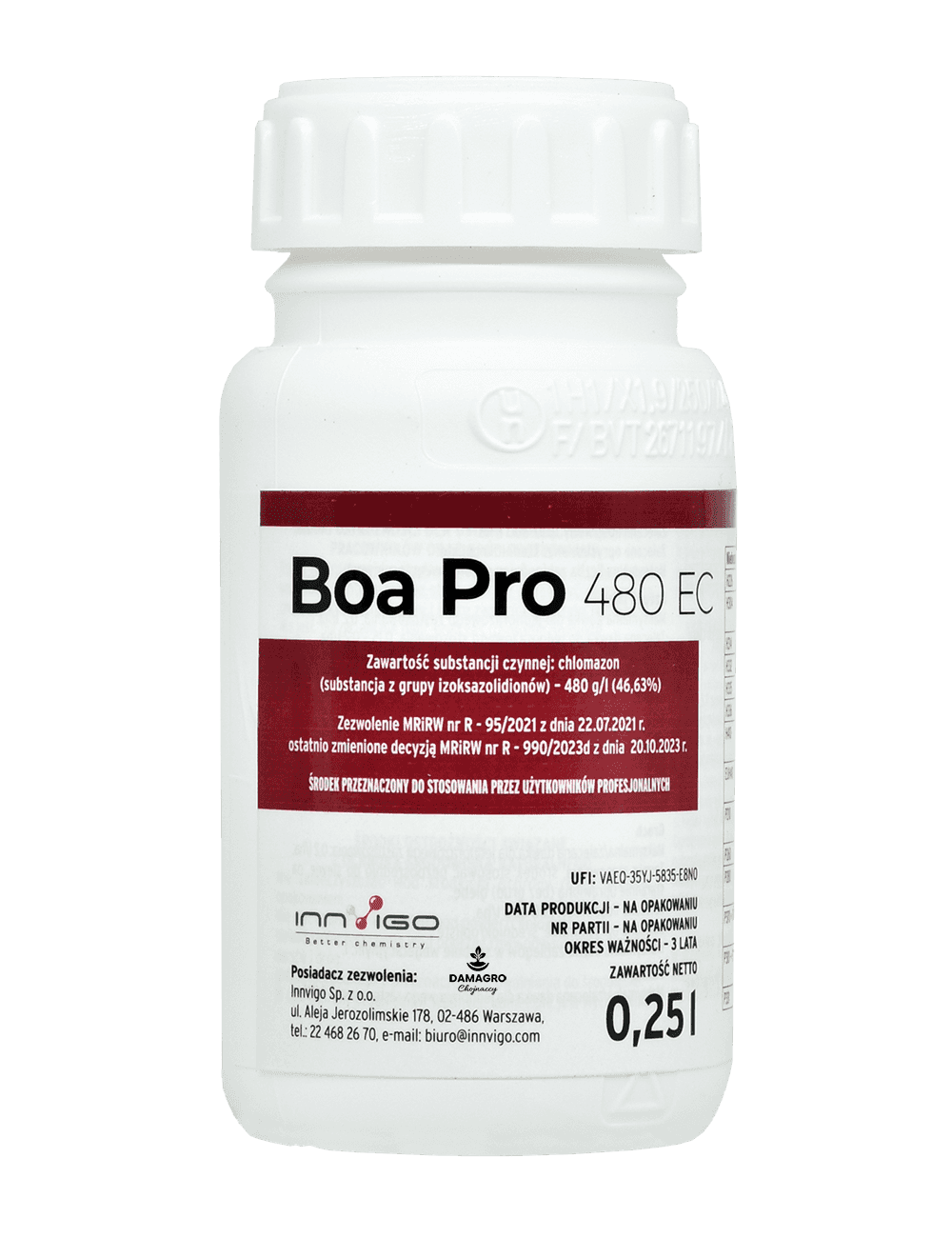
Chlomazon (compound from the isoxazolidinone group) – 480 g/l (47.3%)
Comandor 480 EC is a herbicide in the form of a concentrate for preparing an aqueous emulsion, applied to the soil, intended for controlling certain annual monocotyledonous and dicotyledonous weeds.
Comandor 480 EC is a selective, systemic herbicide absorbed by roots, causing inhibition of carotenoid synthesis. It acts on weeds during their germination. After application, sensitive plants do not emerge or bleach and dry out after emergence.
The product is intended for use with self-propelled or tractor-mounted field sprayers.
Single product application:
dose 0.2 l/ha:
| sensitive weeds | common chickweed, purple dead-nettle, cleavers, shepherd's purse, field pennycress |
| moderately sensitive weeds | field speedwell |
| resistant weeds | cornflower, field violet, white goosefoot, common poppy, scentless mayweed, Persian speedwell, volunteer cereals, small-flowered yellow-cress |
dose 0.25 l/ha:
| sensitive weeds | common chickweed, purple dead-nettle, cleavers, shepherd's purse, field pennycress |
| moderately sensitive weeds | white goosefoot, field speedwell |
| resistant weeds | cornflower, field violet, common poppy, scentless mayweed, Persian speedwell, volunteer cereals, small-flowered yellow-cress |
Application in mixture:
| sensitive weeds | common chickweed, purple dead-nettle, common poppy, scentless mayweed, field pennycress, Persian speedwell, cleavers |
| moderately sensitive weeds | cornflower |
| resistant weeds |
Winter oilseed rape
Maximum dose for single application: 0.25 l/ha.
Recommended dose for single application: 0.2-0.25 l/ha.
Application timing: Apply the product directly after sowing oilseed rape (BBCH 00 – 08) (maximum 5 days after sowing), on carefully cultivated (clod-free) soil. Oilseed rape seeds should be sown at a uniform depth and thoroughly covered with soil. Follow other recommendations ensuring proper preparation of plants for overwintering.
Maximum number of treatments per growing season: 1
Recommended water volume: 200 - 300 l/ha.
Recommended spraying: medium droplet size.
Combined use of Comandor 480 EC + Znachor 500 SC
Maximum / recommended dose for single application: 0.2 l/ha Comandor 480 EC + 1.6 l/ha Znachor 500 SC
Application timing: 3
Apply the product directly after sowing oilseed rape (maximum 5 days after sowing), on carefully cultivated (clod-free) soil. Oilseed rape seeds should be sown at a uniform depth and thoroughly covered with soil. Follow other recommendations ensuring proper preparation of plants for overwintering.
Maximum number of applications per growing season: 1.
Recommended water volume: 200 - 300 l/ha.
Recommended spraying: medium droplet size.