 SKU 33184-c
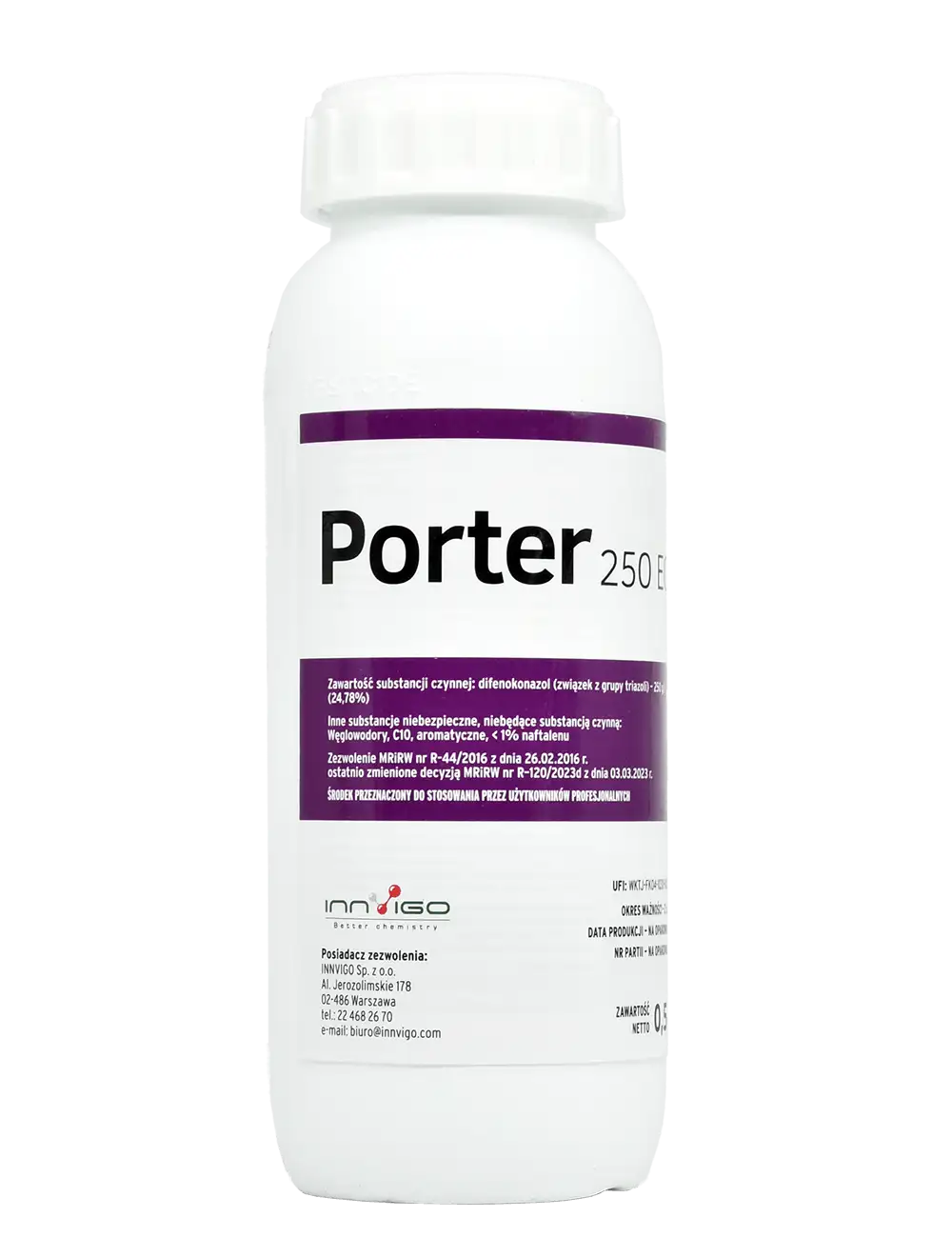
Hajmon 250 EC (difenoconazole) Synthos Agro - fungicide
Hajmon 250 EC Synthos Agro is a fungicide in the form of a concentrate for preparing an aqueous emulsion, with a broad spectrum of activity and systemic properties.
Description
Hajmon 250 EC Synthos Agro - fungicide
- Broad spectrum of activity - both in terms of crops and controlled diseases,
- In the form of an efficient concentrate,
- Suitable for preventive as well as curative use.
Hajmon 250 EC - fungicide in concentrate form for preparing an aqueous emulsion (EC). It exhibits systemic action - penetrates the plant and circulates with the sap, destroying fungi inside the plant. The product is intended for preventive and curative use in protection against fungal diseases.
The product is intended for use in agriculture and horticulture with self-propelled or tractor-mounted field sprayers, self-propelled or tractor-mounted orchard sprayers, or handheld sprayers.
Fungicide Hajmon 250 EC - active substance content:
- difenoconazole (a compound from the triazole group) - 250 g/l (23.64%).
Plant protection product Hajmon 250 EC - crop applications:
- Sugar beet
- Apple tree,
- Winter wheat,
- Winter triticale,
- Winter oilseed rape,
- Sour cherry,
- Potato.
Minor crops:
- Rutabaga,
- Beetroot,
- Horseradish,
- Sweet cherry,
- Pear tree,
- Carrot,
- Parsnip,
- Root parsley,
- Field-grown rose,
- Turnip,
- Radish,
- Salsify,
- Root celery,
- Jerusalem artichoke.
Fungicide Hajmon 250 EC Synthos Agro - controlled fungal diseases:
- Potato alternaria leaf spot (medium efficacy),
- Brown leaf spot (medium efficacy),
- Beet cercospora leaf spot,
- Blackleg of crucifers,
- Leaf spot of stone fruit trees,
- Powdery mildew of cereals and grasses,
- Apple scab,
- Brown rust,
- Leaf septoria (medium efficacy),
- Sclerotinia stem rot.
Also for minor crops:
- Alternaria leaf spot,
- Powdery mildew,
- Pear scab,
- Rust.
Hajmon 250 EC Synthos Agro - pre-harvest interval and safety period:
Pre-harvest interval - time from last application to harvest day:
- winter oilseed rape – 74 days,
- apple tree, sour cherry, pear tree, sweet cherry – 28 days,
- carrot, root parsley, root celery, parsnip, radish, horseradish, Jerusalem artichoke, salsify, turnip, rutabaga, beetroot – 14 days,
- winter wheat, winter triticale – 62 days,
- potato – 14 days,
- sugar beet – 35 days,
- field-grown rose – not applicable.
Feed pre-harvest interval - time from last application on plants intended for feed to the day animals can be fed with these plants:
- green parts of oilseed rape, carrot, parsley, root celery, parsnip, radish, horseradish, Jerusalem artichoke, salsify, turnip, rutabaga and beetroot treated with the product must not be used for feed purposes;
- winter wheat, winter triticale – 62 days;
- sugar beet – 35 days.
Safety period - time from application to when people and animals can enter the treated area:
- Do not enter until the spray liquid on the plant surfaces has completely dried.
Time from last application to sowing or planting of succeeding crops:
- If earlier destruction of the plantation is necessary, do not use products containing difenoconazole on succeeding crops in the same growing season in which the product was previously applied.
Hajmon 250 EC - preparation of spray liquid:
Before preparing the spray liquid, accurately determine the required amount. Pour the measured amount of product into the sprayer tank partially filled with water (with the agitator on). Rinse empty containers three times with water and pour rinsate into the sprayer tank with the spray liquid, then top up with water to the required volume. Spray with the agitator on. If the sprayer tank is not equipped with a hydraulic agitator, mechanically mix the liquid after adding the product. The product easily forms a suspension and does not require additional mixing in a separate vessel. In case of interruptions during spraying, thoroughly mix the spray liquid in the tank before resuming work.
Hajmon Synthos Agro - usage instructions:
- Do not use rose petals for food purposes.
- Use the product at air temperatures above 12°C.
- The product contains the active substance difenoconazole (a triazole compound, sterol biosynthesis inhibitor fungicide – demethylation inhibitor (SBI – DMI), FRAC group 3). As part of resistance management strategy, it is recommended to use the product:
– according to timing and doses specified on the label,
– alternately with fungicides containing active substances from other groups with different modes of action. - Do not eat, drink or smoke while using the product.
- Wear protective gloves, eye and face protection, and protective clothing against plant protection products during preparation and application.
- Wash hands thoroughly after use.
- Avoid inhaling sprayed liquid.
- Do not contaminate water with the plant protection product or its packaging. Do not wash equipment near surface waters. Avoid water contamination via drainage ditches from farms and roads.
- During flowering of apple and pear trees, apply the product outside periods of bee activity.
- For winter oilseed rape: To protect aquatic organisms, establish a buffer zone of 2 m from water bodies and watercourses or 1 m with simultaneous use of drift-reducing techniques reducing spray drift by 50%. To protect plants and non-target arthropods, establish a 1 m buffer zone from non-agricultural land.
- For apple tree, sour cherry, pear tree, sweet cherry, carrot, root parsley, root celery, parsnip, radish, horseradish, Jerusalem artichoke, salsify, turnip, rutabaga, beetroot and field-grown rose: To protect aquatic organisms, establish a buffer zone of 20 m from water bodies and watercourses or 15 m with simultaneous use of drift-reducing techniques reducing spray drift by 50%. To protect plants and non-target arthropods, establish a 10 m buffer zone from non-agricultural land.
- For winter wheat, winter triticale: To protect aquatic organisms, establish a grassed buffer zone of 3 m from water bodies and watercourses or a 1 m buffer zone with simultaneous use of drift-reducing techniques reducing spray drift by 50%. To protect plants and non-target arthropods, establish a 1 m buffer zone from non-agricultural land.
- For potato: To protect aquatic organisms, establish a grassed buffer zone of 1 m from water bodies and watercourses. To protect plants and non-target arthropods, establish a 1 m buffer zone from non-agricultural land.
- For sugar beet: To protect aquatic organisms, establish a 1 m buffer zone from water bodies and watercourses. To protect plants and non-target arthropods, establish a 1 m buffer zone from non-agricultural land.
- Keep out of reach of children.
- Store the plant protection product:
− in original packaging,
− in a way preventing contact with food, beverages or feed, environmental contamination and access by unauthorized persons,
− at temperatures between 0°C and 30°C. - Protect from moisture.
Warning! Use plant protection products safely. Read the label and product information before each use.
The buyer declares to meet the conditions specified in Article 25 paragraph 3 point 5 of the Act of 8 March 2013 on plant protection products and has training in the use of plant protection products in case of products for professional users. Read the label and product information before each use. Pay attention to detailed risk indications. Follow safety rules contained in the label. Plant protection products may only be purchased by adults and persons who have completed training and have qualifications required for persons purchasing plant protection products (Article 28 of the Act on plant protection products of 8 March 2013 as amended). Use plant protection products in a way that does not pose a threat to human health, animals or the environment. The buyer must be sober when purchasing plant protection products. By using this offer, you declare that you meet the above conditions.
Application and dosage
|
Crop |
Target Pest Control |
How to apply? Dosage |
When to apply? |
|---|---|---|---|
|
Winter oilseed rape |
Blackleg of crucifers, sclerotinia stem rot |
Maximum/recommended dose for single application: 0.5 l/ha. Recommended water volume: 300 l/ha. Recommended spraying: fine droplets. |
Apply preventively or at the first symptoms of disease, from the beginning of flowering to full flowering (approx. 50% flowers open) (BBCH 60-65). |
|
Apple tree |
Apple scab |
Maximum/recommended dose for single application: 0.2 l/ha. Recommended water volume: 600 l/ha. Recommended spraying: fine droplets |
Apply preventively every 10 - 14 days or curatively up to 120 hours after infection. Treatments from the beginning of pink flower bud stage to the end of the stage when fruits reach up to 20 mm (BBCH 57-72). |
|
Sour cherry |
Leaf spot of stone fruit trees |
Maximum/recommended dose for single application: 0.2 l/ha. Recommended water volume: 600 l/ha. |
Apply from the beginning of flower withering to the end of the stage when fruit reaches 80% of typical size (BBCH 71-78). |
|
Winter wheat |
Brown leaf spot (medium efficacy), powdery mildew of cereals and grasses, brown rust of wheat, leaf septoria (medium efficacy). |
Maximum/recommended dose for single application: 0.5 l/ha. Recommended water volume: 200-300 l/ha |
Apply preventively or immediately after first disease symptoms, from the 3rd node stage to full heading stage (50% inflorescence emerged) (BBCH 33-55). Apply no more than 1-2 times per season, with 14-21 days interval. If two treatments are needed, the first should be applied up to the beginning of flag leaf sheath swelling (early ear development) (BBCH 41), the second from 30% to full ear emergence (50%) (BBCH 53-55). Maximum number of treatments per growing season: 2. |
|
Winter triticale |
Powdery mildew of cereals and grasses, brown rust, leaf septoria (medium efficacy). |
Maximum/recommended dose for single application: 0.5 l/ha. Recommended water volume: 200-300 l/ha |
Apply preventively or immediately after first disease symptoms, from the 3rd node stage to full heading stage (50% inflorescence emerged) (BBCH 33-55). Apply no more than 1-2 times per season, with 14-21 days interval. If two treatments are needed, the first should be applied up to the beginning of flag leaf sheath swelling (early ear development) (BBCH 41), the second from 30% to full ear emergence (50%) (BBCH 53-55). Maximum number of treatments per growing season: 2. |
|
Potato |
Potato alternaria leaf spot (medium efficacy) |
Maximum dose for single application: 0.3 l/ha . Recommended water volume: 200-400 l/ha Recommended spraying: medium droplets. |
Apply preventively or immediately after first disease symptoms, from the stage when first single flower buds (1-2 mm) of the first inflorescence on the main stem are visible to the beginning of leaf yellowing (BBCH 51-91). Maximum number of treatments per growing season: 4 |
|
Sugar beet |
Beet cercospora leaf spot |
Maximum/recommended dose for single application: 0.4 l/ha. Recommended water volume: 200-300 l/ha |
Apply preventively or immediately after first disease symptoms, from the stage of beginning of row closure (leaves cover 10% of soil surface) to the stage when root reaches harvest size (BBCH 31-49). Recommended water volume: 200-300 l/ha Maximum number of treatments per growing season: 2. |
|
Pear tree (minor crops) |
Pear scab |
Maximum/recommended dose for single application: 0.2 l/ha. Recommended water volume: 600 l/ha. Recommended spraying: fine droplets |
Apply preventively every 10 - 14 days or curatively up to 120 hours after infection. Treatments from the beginning of white flower bud stage to the end of the stage when fruits reach up to 20 mm (BBCH 57-72). |
|
Sweet cherry (minor crops) |
Leaf spot of stone fruit trees |
Maximum/recommended dose for single application: 0.2 l/ha. Recommended water volume: 600 l/ha. |
Apply from the beginning of flower withering to the end of the stage when fruit reaches 80% of typical size (BBCH 71-78). |
|
Carrot, root parsley, root celery, parsnip, horseradish, radish (minor crops) |
Alternaria leaf spot, powdery mildew |
Maximum/recommended dose for single application: 0.5 l/ha. Recommended water volume: 300 l/ha. Recommended spraying: fine droplets. |
Apply preventively or after first disease symptoms, but no later than 14 days before harvest (BBCH 20 - 89). |
|
Jerusalem artichoke (minor crops) |
Sclerotinia stem rot |
Maximum/recommended dose for single application: 0.5 l/ha. Recommended water volume: 300 l/ha. Recommended spraying: fine droplets. |
Apply preventively or after first disease symptoms, but no later than 14 days before harvest (BBCH 20 - 89). |
|
Salsify (minor crops) |
Powdery mildew |
Maximum/recommended dose for single application: 0.5 l/ha. Recommended water volume: 300 l/ha. Recommended spraying: fine droplets. |
Apply preventively or after first disease symptoms, but no later than 14 days before harvest (BBCH 20 - 89). |
|
Turnip, rutabaga (minor crops) |
Alternaria leaf spot |
Maximum/recommended dose for single application: 0.5 l/ha. Recommended water volume: 300 l/ha. Recommended spraying: fine droplets. |
Apply preventively or after first disease symptoms, but no later than 14 days before harvest (BBCH 20 - 89). |
|
Beetroot (minor crops) |
Beet rust |
Maximum/recommended dose for single application: 0.5 l/ha. Recommended water volume: 300 l/ha. |
Apply preventively or after first disease symptoms, but no later than 14 days before harvest (BBCH 20 - 89). |
|
Field-grown rose |
Powdery mildew, rust |
Maximum/recommended dose for single application: 0.5 l/ha. Recommended water volume: 300 l/ha. Recommended spraying: fine droplets. |
Apply preventively or after first disease symptoms. |