 SKU CH-13365
Labrador Extra 50 EC
Labrador Extra 50 EC is a selective systemic herbicide in concentrate form for foliar application, effectively controlling post-emergence monocotyledonous weeds.
Description
MODE OF ACTION OF LABRADOR EXTRA 50EC :
Labrador Extra 50 EC is a selective systemic herbicide designed for post-emergence control of monocotyledonous weeds. The concentrate formulation for preparing a water emulsion ensures easy and precise foliar application. After absorption through the leaves, the product is transported to the roots and rhizomes of weeds, where it inhibits their growth and development, leading to gradual yellowing and drying of young leaves. The first effects of the herbicide are visible within about a week, and full effectiveness is revealed within 2-3 weeks, depending on weather conditions. Rainfall as soon as 3 hours after application does not reduce the effectiveness.
Labrador Extra 50 EC shows the highest effectiveness in controlling annual weeds from the two-leaf stage to the beginning of tillering and couch grass at the 4-6 leaf stage.
Advantages of using Labrador Extra 50EC:
- broad spectrum of action: effectively eliminates monocotyledonous weeds in a wide range of crops, including popular vegetables, oilseed rape, sugar beet, potatoes, and in small-scale crops.
- application flexibility: The possibility of use already in early developmental stages of crops and weeds ensures optimal timing of treatment.
- effective action: Selectively controls troublesome monocotyledonous weeds, including couch grass, blackgrass and barren brome, protecting crops.
- economical dosing: The ability to adjust the dose to the specific needs of the controlled weeds translates into more efficient use of the product.
- convenient form: The concentrate for preparing a water emulsion facilitates preparation of the working solution and application.
ACTIVE SUBSTANCE CONTENT IN LABRADOR EXTRA 50EC:
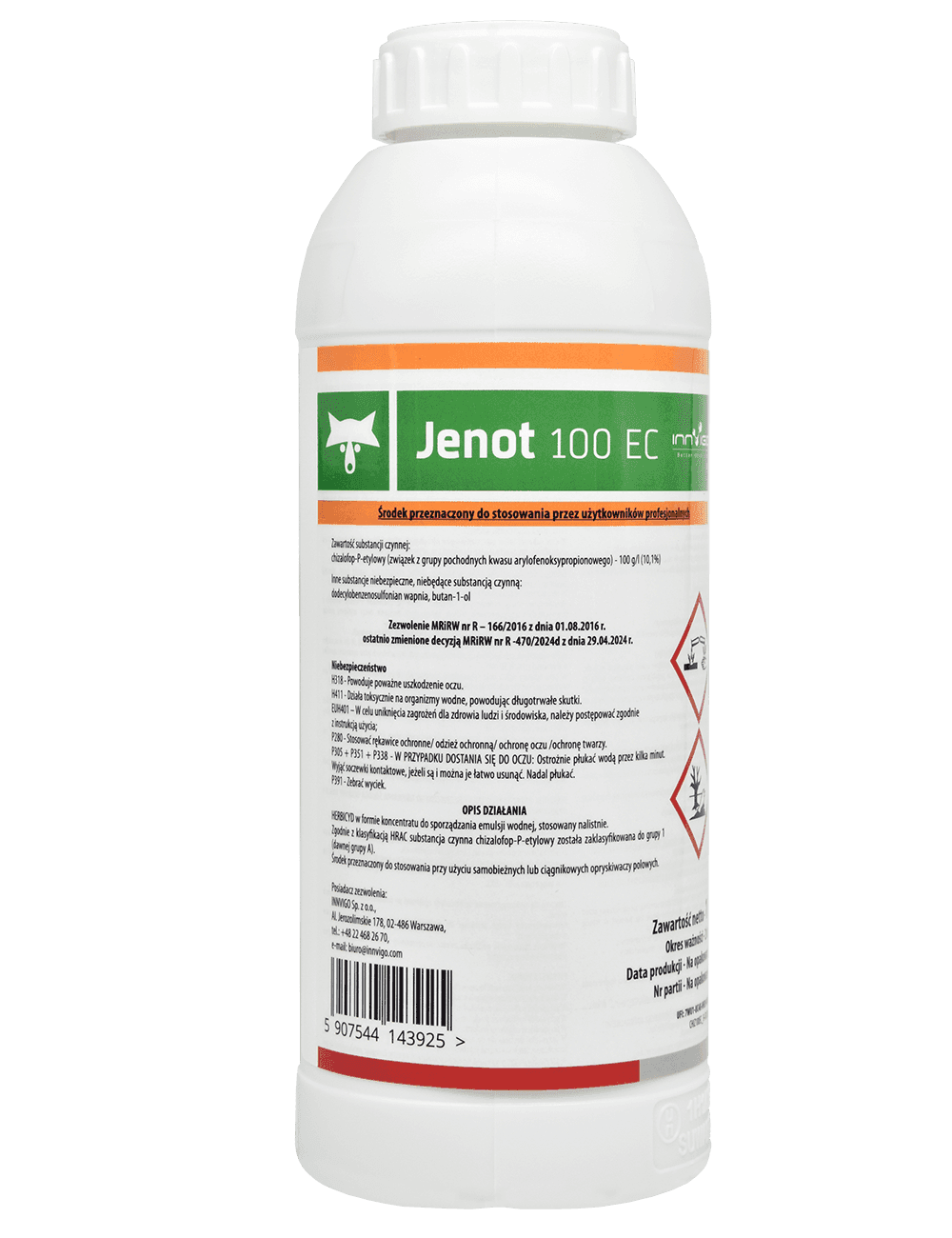
Chizalofop-p-ethyl (a compound from the aryloxyphenoxypropionic acid derivatives group) - 50 g/l (5.42%).
LABRADOR EXTRA 50EC SCOPE OF USE, TIMING AND DOSES:
The product is intended for use with self-propelled or tractor-mounted field sprayers.
Labrador Extra 500 EC - effect on weeds:
dose 0.75 l/ha:
Sensitive weeds: silky bent, blackgrass, sterile oat, volunteer cereals, common meadow-grass, slender meadow-grass, green foxtail.
Moderately resistant weeds: couch grass.
Resistant weeds: perennial ryegrass.
dose 1.5 l/ha:
Sensitive weeds: silky bent, blackgrass, sterile oat, volunteer cereals, common meadow-grass, slender meadow-grass, green foxtail, perennial ryegrass.
dose 2.0 l/ha:
Sensitive weeds: silky bent, blackgrass, sterile oat, couch grass, volunteer cereals, common meadow-grass, slender meadow-grass, green foxtail, perennial ryegrass.
How to use Labrador Extra 50EC:
Winter oilseed rape
Application timing:
- in autumn when oilseed rape has developed at least the first pair of leaves (BBCH 12)
or
- in spring, after the start of vegetation, but no later than the beginning of flower bud development ("green bud" stage) (up to BBCH 50).
Maximum dose for single application: 2.0 l/ha.
Recommended dose for single application: 0.75 - 2.0 l/ha.
Recommended water volume: 200-300 l/ha.
Recommended spraying: medium droplet size.
Maximum number of treatments per growing season: 1.
Sugar beet (production plantations)
Application timing:
Apply the product when sugar beet plants have developed the first pair of leaves until plants cover no more than 50% of the inter-row space (BBCH 12-35).
Maximum dose for single application: 2.0 l/ha.
Recommended dose for single application: 0.75 - 2.0 l/ha.
Recommended water volume: 200-300 l/ha.
Recommended spraying: medium droplet size.
Maximum number of treatments per growing season: 1.
Potato
Application timing:
Apply after potato emergence, after inter-row cultivation but before canopy closure (BBCH 20-34).
Maximum dose for single application: 2.0 l/ha.
Recommended dose for single application: 0.75 - 2.0 l/ha.
Recommended water volume: 200-300 l/ha.
Recommended spraying: medium droplet size.
Maximum number of treatments per growing season: 1.
USE OF THE PLANT PROTECTION PRODUCT IN SMALL-SCALE CROPS AND APPLICATIONS
The user alone is responsible for the effectiveness and phytotoxicity of the plant protection product used in small-scale crops.
Spring oilseed rape
Application timing:
Apply in spring from the 2-leaf stage to the beginning of flower bud development ("green bud" stage) (BBCH 12 - 50)
Maximum dose for single application: 2.0 l/ha.
Recommended dose for single application: 0.75 - 2.0 l/ha.
Recommended water volume: 200-300 l/ha.
Recommended spraying: medium droplet size.
Maximum number of treatments per growing season: 1.
Fodder beet
Application timing:
Apply when beet plants have developed the first pair of leaves until plants cover
no more than 50% of the inter-row space (BBCH 12-35).
Maximum dose for single application: 2.0 l/ha.
Recommended dose for single application: 0.75 - 2.0 l/ha.
Recommended water volume: 200-300 l/ha.
Recommended spraying: medium droplet size.
Maximum number of treatments per growing season: 1.
Strawberry
Application timing:
Apply:
– before flowering from the developed first leaf stage to the stage when most flowers with petals form a concave ball (BBCH 11-59)
or
– after fruit harvest, from the beginning of crown formation in leaf axils to the end of the stage when old leaves die off (BBCH 91 -97).
Maximum dose for single application: 2.0 l/ha.
Recommended dose for single application: 0.75 - 2.0 l/ha.
Recommended water volume: 200-300 l/ha.
Recommended spraying: medium droplet size.
Maximum number of treatments per growing season: 1.
Wild strawberry
Application timing: Apply after fruit harvest, from the beginning of crown formation in leaf axils to the end of the stage when old leaves die off (BBCH 91 -97)
Maximum dose for single application: 2.0 l/ha.
Recommended dose for single application: 0.75 - 2.0 l/ha.
Recommended water volume: 200-300 l/ha.
Recommended spraying: medium droplet size.
Maximum number of treatments per growing season: 1.
Onion grown from seed
Application timing: Apply from the stage of clearly visible 1st true leaf (> 3 cm) to the stage when 9 leaves are visible (BBCH 11-19).
Maximum dose for single application: 2.0 l/ha.
Recommended dose for single application: 0.75 - 2.0 l/ha.
Recommended water volume: 200-300 l/ha.
Recommended spraying: medium droplet size.
Maximum number of treatments per growing season: 1.
Carrot
Application timing: Apply from the developed 1st true leaf stage to the stage when the root is fully developed and reaches typical size and shape (BBCH 11-49)
Maximum dose for single application: 2.0 l/ha.
Recommended dose for single application: 0.75 - 2.0 l/ha.
Recommended water volume: 200-300 l/ha.
Recommended spraying: medium droplet size.
Maximum number of treatments per growing season: 1.
Celeriac, white turnip, black turnip, horseradish, red beet, edible rutabaga
Application timing: Apply from the 2nd true leaf stage to the 5th true leaf stage (BBCH 12-15).
Maximum dose for single application: 2.0 l/ha.
Recommended dose for single application: 0.75 - 2.0 l/ha.
Recommended water volume: 200-300 l/ha.
Recommended spraying: medium droplet size.
Maximum number of treatments per growing season: 1.
White headed cabbage, red headed cabbage
Application timing: Apply from the 4th true leaf stage to the 9th true leaf stage (BBCH 14-19).
Maximum dose for single application: 2.0 l/ha.
Recommended dose for single application: 0.75 - 2.0 l/ha.
Recommended water volume: 200-300 l/ha.
Recommended spraying: medium droplet size.
Maximum number of treatments per growing season: 1.
Green bean
Application timing: Apply from the developed 3rd true leaf stage (first trifoliate leaf) to the stage of visible first lateral shoot (BBCH 13-21).
Maximum dose for single application: 2.0 l/ha.
Recommended dose for single application: 0.75 - 2.0 l/ha.
Recommended water volume: 200-300 l/ha.
Recommended spraying: medium droplet size.
Maximum number of treatments per growing season: 1.
PRE-HARVEST INTERVAL:
Winter oilseed rape, spring oilseed rape – 60 days
Sugar beet, fodder beet – 110 days
Potato – 45 days
Strawberry (spray before flowering) – 40 days
Strawberry, wild strawberry (spray after flowering) – not applicable
Carrot, green bean – 40 days
Onion grown from seed – 42 days
White headed cabbage, red headed cabbage – 87 days
Celeriac, white turnip, black turnip, horseradish, red beet, edible rutabaga – 56 days