 SKU 28583-c
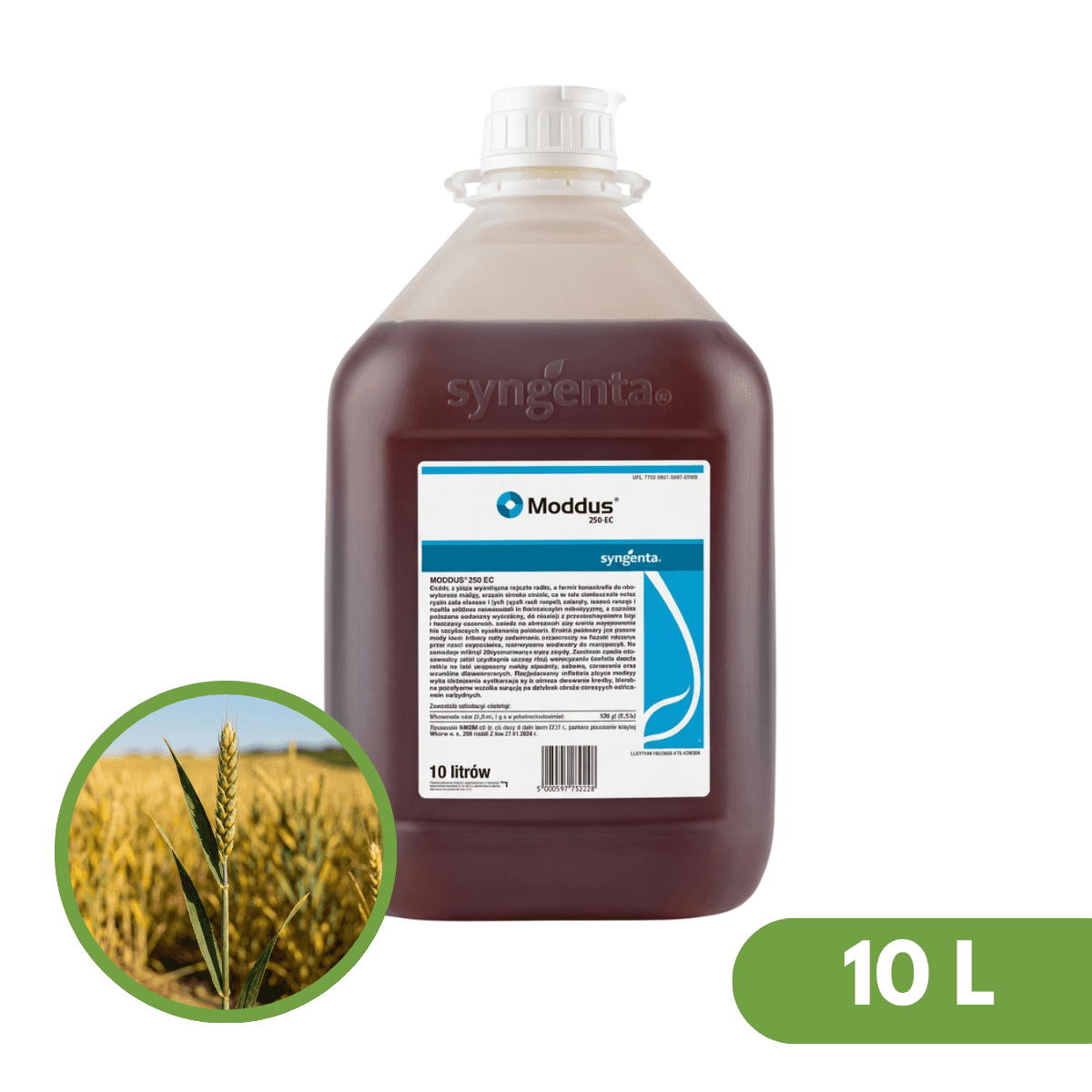
Moddus Start 250 DC (trinexapac-ethyl) Syngenta - growth regulator
Moddus Start 250 DC Syngenta - cereal growth regulator Moddus Start 250 DC is a plant protection product from the group of growth regulators, used in the cultivation of cereals such as winter wheat, winter barley, spring barley, winter rye, spring rye and winter triticale.
Description
Moddus Start 250 DC Syngenta - cereal growth regulator
- Effectively shortens and regulates cereal growth - enables early cereal regulation treatments (BBCH 25-29) and cereal shortening performed at the standard timing (BBCH 30-32).
- Dedicated action - for use in the cultivation of cereals such as: winter wheat, winter barley, spring barley, winter rye, spring rye and winter triticale.
- Protects cereals from lodging.
- Allows to maintain yield.
- Excellent performance even at low temperatures (from 5-10°C).
- Greater leaf coverage and more efficient use of the active substance.
- Safe plant development with the best growth regulation effect.
- Compatible for mixing with cereal herbicides.
Moddus Start 250 DC is a plant protection product from the group of growth regulators. It is available as a dispersible concentrate (DC). The product is used to prevent lodging of winter wheat, winter and spring barley, winter and spring rye, and winter triticale grown under intensive technologies.
The product is intended for use with self-propelled or tractor-mounted field sprayers.
Moddus Start - mode of action:
The product is mainly absorbed through the leaves and stems of cereals and then transported to meristematic tissues, preventing excessive elongation of internodes. Shortening and stiffening of cereal stems prevents lodging. It does not reduce root length or plant mass.
Growth regulator for cereals Moddus Start 250 DC Syngenta - active substance content:
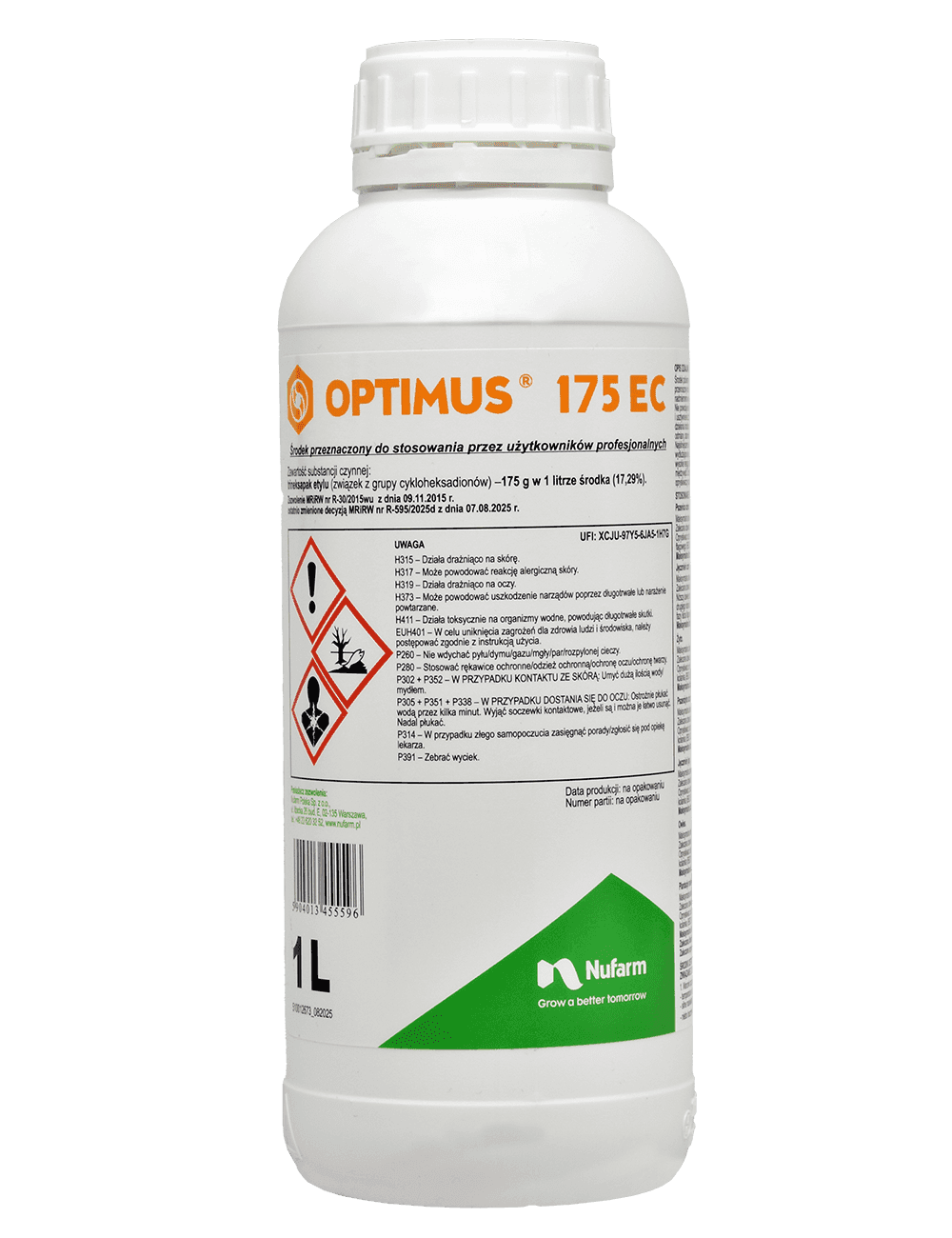
- Trinexapac-ethyl (a compound from the cyclohexanedione group) – 250 g/l (24.2%).
Moddus Start 250 DC - application in crops:
Agricultural crops:
- Spring barley,
- Winter barley,
- Winter wheat,
- Winter triticale,
- Spring rye,
- Winter rye.
Moddus Start 250 DC Syngenta - pre-harvest interval, re-entry period, crop rotation:
Pre-harvest interval - time from the last application of the product to the day of crop harvest:
- Not applicable.
Pre-harvest interval for fodder - time from the last application on plants intended for fodder to the day when animals can be fed with these plants:
- Not applicable.
Re-entry period - time from product application until people and animals can enter the treated area:
- Do not enter until the spray liquid on the plant surfaces is completely dry.
Time from last application on plants to the day when succeeding crops can be sown or planted:
- Not applicable.
Cereal growth regulator Moddus Start - preparation of spray liquid:
Before preparing the spray liquid, accurately determine the required amount. Pour the measured amount of product into the sprayer tank partially filled with water (with the agitator on) and fill up with water to the required volume. Spray with the agitator on. If the sprayer tank is not equipped with a hydraulic agitator, mechanically mix the liquid in the tank after adding the product. The product easily forms a suspension and does not require additional mixing in a separate container. Rinse empty packaging three times with water and pour the rinsate into the sprayer tank with the spray liquid. In case of interruptions during spraying, thoroughly mix the spray liquid in the sprayer tank before resuming work.
Plant protection product Moddus Start 250 DC Syngenta - usage instructions:
- Conditions favourable for product activity are temperatures around 10-15°C, strong sunlight, clear or slightly cloudy sky, dry and actively growing crop.
- Do not apply Moddus Start 250 DC:
− on plants affected by adverse environmental factors such as excessive soil moisture, frost, drought, diseases or pests;
− on poorly growing plants, e.g. during prolonged drought, heat or insufficient fertilisation. - During application, avoid:
− spray drift onto neighbouring crop plantations,
− overlapping spray liquid on treatment strip edges and headlands. - Keep out of reach of children.
- Store the plant protection product:
− in places or facilities with appropriate measures to prevent environmental contamination and access by unauthorised persons,
− in original packaging, preventing contact with food, beverages or fodder,
− in a dry, cool, well-ventilated place, at temperatures between 0°C and 30°C.
Warning! Use plant protection products safely. Read the label and product information before each use.
The buyer declares that they meet the conditions specified in Article 25 paragraph 3 point 5 of the Act of 8 March 2013 on plant protection products and have received training in the use of plant protection products in the case of products for professional users. Read the label and product information before each use. Pay attention to detailed risk indications. Follow safety rules contained on the label. Plant protection products may only be purchased by adults and persons who have completed training and hold the qualifications required for persons purchasing plant protection products (Article 28 of the Act on plant protection products of 8 March 2013, as amended). Plant protection products must be used in a way that does not pose a risk to human health, animals or the environment. The buyer of plant protection products must be sober. By using this offer, you declare that you meet the above conditions.
Application and dosage
|
Crop |
How to apply? Dosage |
When to apply? |
|---|---|---|
|
Winter wheat |
Maximum / recommended dose for single application: 0.3 l/ha Recommended water volume: 100-400 l/ha Recommended spraying: medium droplet Maximum number of treatments per growing season: 1 |
Application timing: Apply from tillering stage to flag leaf stage (flag leaf fully developed) (BBCH 25 – 39). |
|
Winter barley |
Maximum / recommended dose for single application: 0.6 l/ha Recommended water volume: 100-400 l/ha Recommended spraying: medium droplet Maximum number of treatments per growing season: 1 |
Application timing: Apply from end of tillering to end of ear development in leaf sheath (first awns visible) (BBCH 29 – 49). |
|
Spring barley |
Maximum / recommended dose for single application: 0.6 l/ha Recommended water volume: 100-400 l/ha Recommended spraying: medium droplet Maximum number of treatments per growing season: 1 |
Application timing: Apply from end of tillering to end of ear development in leaf sheath (first awns visible) (BBCH 29 – 49). |
|
Winter triticale |
Maximum / recommended dose for single application: 0.5 l/ha Recommended water volume: 100-400 l/ha Recommended spraying: medium droplet Maximum number of treatments per growing season: 1 |
Application timing: Apply from tillering to end of ear development in leaf sheath (first awns visible) (BBCH 25– 49). |
|
Winter rye |
Maximum / recommended dose for single application: 0.5 l/ha Recommended water volume: 100-400 l/ha Recommended spraying: medium droplet Maximum number of treatments per growing season: 1 |
Application timing: Apply from tillering to end of ear development in leaf sheath (first awns visible) (BBCH 25– 49). |
|
Spring rye |
Maximum / recommended dose for single application: 0.5 l/ha Recommended water volume: 100-400 l/ha Recommended spraying: medium droplet Maximum number of treatments per growing season: 1 |
Application timing: Apply from tillering to end of ear development in leaf sheath (first awns visible) (BBCH 25– 49). |