 SKU 44275
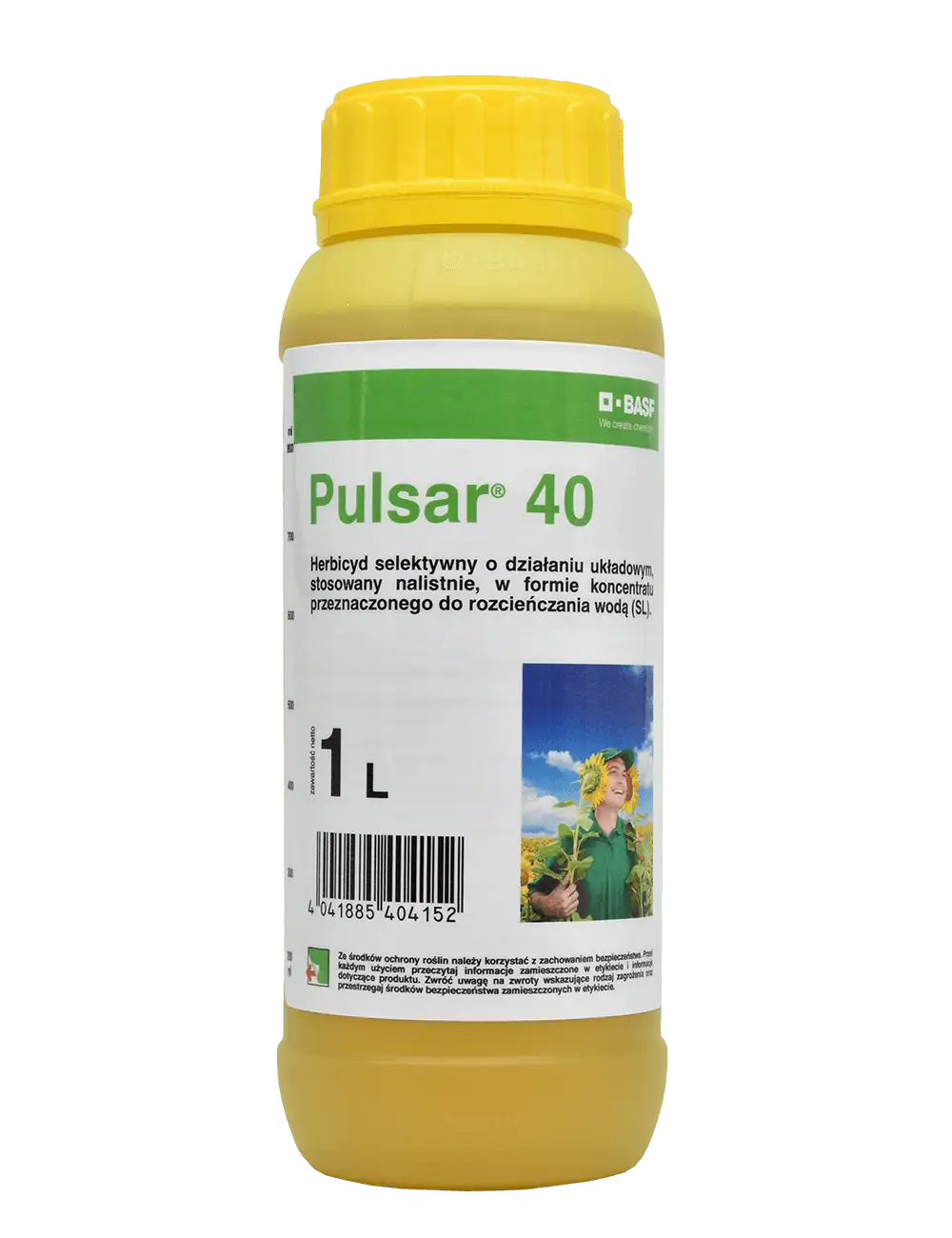
Pulsar 40 5l (imazamox) BASF - herbicide
Pulsar 40 BASF is a selective systemic herbicide dedicated to the control of monocotyledonous and dicotyledonous weeds. Intended for use in soybean cultivation and limited use in sunflower cultivation.
Currently unavailable
Sold only to professional users with a certificate of competence.
Description
Pulsar 40 BASF - herbicide
- Effectively controls monocotyledonous and dicotyledonous weeds.
- Dedicated action - for use in soybean cultivation and limited use in sunflower cultivation.
- In a convenient and efficient concentrate form intended for dilution with water.
Pulsar 40 BASF is a selective systemic herbicide, applied to leaves, in concentrate form intended for dilution with water (SL).
The product is intended for use with self-propelled or tractor-mounted field sprayers.
Pulsar 40 BASF - mode of action:
The product contains imazamox, an active substance from the acetolactate synthase (ALS) inhibitor group, which is the first enzyme in the biosynthesis pathway of essential amino acids for plants: valine, leucine, and isoleucine. Inhibition of ALS activity leads to a lack of essential amino acids. This inhibits cell division in meristematic tissues, resulting in strong growth and development suppression of weeds and their gradual death. The product is mainly absorbed through weed leaves. It most effectively destroys dicotyledonous weeds at the 2-4 leaf stage and monocotyledonous weeds at the 1-3 leaf stage.
Pulsar 40 BASF herbicide - active substance content:
- Imazamox (compound from the imidazolinone group) 40 g/l (3.7%).
According to HRAC classification, the active substance imazamox belongs to group 2 (formerly group B).
Pulsar 40 BASF - controlled weeds, dose 1.0 l/ha:
Sensitive weeds:
- jimsonweed, one-sided foxtail, annual woundwort, white mustard, common chickweed, purple deadnettle, pink deadnettle, common lambsquarters, largeleaf lambsquarters, manyseed lambsquarters, field pansy, scentless mayweed, redshank, black nightshade, cleavers, pale smartweed, bird's knotweed, common chamomile, wild radish, volunteer oilseed rape, rough amaranth, shepherd's purse, field pennycress, prostrate spurge, green foxtail, common mallow, small-flowered yellowcress.
Moderately sensitive weeds:
- jimsonweed, one-sided foxtail, annual woundwort, white mustard, common chickweed, purple deadnettle, pink deadnettle, common lambsquarters, largeleaf lambsquarters, manyseed lambsquarters, field pansy, scentless mayweed, redshank, black nightshade, cleavers, pale smartweed, bird's knotweed, common chamomile, wild radish, volunteer oilseed rape, rough amaranth, shepherd's purse, field pennycress, prostrate spurge, green foxtail, common mallow, small-flowered yellowcress.
Moderately resistant weeds:
- common ragwort.
Resistant weeds:
- field violet, field bindweed, field thistle, volunteer oilseed rape CL (Clearfield) varieties.
Pulsar 40 BASF - controlled weeds, dose 1.25 l/ha:
Sensitive weeds:
- jimsonweed, one-sided foxtail, annual woundwort, white mustard, common chickweed, purple deadnettle, pink deadnettle, hedge mustard, common lambsquarters, largeleaf lambsquarters, manyseed lambsquarters, field pansy, scentless mayweed, oats (wild oats), redshank, field bindweed, cleavers, black nightshade, pale smartweed, bird's knotweed, common chamomile, wild radish, volunteer oilseed rape, rough amaranth, annual mercury, shepherd's purse, field pennycress, prostrate spurge, green foxtail, common mallow, small-flowered yellowcress.
Moderately sensitive weeds:
- common ragweed, southern hibiscus, spiny sow-thistle, field sow-thistle, field thistle, bindweed knotweed, many-flowered ryegrass.
Moderately resistant weeds:
- field violet.
Resistant weeds:
- volunteer oilseed rape CL (Clearfield) varieties.
Pulsar 40 BASF herbicide - use in crops:
Agricultural crops:
- Soybean.
In limited use:
- Common sunflower – imazamox-tolerant varieties.
Pulsar 40 BASF herbicide - pre-harvest interval and safety period:
Pre-harvest interval - period from the last application of the product to the day of crop harvest:
- Soybean, common sunflower - not required.
Safety period - period from product application to the day when people and animals may enter the treated area:
- Do not enter until the spray liquid has completely dried on the plant surfaces.
Pulsar 40 BASF herbicide - crop rotation:
The product decomposes during the plant growing season without posing a threat to subsequently cultivated crops. If early destruction of the crop is necessary, leguminous plants can be grown on the treated field immediately after crop destruction. Maize can be grown 20 days after application followed by deep ploughing or after 60 days if shallow soil cultivation was performed. Cereals can be grown after 30 days and deep ploughing or after 60 days if shallow soil cultivation was performed. Brassica crops can be grown 60 days after application if deep soil cultivation was performed or after 100 days if shallow cultivation was used. Sunflower (conventional varieties - not tolerant to imazamox) can be grown 60 days after application if deep soil cultivation was performed or after 120 days if shallow cultivation was used. Sugar beet, being very sensitive to imazamox, can be grown 100 days after application and after deep soil cultivation. In the case of shallow soil cultivation, the period from application to beet sowing should be extended to 140 days.
Pulsar 40 BASF herbicide - preparation of spray liquid:
Prepare the spray liquid immediately before use. Before preparation, accurately determine the required amount. Pour the measured amount of product into the sprayer tank partially filled with water (with the agitator on). Rinse empty containers three times with water and pour the rinsate into the sprayer tank with the spray liquid, top up with water to the required volume and mix thoroughly. After adding the product to a sprayer tank without a hydraulic agitator, mechanically mix the liquid in the tank. In case of interruptions during spraying, mix the spray liquid thoroughly before resuming work.
Pulsar 40 BASF plant protection product - usage instructions:
- The product used in limited area applications may also control other weed species than those listed on the label. However, this has not been unequivocally confirmed by research. Therefore, for detailed information on the spectrum of controlled weeds and their sensitivity to the product used in limited area applications, it is recommended to contact the authorisation holder or their representative.
- Do not use products containing the active substance imazamox more frequently than once every three years on the same area.
- Keep out of reach of children.
- Store the plant protection product:
− in original packaging,
− in a way preventing contact with food, beverages or feed, environmental contamination, and access by unauthorized persons,
− at a temperature of 5°C - 30°C. - Keep locked.
Warning! Plant protection products must be used safely. Read the label and product information before each use.
The buyer declares that they meet the conditions specified in Article 25 paragraph 3 point 5 of the Act of 8 March 2013 on plant protection products and have training in the use of plant protection products in the case of products for professional users. Read the label and product information before each use. Pay attention to detailed risk indications. Follow the safety rules contained on the label. Plant protection products may only be purchased by adults and persons who have completed training and have the qualifications required for persons purchasing plant protection products (Article 28 of the Act on plant protection products of 8 March 2013 with amendments). Plant protection products must be used in a way that does not pose a threat to human health, animals, or the environment. The buyer of plant protection products must be sober. By using this offer, you declare that you meet the above conditions.
Application and dosage
|
Crop |
Target Pest Control |
How to apply? Dosage |
When to apply? |
|---|---|---|---|
|
Soybean |
jimsonweed, one-sided foxtail, annual woundwort, white mustard, common chickweed, purple deadnettle, pink deadnettle, hedge mustard, common lambsquarters, largeleaf lambsquarters, manyseed lambsquarters, field pansy, scentless mayweed, oats (wild oats), redshank, field bindweed, cleavers, black nightshade, pale smartweed, bird's knotweed, common chamomile, wild radish, volunteer oilseed rape, rough amaranth, annual mercury, shepherd's purse, field pennycress, prostrate spurge, green foxtail, common mallow, small-flowered yellowcress, common ragweed, southern hibiscus, spiny sow-thistle, field sow-thistle, field thistle, bindweed knotweed, many-flowered ryegrass. |
Maximum single application dose: 1.25 l/ha Recommended single application dose: 1.0 - 1.25 l/ha Recommended water volume: 100 - 400 l/ha Recommended spraying: medium droplet. Maximum number of treatments per growing season: 1 WARNING: Do not use products containing the active substance imazamox more frequently than once every three years on the same area. |
Application timing: apply after soybean emergence, from the stage when the trifoliate leaf on the second node is developed to the stage when the trifoliate leaf on the sixth node is developed (BBCH 12-16). |
|
Common sunflower – imazamox-tolerant varieties - limited use |
jimsonweed, one-sided foxtail, annual woundwort, white mustard, common chickweed, purple deadnettle, pink deadnettle, hedge mustard, common lambsquarters, largeleaf lambsquarters, manyseed lambsquarters, field pansy, scentless mayweed, oats (wild oats), redshank, field bindweed, cleavers, black nightshade, pale smartweed, bird's knotweed, common chamomile, wild radish, volunteer oilseed rape, rough amaranth, annual mercury, shepherd's purse, field pennycress, prostrate spurge, green foxtail, common mallow, small-flowered yellowcress, common ragweed, southern hibiscus, spiny sow-thistle, field sow-thistle, field thistle, bindweed knotweed, many-flowered ryegrass. |
Maximum/recommended single application dose: 1.25 l/ha. Recommended water volume: 100-300 l/ha. Recommended spraying: medium droplet. Maximum number of treatments per growing season: 1. WARNING: Do not use products containing the active substance imazamox more frequently than once every three years on the same area. |
Application timing: post-emergence from the stage when the first pair of leaves is developed to the 6-leaf stage (BBCH 12-16). |