SKU 11601
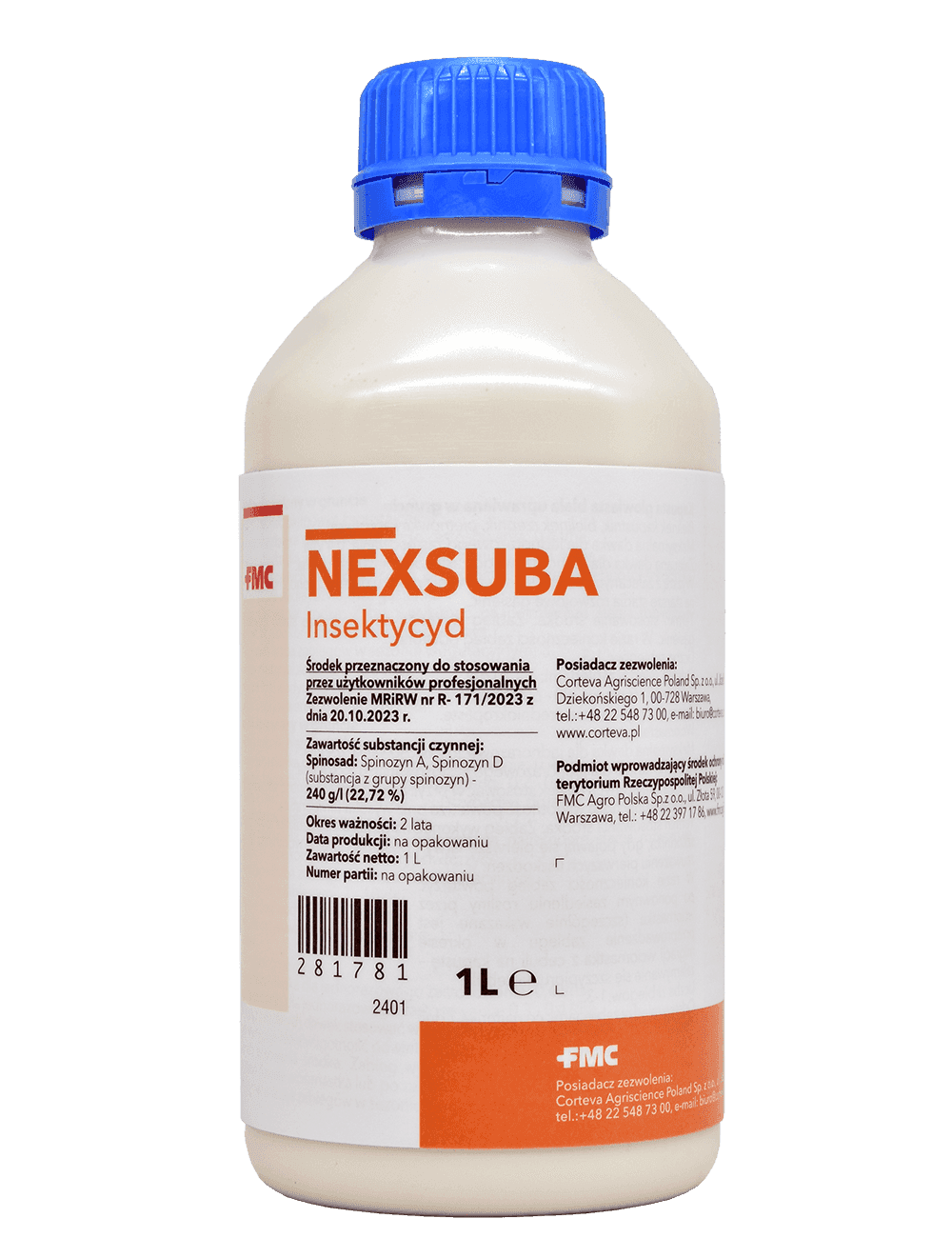
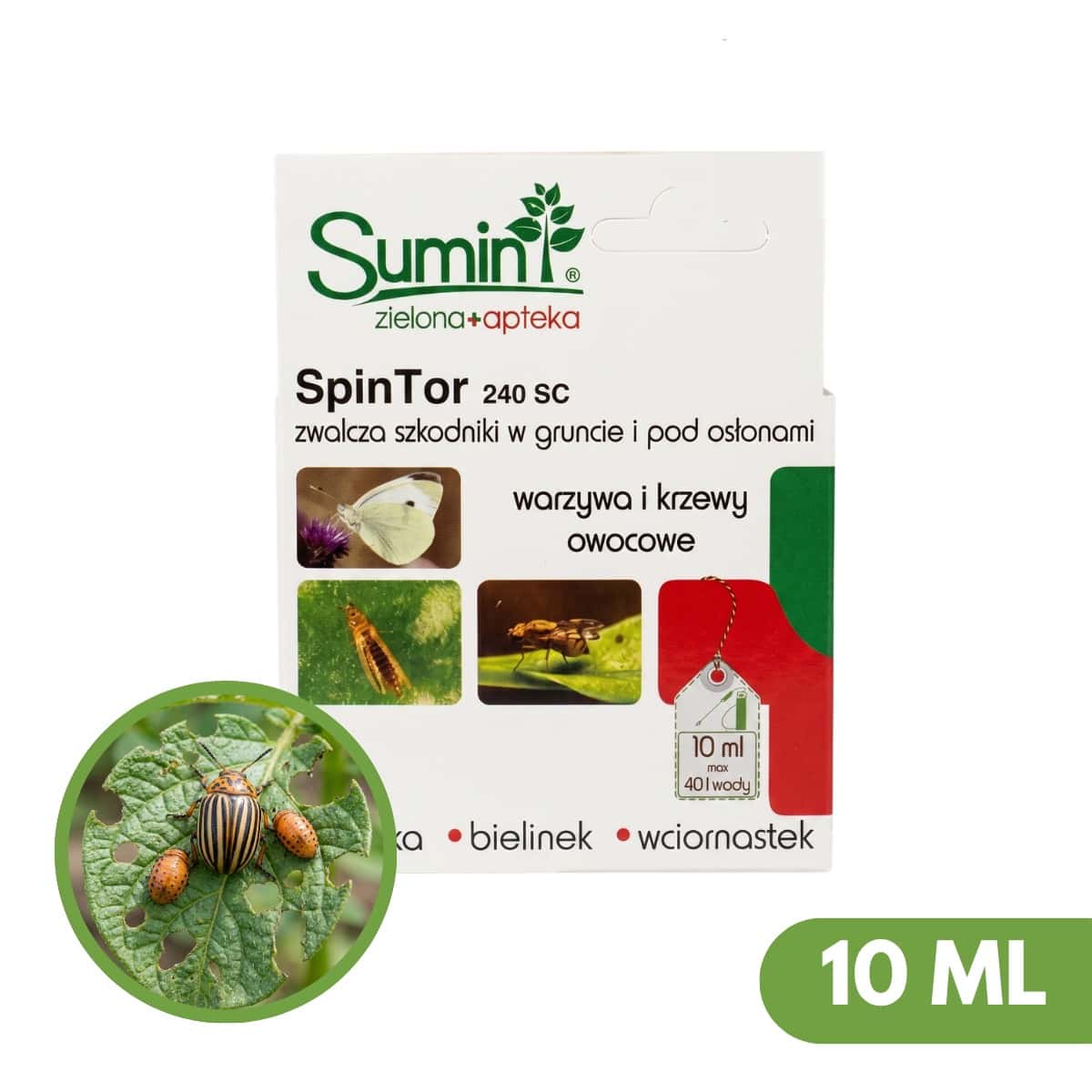
Spintor 240 SC 250 ml (Spinosad) - insecticide
Spintor 240 SC is an insecticide in concentrate form (concentrated suspension), intended for preparing a water suspension. It acts contact, stomach and ovicidal, mainly on young leaves. It is obtained by bacterial fermentation.
Currently unavailable
Sold only to professional users with a certificate of competence.
Description
Spintor 240 SC
is a insecticide in concentrate form as a concentrated suspension for preparing a water suspension, with contact, stomach and ovicidal action, intended for the control of certain chewing pests in the recesses. The recess action applies only to young leaves.
The product is obtained by bacterial fermentation. The biologically active substance acts on the insect's nerve cells, leading to paralysis and then death of the pests.
Symptoms of the product's action appear within several minutes after treatment, pest death occurs after a few hours.
Content of active substance
Spinosad: Spinosyn A, Spinosyn D (substance from the spinosyn group) - 240 g/l (22.72%)
Which insects does Spintor 240 SC control
- Colorado potato beetle larva
- cabbage white butterfly
- cabbage moth
- diamondback moth
- tobacco thrips
- cabbage white butterfly
- diamondback moth
- tobacco thrips
- western flower thrips
- and others (in crops and small-scale applications)
Warning! Plant protection products must be used with safety precautions. Before each use, read the information on the label and product information.
The buyer declares that they meet the conditions specified in Article 25 paragraph 3 point 5 of the Act of 8 March 2013 on plant protection products and have training in the use of plant protection products in the case of products for professional users. Before each use, read the information on the label and product information. Attention should be paid to detailed risk indications. Safety rules contained in the label must be followed. Plant protection products may only be purchased by adults and persons who have completed training and have the qualifications required for persons purchasing plant protection products (Article 28 of the Act on plant protection products of 8 March 2013 as amended). Plant protection products should be used in such a way as not to pose a threat to human health, animals or the environment. The buyer of plant protection products must be sober. By using this offer, you declare that you meet the above conditions.
Application and dosage
|
Crop |
Pest control |
How to apply? Dosage |
When to apply? |
|---|---|---|---|
|
head lettuce, romaine lettuce, leaf lettuce (curly lettuce) grown in the field |
thrips, warm-loving leaf miner, nightshade leaf miner, polyphagous leaf miner, vegetable leaf beetle, diamondback moth |
Maximum/recommended dose for single application: 4.0 ml/100m2 Maximum number of treatments per growing season: 3. |
Apply from eight true leaves until heads reach typical size and firmness or plants not forming heads reach typical leaf mass (BBCH 18-49). Perform treatment at the beginning of pest colonisation or after first damage is noticed. Repeat treatment if necessary. |
|
celeriac grown in the field, celery grown under cover |
celery leaf miner |
Maximum/recommended dose for single application: 4.0 ml/100m2 Maximum number of treatments per growing season: 3. |
Application timing: – Celeriac – apply from the stage when the root reaches 40% of typical diameter until root reaches typical size and shape (BBCH 44-49); – Celery – apply from 40% leaf mass until 100% leaf mass typical for the variety (BBCH 44-49). Perform treatment at the beginning of pest colonisation or after first damage is noticed. Repeat treatment if necessary. |
|
kale grown in the field, kohlrabi grown in the field |
cabbage white butterfly, cabbage moth, diamondback moth |
Maximum/recommended dose for single application: 0.4 l/ha. Maximum number of treatments per growing season: 3. |
Apply from eight true leaves until plants reach typical size, shape and leaf mass (BBCH 18-49). Perform treatment at the beginning of pest colonisation or after first damage is noticed. Repeat treatment if necessary. |
|
rocket grown in the field, lamb's lettuce grown in the field |
warm-loving leaf miner, nightshade leaf miner, polyphagous leaf miner |
Maximum/recommended dose for single application: 0.4 l/ha. |
Apply from eight true leaves until plants reach typical size, shape and leaf mass (BBCH 18-35). Perform treatment at the beginning of pest colonisation or after first damage is noticed. Repeat treatment if necessary. |
|
chives grown in the field |
thrips |
Maximum/recommended dose for single application: 0.4 l/ha. |
Apply from the thickening of leaf bases to the beginning of flower stalk formation BBCH (40-47). Perform treatment when first thrips larvae and adults appear or after first damage is noticed. |
|
garlic, shallot grown in the field |
thrips |
Maximum/recommended dose for single application: 0.4 l/ha. |
Apply from the thickening of leaf bases to the beginning of flower stalk formation BBCH (40-47). Perform treatment when first thrips larvae and adults appear or after first damage is noticed. |
|
vegetable plants grown for young leaves in the field |
thrips, warm-loving leaf miner, nightshade leaf miner, polyphagous leaf miner, vegetable leaf beetle, diamondback moth, cabbage white butterfly, cabbage white butterfly, beet fly |
Maximum/recommended dose for single application: 0.4 l/ha. |
Apply from 3 to 8 leaves stage (BBCH 13-18). Treat the youngest pest developmental stages. Perform treatment at the beginning of pest colonisation or after first damage is noticed. Repeat treatment if necessary. |
|
spinach grown in the field, sorrel grown in the field |
beet fly, warm-loving leaf miner, nightshade leaf miner, polyphagous leaf miner, vegetable leaf beetle, diamondback moth, cabbage white butterfly, cabbage white butterfly |
Maximum dose for single application: 0.4 l/ha. |
Apply from eight true leaves until plants reach typical size, shape and leaf mass (BBCH 18-49). Perform treatment at the beginning of pest colonisation or after first damage is noticed. Repeat treatment if necessary. |
|
eggplant grown under cover and in greenhouse, sweet pepper grown under cover and in greenhouse, tomato grown under cover and in greenhouse |
tomato leafminer, thrips, warm-loving leaf miner, nightshade leaf miner, polyphagous leaf miner |
Maximum/recommended dose for single application: 4.0 ml/100m2 Number of treatments: 3. |
Apply at the beginning of pest colonisation or after first damage is noticed, from the beginning of flowering to the stage when 70% of fruits reach typical colour (BBCH 61-71). Repeat treatment if necessary. |
|
highbush blueberry, strawberry, gooseberry, raspberry, blackberry, black currant, red currant, white currant, cranberry |
spotted wing drosophila (Drosophila suzukii), western flower thrips, beech leafroller, netted leafroller, pink leafroller |
Maximum dose for single application: 4.0 ml/100 m2 sprayed area. Maximum number of treatments per growing season: 2. |
Apply from the stage of visible (still closed) first flower buds before flowering of the crop plants (BBCH 51-59) or after flowering until the end of fruit ripening phase observing the pre-harvest interval (BBCH 70-89). Perform treatment when adults and first larvae appear or after first damage is noticed. Repeat treatment if necessary. |
|
pear tree |
netted leafroller, winter moth |
Maximum/recommended dose for single application: 6.0 ml/100 m2 Number of treatments: 1. |
Apply during leaf and inflorescence development, before flowering of trees (<BBCH 59). |
|
pear tree |
netted leafroller |
Maximum/recommended dose for single application: 6.0 ml/100 m2 Number of treatments: 2. |
Apply after flowering of trees (>BBCH 70). |
|
potato |
Colorado potato beetle larvae |
Maximum dose for single application: 1.5 ml/100 m2 sprayed area. Use the higher recommended dose in case of high pest population, for older larval stages and in case of lush potato foliage. Maximum number of treatments per growing season: 3. |
Apply to the youngest larval stages. Repeat treatment if necessary. |
|
white head cabbage grown in the field |
cabbage white butterfly, cabbage white butterfly, diamondback moth |
Maximum dose for single application: 4.0 ml/100 m2 sprayed area |
Apply to the youngest caterpillar stages. Repeat treatment if necessary. |
|
white head cabbage grown in the field |
tobacco thrips |
Maximum dose for single application: 4.0 ml/100 m2 sprayed area. Number of treatments: 1-3. |
Apply at the beginning of pest colonisation, when first thrips larvae and adults appear or after first damage is noticed. Repeat treatment after re-colonisation by thrips (especially recommended during thrips migration from onion to cabbage – bending of onion leaves). |
|
cauliflower grown in the field |
cabbage white butterfly, diamondback moth |
Maximum dose for single application: 4.0 ml/100 m2 sprayed area. |
Apply to the youngest caterpillar stages. Repeat treatment if necessary. |
|
broccoli grown in the field |
diamondback moth, cabbage white butterfly |
Maximum dose for single application: 4.0 ml/100 m2 sprayed area |
Apply to the youngest caterpillar stages. Repeat treatment if necessary. |
|
onion |
tobacco thrips |
Maximum dose for single application: 4.0 ml/100 m2 sprayed area |
Apply when first thrips larvae and adults appear or after first damage is noticed. |
|
leek |
tobacco thrips |
Maximum dose for single application: 4.0 ml/100 m2 sprayed area. |
Apply when first thrips larvae and adults appear or after first damage is noticed. |
|
grown under cover, cucumber grown under cover |
western flower thrips |
Maximum dose for single application: 0.04% (2 ml product in 5 litres of water). Maximum number of treatments per growing season: 4. |
Apply when adults appear. Repeat treatment if necessary. |
|
cucumber grown under cover |
western flower thrips |
Maximum dose for single application: 0.04% (2 ml product in 5 litres of water) |
Apply when adults appear. Repeat treatment if necessary. |