 SKU 44295-c
ASX Calcium Chelate - calcium fertiliser with micronutrients
ASX Calcium Chelate is a calcium fertiliser with micronutrients, intended for vegetable, orchard and agricultural crops.
Description
ASX Calcium Chelate - fertiliser supplying calcium and micronutrients
- Calcium fertiliser for vegetable, orchard and agricultural crops,
- Competitive price and low cost of treatment per hectare,
- Excellent compatibility with plant protection products and foliar fertilisers - chelation at 100%,
- The fertiliser is not hygroscopic, does not cake,
- Dissolves well,
- Calcium chelation in ASX Calcium Chelate fertiliser allows greater possibilities for combined use of calcium fertilisers with pesticides.
ASX Calcium Chelate is a calcium fertiliser with nutritional micronutrients. Calcium as well as copper, iron, zinc and manganese are chelated with biodegradable IDHA chelate. Thanks to this, the product is biodegradable, environmentally safe, stable in aqueous solutions and characterised by high efficiency in plant nutrition. The fertiliser is perfectly compatible with plant protection products and foliar fertilisers. ASX Calcium Chelate is recommended for fertilisation of agricultural crops, vegetables and orchard crops. In orchard crops, it fits perfectly into programmes for improving fruit quality during growth. It is an excellent complement to other calcium fertilisers.
ASX Calcium Chelate fertiliser has been tested for compatibility with plant protection products. Solutions are stable over time. Calcium does not precipitate.
ASX Calcium Chelate - composition and parameters:
Parameters:
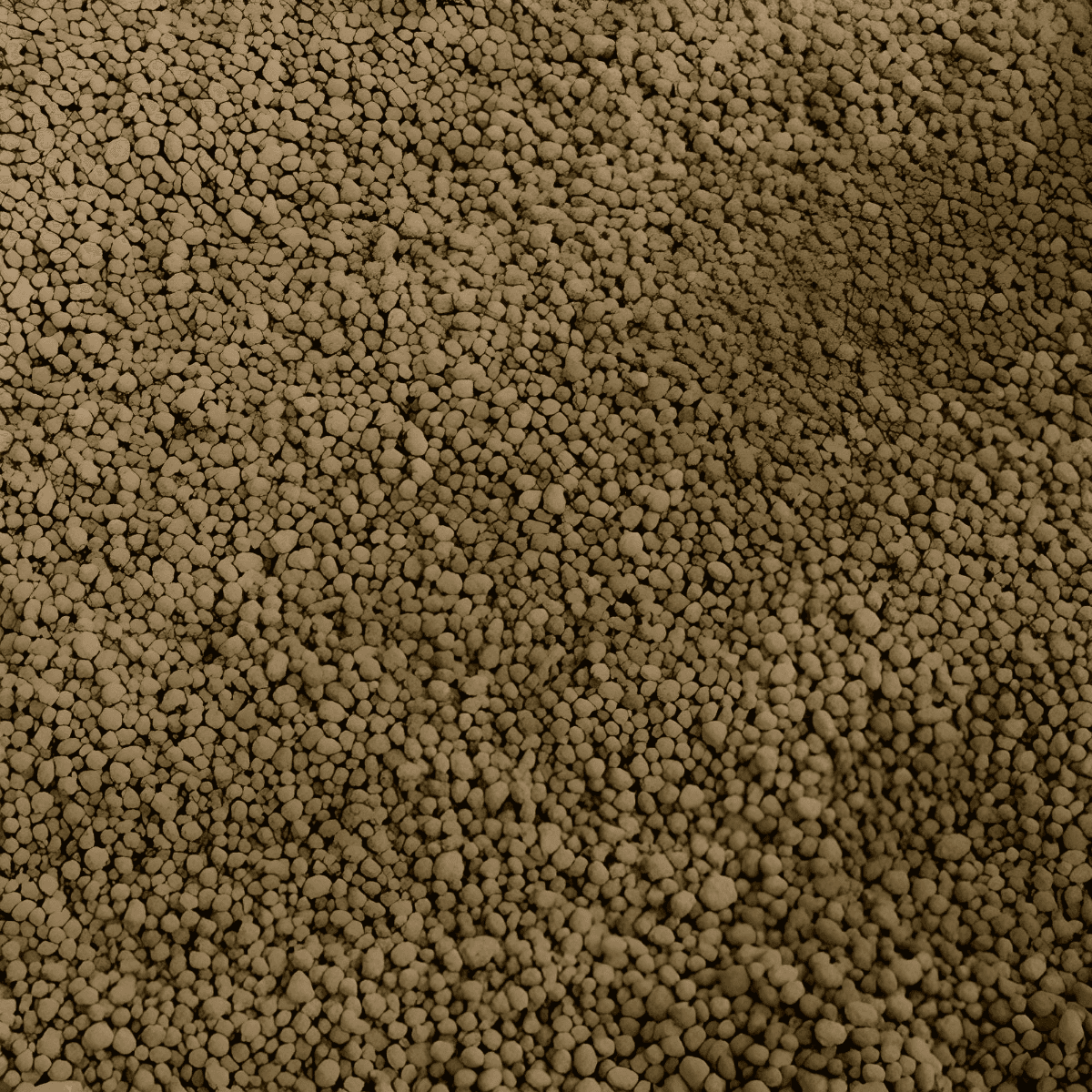
- Form: white-brown-blue microgranulate,
Composition:
- CaO (as IDHA chelate) (9.5%) - calcium chelated with IDHA agent,
- B (0.5%);
- Mn (0.1%);
- Cu (0.05%);
- Fe (0.05%);
- Zn (0.05%);
- Mo (0.01%).
The importance of calcium in plant cultivation:
- Calcium in the plant serves a structural function ("glues" cells together),
- Plants deficient in calcium do not grow (calcium is responsible for cell divisions in apical meristems), are limp, and have significantly lower lodging resistance.
- Calcium plays an important role in flowering and seed setting processes.
- Foliar calcium fertilisation is one of the basic treatments in orchard and vegetable crops.
When to use ASX Calcium Chelate:
- ASX Calcium Chelate should be used in areas where the availability of nutritional calcium from the soil is low, as foliar feeding of plants.
- Calcium demand increases with plant growth practically throughout the vegetation period, so calcium should be applied regularly to meet this need.
- Very high calcium demand is found in sugar beet and oilseed rape - in the cultivation of these crops calcium supplementation will be necessary for their proper development.
- Potato, maize, cereals and large-seeded legumes as well as small-seeded legumes have medium calcium demand, but also, as with sugar beet or oilseed rape, calcium supplementation should be applied regularly but in smaller amounts.
Application and dosage
|
Crop |
How to apply? Dosage |
When to apply? |
|---|---|---|
|
Cereals |
Dosage per application 1 kg/ha. Spray liquid volume 200-300 l/ha. Number of applications per season: 1. |
From first node to flag leaf (BBCH 31-39). |
|
Oilseed rape |
Dosage per application 1 kg/ha. Spray liquid volume 200-300 l/ha. Number of applications per season: 1. |
Beginning of main shoot elongation (BBCH 30-31). |
|
Maize |
Dosage per application 1.5 kg/ha. Spray liquid volume 200-300 l/ha. Number of applications per season: 1. |
4-6 leaf stage (BBCH 14-16). |
|
Potato |
Dosage per application 1 kg/ha. Spray liquid volume 200-300 l/ha. Number of applications per season: 1. |
Closing of inter-rows (BBCH 31-39). |
|
Sugar beet |
Dosage per application 2 kg/ha. Spray liquid volume 200-300 l/ha. Number of applications per season: 1. |
Closing of inter-rows (BBCH 32-39). |
|
Soya |
Dosage per application 1 kg/ha. Spray liquid volume 200-300 l/ha. Number of applications per season: 1. |
Development of lateral shoots and main shoot (BBCH 21-49). |
|
Legumes |
Dosage per application 1.5 kg/ha. Spray liquid volume 200-300 l/ha. Number of applications per season: 1. |
Shoot growth (BBCH 30-39). |
|
Onion crops |
Dosage per application 1-2 kg/ha. Spray liquid volume 300-500 l/ha. Number of applications per season: 1. |
Development of harvestable plant parts (BBCH 41-49). |
|
Cucurbits |
Dosage per application 1 kg/ha. Spray liquid volume 300-500 l/ha. Number of applications per season: 2. |
Flowering and fruit development (BBCH 61-79), fruit and seed ripening (BBCH 81-89). |
|
Cabbage crops |
Dosage per application 1 kg/ha, in case of application at BBCH 41-45 stage 1-2 kg/ha. Spray liquid volume 300-500 l/ha. Number of applications per season: 2-3. |
Leaf development (BBCH 17-19), development of harvestable plant parts (BBCH 41-45 and BBCH 46-49). |
|
Root crops |
Dosage per application 1 kg/ha. Spray liquid volume 300-500 l/ha. Number of applications per season: 1-2. |
Development of harvestable plant parts (BBCH 43-45 and BBCH 46-49). |
|
Leafy vegetables |
Dosage per application 1 kg/ha, in case of application at BBCH 46-49 stage 1.5 kg/ha. Spray liquid volume 300-500 l/ha. Number of applications per season: 2. |
Development of harvestable plant parts (BBCH 41-45 and BBCH 46-49). |
|
Solanaceous crops |
Dosage per application 1 kg/ha. Spray liquid volume 300-500 l/ha. Number of applications per season: 1-3. |
Inflorescence development and flowering (BBCH 51-69), fruit development (BBCH 71-79), fruit and seed ripening (BBCH 81-89). |
|
Leguminous crops |
Dosage per application 1 kg/ha. Spray liquid volume 300-500 l/ha. Number of applications per season: 1. |
Pod development (BBCH 71-79). |
|
Stone fruit trees |
Dosage per application 1-1.5 kg/ha. Spray liquid volume 500-800 l/ha. Number of applications per season: 3-4. |
Fruit development (BBCH 71-79). |
|
Pome fruit trees |
Dosage per application 1-2 kg/ha. Spray liquid volume 500-800 l/ha. Number of applications per season: 3-6. |
Fruit development (BBCH 71-79), fruit ripening (BBCH 81-85). |
|
Berry crops |
Dosage per application 1-1.5 kg/ha. Spray liquid volume 300-500 l/ha. Number of applications per season: 3-4. |
Fruit development (BBCH 71-79). |
|
Strawberry |
Dosage per application 1-1.5 kg/ha. Spray liquid volume 300-500 l/ha. Number of applications per season: 3-4. |
Flowering and fruit development (BBCH 65-73). |