 SKU 33473-c
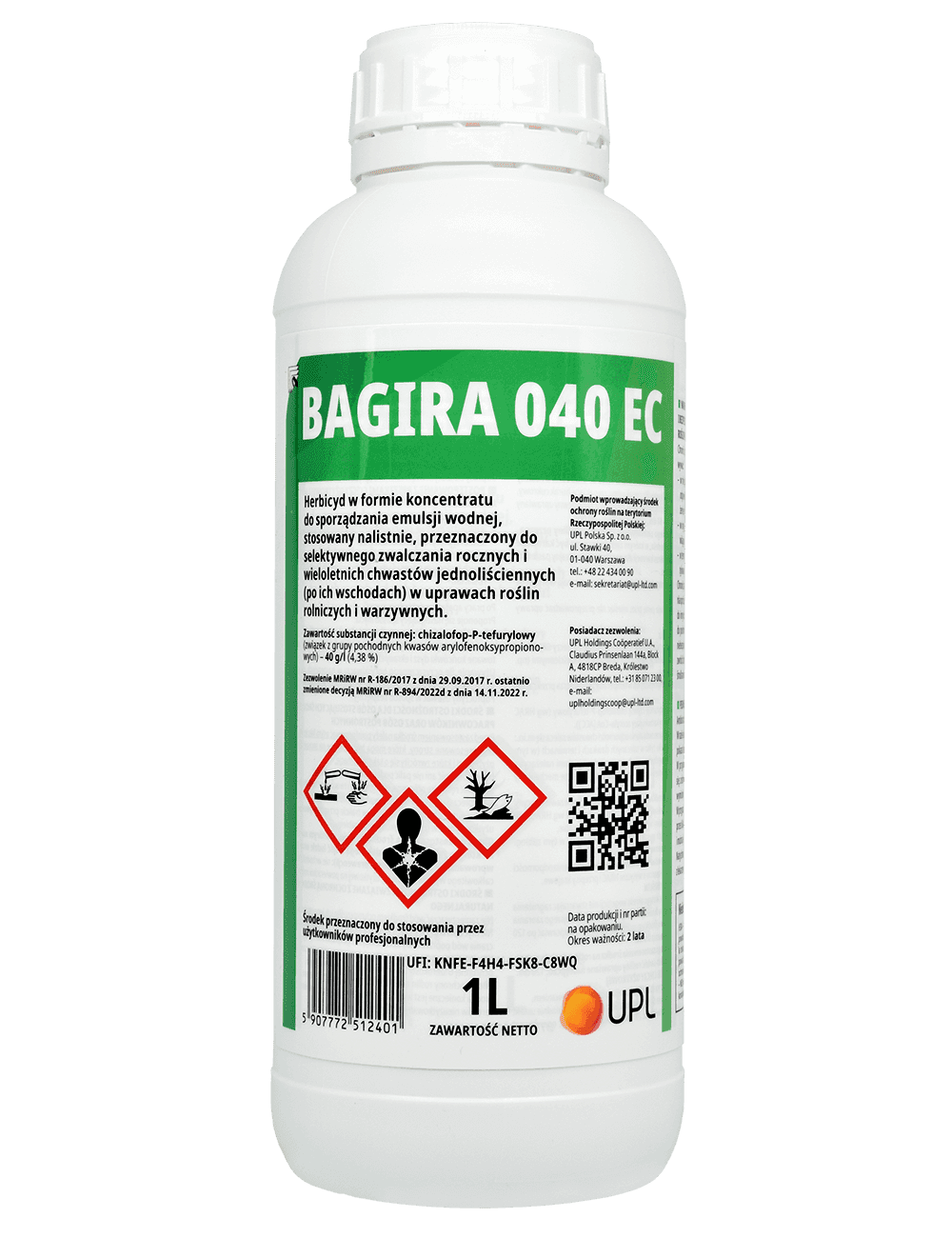
Bagira (chizalofop-P-tefuryl) - herbicide for arable and vegetable crops
Bagira 040 EC is a selective herbicide for the control of monocotyledonous weeds in arable and vegetable crops. The product is applied foliarly and is available as a concentrate for preparing an aqueous emulsion. The main active substance is chizalofop-P-tefuryl.
Description
Bagira 040 EC - herbicide for the control of monocotyledonous weeds in arable and vegetable crops
What are the benefits of using the herbicide Bagira?
- The product has high efficacy in controlling monocotyledonous weeds (including those with a well-developed root system) in cereals and vegetables,
- Rapid action - full effect visible after 14-20 days,
- Low treatment cost - saving money,
- Adverse weather conditions do not reduce the product's effectiveness,
- Foliar application - convenience.
Bagira 040 EC is a plant protection product, specifically a herbicide. It is applied foliarly. It is available as a concentrate for preparing an aqueous emulsion (EC). It is intended for selective control of annual and perennial monocotyledonous weeds (post-emergence) in arable and vegetable crops.
The product is intended for professional users and is approved for use with self-propelled or tractor-mounted field sprayers.
Bagira 040 EC should be applied at the appropriate growth stage of the weeds, taking into account the recommended growth stages of the crop. The dose should be adjusted to the species of weed being controlled.
How does the Bagira herbicide from UPL work?
The selective herbicide Bagira is a systemic product that is rapidly absorbed through the leaves and then translocated to the roots and rhizomes of weeds, causing inhibition of their growth and development. The effect on weeds is manifested by yellowing and then drying of the youngest leaves.
How quickly will I see the effect of the Bagira herbicide?
First symptoms are visible about 6-10 days after treatment. The full effect is visible after 14-20 days.
Cool and dry weather delays the action but does not reduce its effectiveness. Warm weather and sufficiently moist soil accelerate the action, favouring rapid absorption by actively growing weeds.
Annual monocotyledonous weeds are most sensitive from the 2-leaf stage to the beginning of tillering, while perennial weeds (e.g. couch grass) are sensitive at the 4-6 leaf stage.
Rainfall within one hour after treatment does not affect the product's action.
What is the content of the active substance in Bagira from UPL?
Active substance content:
- Chizalofop-P-tefuryl (a compound from the aryloxyphenoxypropionic acid derivatives group) - 40 g/l (4.38%).
Which weeds does the Bagira herbicide control?
Sensitive weeds: slender foxtail, volunteer cereals, couch grass.
Resistant weeds: dicotyledonous plants.
Which weeds does Bagira herbicide control when used in small-scale applications?
Sensitive weeds: slender foxtail, green foxtail, blue foxtail, redshank, couch grass.
Resistant weeds: dicotyledonous plants.
In which crops can Bagira herbicide be used to control weeds?
- Sugar beet,
- Winter oilseed rape,
- Spring oilseed rape,
- Common fodder pea (field pea), common dry pea (also small-scale),
- Onion (small-scale),
- Carrot (small-scale).
What is the crop rotation following the use of Bagira herbicide from UPL?
The product decomposes during the growing season without posing a threat to succeeding crops. If the treated crop is ploughed in earlier, succeeding crops can be grown 120 days after application.
What are the re-entry and pre-harvest intervals when using Bagira herbicide?
Re-entry interval, i.e. the period from application until people and animals may enter the treated area:
- Do not enter until the spray liquid has completely dried on the plant surfaces.
Pre-harvest interval, i.e. the period from last application to crop harvest:
- Winter oilseed rape, spring oilseed rape, sugar beet, common fodder pea (field pea), common dry pea – 60 days,
- Onion, carrot – 30 days.
Pre-harvest interval for fodder, i.e. the period from last application to the day animals can be fed with treated plants:
- Common fodder pea (field pea) – 60 days.
Interval from last application to sowing or planting of succeeding crops:
- 120 days.
How to prepare the spray liquid from Bagira herbicide?
Prepare the spray liquid immediately before use. Before preparation, determine the required volume of spray liquid and the amount of product needed. When filling the sprayer, follow the manufacturer's instructions. If no instructions are available, add the measured amount of product to a partially filled sprayer tank with water (with the agitator on). Rinse empty containers three times with water and pour the rinsate into the sprayer tank with the spray liquid, top up with water to the required volume and mix thoroughly. If the sprayer does not have a hydraulic agitator, mix the spray liquid mechanically after adding the product. In case of interruptions during spraying, mix the spray liquid thoroughly before resuming work.
What are the recommendations for weed control with the spray liquid (herbicide) Bagira?
- Rainfall occurring 1 hour after treatment does not affect the product's action.
- After controlling couch grass, do not perform mechanical cultivation for one month.
- Do not apply the product:
− during wind conditions that may cause spray drift to neighbouring crops, especially monocotyledonous plants (e.g. maize, cereals),
− during prolonged drought or when air temperature exceeds 27°C, - The product contains the active substance chizalofop-P-tefuryl (HRAC group A – acetyl-CoA carboxylase [ACC] inhibitors). As part of resistance management strategies, it is recommended to:
− use the product only at recommended doses and timings (including weed growth stages), in rotation with herbicides from other chemical groups with different modes of action,
− avoid mixing with other products containing ACC inhibitors (HRAC group A) or using them sequentially in the same season,
− use various weed control methods, including cultivation practices, crop rotation, etc. - Resistance management strategies should be applied following HRAC guidelines and national regulations.
- Do not eat, drink or smoke while using the product.
- Wear protective gloves, eye and face protection, protective clothing, and appropriate footwear (e.g. rubber boots) during preparation and application of the spray liquid.
- Keep out of reach of children.
- Store the plant protection product:
− in places or facilities with appropriate measures to prevent environmental contamination and unauthorized access,
− in original packaging, preventing contact with food, beverages or feed,
− at 0°C – 30°C, in a cool, well-ventilated place. - Protect from freezing.
Bagira 040 EC - plant protection product label:
More information can be found in the Plant Protection Product Label available in the Downloads section.
Warning! Plant protection products must be used safely. Before each use, read the information on the label and product information.
The buyer declares that they meet the conditions specified in Article 25(3)(5) of the Act of 8 March 2013 on plant protection products and have received training in the use of plant protection products for professional users. Before each use, read the label and product information carefully. Pay attention to detailed risk indications. Follow safety rules contained in the label. Plant protection products may only be purchased by adults and persons who have completed training and hold qualifications required for persons purchasing plant protection products (Article 28 of the Act on plant protection products of 8 March 2013, as amended). Plant protection products must be used in a way that does not pose a threat to human health, animals or the environment. The buyer of plant protection products must be sober. By purchasing, you declare that you meet the above conditions.
Application and dosage
|
Crop |
Target Pest Control |
How to apply? Dosage |
|---|---|---|
|
Sugar beet |
slender foxtail |
Maximum dose for single application: 1.5 l/ha |
|
Sugar beet |
couch grass |
Maximum dose for single application: 2.0 l/ha |
|
Winter oilseed rape |
volunteer cereals |
Maximum dose for single application: 1.0 l/ha |
|
Winter oilseed rape |
couch grass |
Maximum dose for single application: 2.0 l/ha |
|
Spring oilseed rape |
couch grass |
Maximum dose for single application: 2.0 l/ha |
|
Common fodder pea (field pea), common dry pea |
couch grass |
Maximum dose for single application: 2.0 l/ha |
| Common fodder pea (field pea), common dry pea * |
slender foxtail, green foxtail, blue foxtail, redshank |
Maximum dose for single application: 1.5 l/ha |
| Onion * |
slender foxtail, green foxtail, blue foxtail, redshank |
Maximum dose for single application: 1.5 l/ha |
| Onion * |
couch grass |
Maximum dose for single application: 2.0 l/ha |
| Carrot * |
slender foxtail, green foxtail, blue foxtail, redshank |
Maximum dose for single application: 1.5 l/ha |
| Carrot * |
couch grass |
Maximum dose for single application: 2.0 l/ha |
* The user is solely responsible for the efficacy and phytotoxicity of the plant protection product used in small-scale crops.