 SKU CH-13770
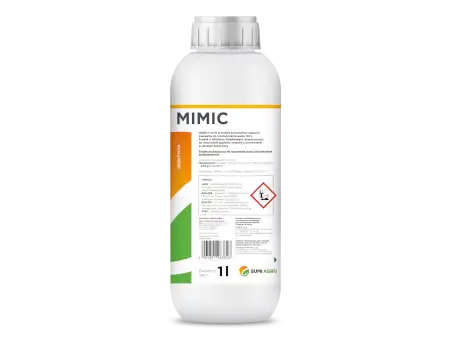
Mimic
Mimic is an insecticide in the form of a concentrated suspension (SC), designed for effective control of harmful insect caterpillars. Its action is selective and stomach poison – after consuming the treated plant, caterpillars immediately stop feeding and die.
- Pack
- 1 l
Description
ACTION OF MIMIC PRODUCT:
Mimic is a selective insecticide, which acts in a stomach poison manner, effectively eliminating pest caterpillars. The product is a concentrate for dilution with water (SC), facilitating its application. After spraying, the active substance, tebufenozide, remains on the surface of the plants. When pest caterpillars (e.g. European corn borer, codling moth, leafrollers) consume plant parts, they stop feeding within 24 hours and then die.
Mimic shows high efficacy against moth caterpillars, without negatively affecting beneficial insects.
Advantages of using Mimic:
- Selective action: Controls caterpillars while being safe for beneficial insects.
- Rapid effect: Caterpillars stop feeding within 24 hours after ingestion.
- Wide application: Can be used on maize, apple tree and in small-scale crops such as grapevine, pear tree, tomato and sweet pepper.
- Convenient form: Concentrate for dilution with water, easy to prepare for spraying.
- Unique mode of action: Effectively controls pests while minimising the risk of resistance development.
MIMIC ACTIVE SUBSTANCE CONTENT:
tebufenozide (a compound from the diacylhydrazine derivatives group) – 240 g/l (22.49 %)
MIMIC SCOPE OF USE, TIMING AND DOSES:
How to use Mimic:
Maize grown for grain and silage
European corn borer
Maximum/recommended dose for single application: 0.75 l/ha.
Application timing: apply the product according to warning signals or based on available pest monitoring methods, during the period of mass caterpillar hatching, from the beginning of stem growth to the stage when kernels reach typical size (BBCH 30-79).
Recommended water volume: 200-400 l/ha.
Recommended spraying: medium droplet size.
Maximum number of treatments per growing season: 1.
Apple tree
Codling moth, leafrollers
Maximum/recommended dose for single application: 0.75 l/ha.
Application timing: perform treatment during the period of intense moth flight and mass egg laying, based on observations of moth catches in pheromone traps or according to warning signals, from the bud swelling stage to the end of flowering: all petals fallen (BBCH 51-69).
Recommended water volume: 500-1000 l/ha
Recommended spraying: medium droplet size.
Maximum number of treatments per growing season: 1.
USE OF THE PLANT PROTECTION PRODUCT IN SMALL-SCALE CROPS AND APPLICATIONS
The user alone is responsible for the efficacy and phytotoxicity of the plant protection product applied in small-scale crops.
Grapevine
Leafroller moth, grapevine leafroller
Maximum/recommended dose for single application: 0.8 l/ha.
Application timing: apply the product from the beginning of flowering to the end of berry ripening (BBCH 51-89).
Number of treatments: 3.
Minimum interval between treatments: 7 - 14 days.
Recommended water volume: 250 – 1600 l/ha.
Recommended spraying: medium droplet size.
Maximum number of treatments per growing season: 3.
Pear tree
Codling moth
Maximum/recommended dose for single application: 0.75 l/ha.
Application timing: apply the product from the bud swelling stage (BBCH 51) to the end of flowering: all petals fallen (BBCH 69) observing the pre-harvest interval.
Recommended water volume: 500-1000 l/ha.
Recommended spraying: fine droplet size.
Maximum number of treatments per growing season: 1.
Tomato, eggplant
Use permitted only in greenhouses with permanent structure isolated from the growing medium
Tomato leafminer, tomato pinworm and other leaf-eating moth caterpillars
Maximum/recommended dose: 0.75 l/ha.
Application timing: apply the product at the moment of pest appearance, regardless of plant growth stage, observing the pre-harvest interval.
Number of treatments: 3.
Minimum interval between treatments: at least 14 days.
Recommended water volume: 800-1200 l/ha.
Recommended spraying: medium droplet size.
Maximum number of treatments per growing season: 3.
Sweet pepper
Use permitted only in greenhouses with permanent structure isolated from the growing medium
European corn borer, pepper moth, vegetable leafminer and other leaf-eating moth caterpillars
Maximum/recommended dose: 0.75 l/ha.
Application timing: apply the product at the moment of pest appearance, regardless of plant growth stage, observing the pre-harvest interval.
Number of treatments: 3.
Minimum interval between treatments: at least 14 days.
Recommended water volume: 1000-2000 l/ha.
Recommended spraying: medium droplet size
Maximum number of treatments per growing season: 3.
Ornamental plants
Tomato leafminer, box tree moth and other leaf-eating moth caterpillars
Maximum/recommended dose: 0.75 l/ha.
Application timing: apply the product at the moment of pest appearance, no earlier than 4 weeks after planting.
Recommended water volume: 500-2000 l/ha.
Recommended spraying: medium droplet size.
Maximum number of treatments per growing season: 1.
Ornamental plant nurseries, fruit tree and shrub nurseries
Leaf-eating moth caterpillars
Maximum/recommended dose: 0.75 l/ha.
Application timing: apply the product at the moment of pest appearance.
Recommended water volume: 300-1500 l/ha.
Recommended spraying: medium droplet size.
Maximum number of treatments per growing season: 1.
Sweet corn and popping corn
European corn borer
Maximum/recommended dose for single application: 0.75 l/ha.
Application timing: apply the product according to warning signals or based on available pest monitoring methods, during the period of mass caterpillar hatching, from the beginning of stem growth to the stage when kernels reach typical size (BBCH 30-79).
Recommended water volume: 200-400 l/ha.
Recommended spraying: medium droplet size.
Maximum number of treatments per growing season: 1
MIMIC PRE-HARVEST INTERVAL:
Maize grown for grain and silage, sweet corn, popping corn – 42 days
Apple tree, pear tree – 14 days
Grapevine – 21 days
Tomato, eggplant, sweet pepper – 3 days
Ornamental plants, ornamental plant nurseries, fruit tree and shrub nurseries – not required.