 SKU 16040-c
Leopard Extra 05 EC (chizalofop)
Leopard extra 05 EC is a foliar herbicide designed for the selective control of monocotyledonous weeds such as couch grass, false oat-grass, blackgrass and volunteer cereals in agricultural and vegetable crops during vegetation.
Description
Leopard extra 05 EC is a foliar herbicide. It is intended for the selective control of weeds – couch grass, false oat-grass, blackgrass, volunteer cereals and other monocotyledonous weeds (after emergence) – in certain agricultural and vegetable crops during the growing season.
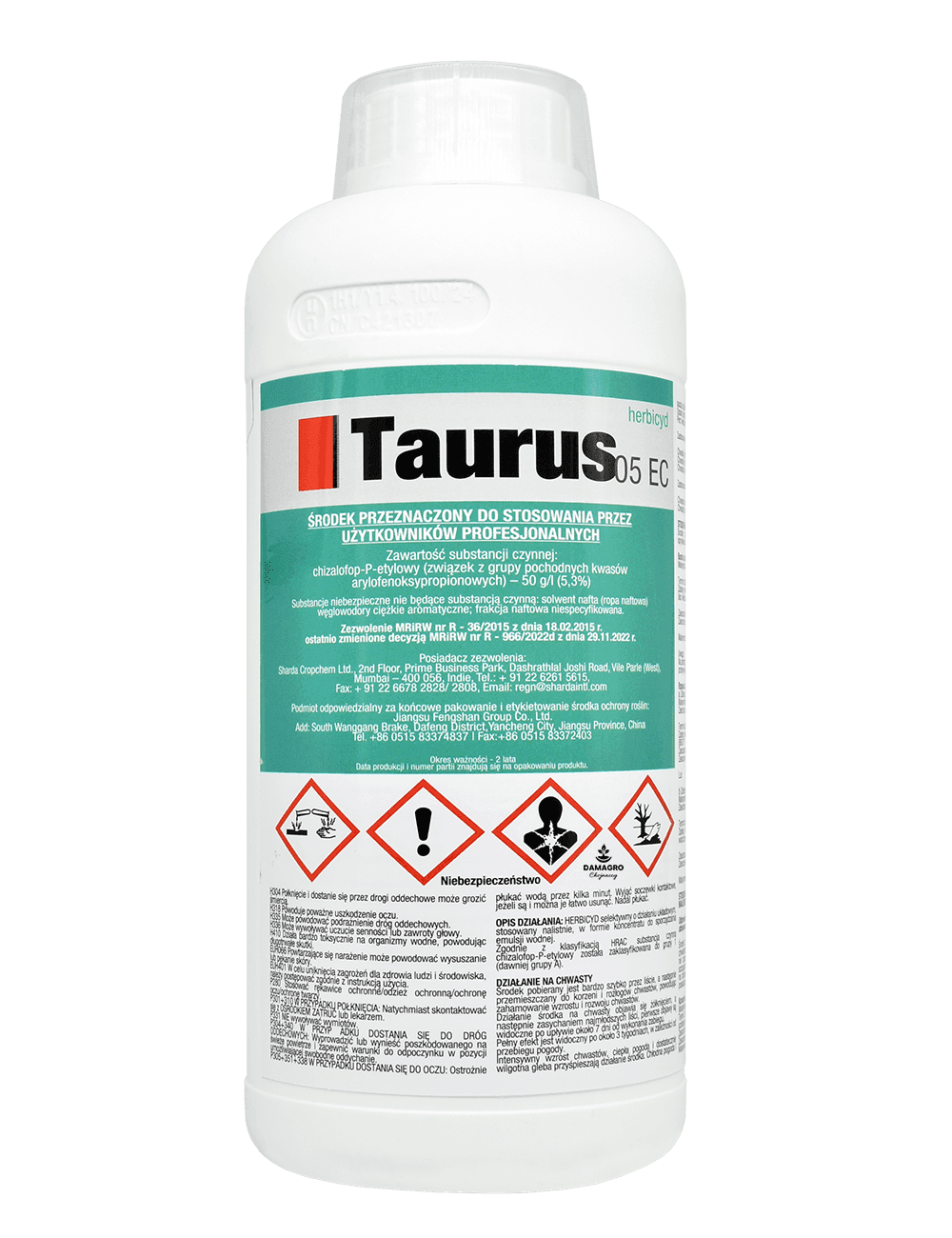
CONTENT OF ACTIVE SUBSTANCE chizalofop-P-ethyl (a compound from the aryloxyphenoxypropionic acid derivatives group) - 50 g/l
The product is absorbed very quickly through the leaves and then transported to the roots and rhizomes of weeds, causing inhibition of growth and development. The effect on weeds is manifested by yellowing and then drying of the youngest leaves.
Leopard extra 05 EC application timing
| Crop | Controlled weeds | Timing |
| Sugar beet | Sensitive weeds: false oat-grass, blackgrass, wild oats, redshank, couch grass, volunteer cereals, bromes, barren brome, perennial ryegrass. | Apply the product from the moment sugar beet plants have formed the first pair of leaves (2-leaf stage) until row closure (rosette development stage), when leaves cover no more than 50% of the soil surface (BBCH 12-35). |
| Potato | Moderately resistant weeds: sand couch, annual meadow-grass. | Apply the product after the inter-row cultivation is finished (from the beginning of the development of the first potato leaves but before row closure) (BBCH 10-30). |
| Winter oilseed rape | Apply the product in autumn when oilseed rape has developed at least four leaves (BBCH 14-15) or in spring no later than the beginning of side shoot development (BBCH 21). | |
| Bean, pea in pods | Apply the product from the 3rd true leaf or 4th true leaf stage of the crop (BBCH 13-14). It is recommended to perform 1 to 2 treatments within 15 days. | |
| Carrot, root parsley | Apply the product after emergence, from the 2nd to the 4th true leaf stage of carrot and root parsley (BBCH 12-14). | |
| Onion | Apply the product from the clearly visible 2nd leaf stage to the clearly visible (>3 cm) 4th leaf stage of onion (BBCH 12-14). | |
| Head cabbage (white, red) | Apply the product from the 5 to 9 leaf stage of the crop (BBCH 15-19). |
Warning! Plant protection products must be used safely. Before each use, read the information on the label and product information.
The purchaser declares that they meet the conditions specified in Article 25 paragraph 3 point 5 of the Act of 8 March 2013 on plant protection products and has training in the use of plant protection products in the case of products for professional users. Before each use, read the information on the label and product information. Pay attention to detailed risk indications. Follow the safety rules contained on the label. Plant protection products may only be purchased by adults and persons who have completed training and have the qualifications required for persons purchasing plant protection products (Article 28 of the Act on plant protection products of 8 March 2013 as amended). Plant protection products must be used in a way that does not pose a threat to human health, animals or the environment. The purchaser of plant protection products must be sober. By using this offer, you declare that you meet the above conditions.
Application and dosage
Crop | Control of Pest | How to apply? Dosage | When to apply? |
|---|---|---|---|
fodder beet, sugar beet | false oat-grass, blackgrass, wild oats, redshank, couch grass, volunteer cereals, bromes, barren brome, perennial ryegrass | Maximum dose for single application: 3.0 l/ha.
| |
celeriac, horseradish, Jerusalem artichoke, parsnip, black radish, Japanese radish, radish, salsify, white turnip, black turnip, rutabaga | false oat-grass, blackgrass, wild oats, redshank, couch grass, volunteer cereals, bromes, barren brome, perennial ryegrass | Maximum dose for single application: 3.0 l/ha.
| |
broad bean, field bean, vetch, white lupin, narrow-leafed lupin, yellow lupin, alfalfa, sown alfalfa, kidney vetch, sickle medick, clover, white clover, red clover, crimson clover, esparcet, vetchling, serradella, lentil, soybean, white melilot, yellow melilot, sainfoin | false oat-grass, blackgrass, wild oats, redshank, couch grass, volunteer cereals, bromes, barren brome, perennial ryegrass | Maximum dose for single application: 3.0 l/ha.
| |
spring oilseed rape, flax, opium poppy, flax-leaved hemp-nettle, sunflower, mustard, white mustard, black mustard, Sarepta mustard | false oat-grass, blackgrass, wild oats, redshank, couch grass, volunteer cereals, bromes, barren brome, perennial ryegrass | Maximum dose for single application: 3.0 l/ha.
| |
shallot, garlic | false oat-grass, blackgrass, wild oats, redshank, couch grass, volunteer cereals, bromes, barren brome, perennial ryegrass | Maximum dose for single application: 3.0 l/ha.
| |
cauliflower, broccoli | false oat-grass, blackgrass, wild oats, redshank, couch grass, volunteer cereals, bromes, barren brome, perennial ryegrass | Maximum dose for single application: 3.0 l/ha.
| |
sugar beet | false oat-grass, blackgrass, wild oats, redshank, couch grass, volunteer cereals, bromes, barren brome, perennial ryegrass | Maximum dose for single application: 3.0 l/ha
| Apply the product from the moment sugar beet plants have formed the first pair of leaves (2-leaf stage) until row closure (rosette development stage), when leaves cover no more than 50% of the soil surface (BBCH 12-35). |
potato | false oat-grass, blackgrass, wild oats, redshank, couch grass, volunteer cereals, bromes, barren brome, perennial ryegrass | Maximum dose for single application: 3.0 l/ha
| Apply the product after the inter-row cultivation is finished (from the beginning of the development of the first potato leaves but before row closure) (BBCH 10-30). |
winter oilseed rape | false oat-grass, blackgrass, wild oats, redshank, couch grass, volunteer cereals, bromes, barren brome, perennial ryegrass | Maximum dose for single application: 3.0 l/ha
| Apply the product in autumn when oilseed rape has developed at least four leaves (BBCH 14-15)
|
bean, pea | false oat-grass, blackgrass, wild oats, redshank, couch grass, volunteer cereals, bromes, barren brome, perennial ryegrass | Maximum dose for single application: 3.0 l/ha
| Apply the product from the 3rd true leaf or 4th true leaf stage of the crop (BBCH 13-14). |
carrot, parsley | false oat-grass, blackgrass, wild oats, redshank, couch grass, volunteer cereals, bromes, barren brome, perennial ryegrass | Maximum dose for single application: 3.0 l/ha
| Apply the product after emergence, from the 2nd to the 4th true leaf stage of carrot and root parsley (BBCH 12-14). |
onion | false oat-grass, blackgrass, wild oats, redshank, couch grass, volunteer cereals, bromes, barren brome, perennial ryegrass | Maximum dose for single application: 3.0 l/ha
| Apply the product from the clearly visible 2nd leaf stage to the clearly visible (>3 cm) 4th leaf stage of onion (BBCH 12-14). |
white head cabbage, red head cabbage | false oat-grass, blackgrass, wild oats, redshank, couch grass, volunteer cereals, bromes, barren brome, perennial ryegrass | Maximum dose for single application: 3.0 l/ha
| Apply the product from the 5 to 9 leaf stage of the crop (BBCH 15-19). |