 SKU 45174-c
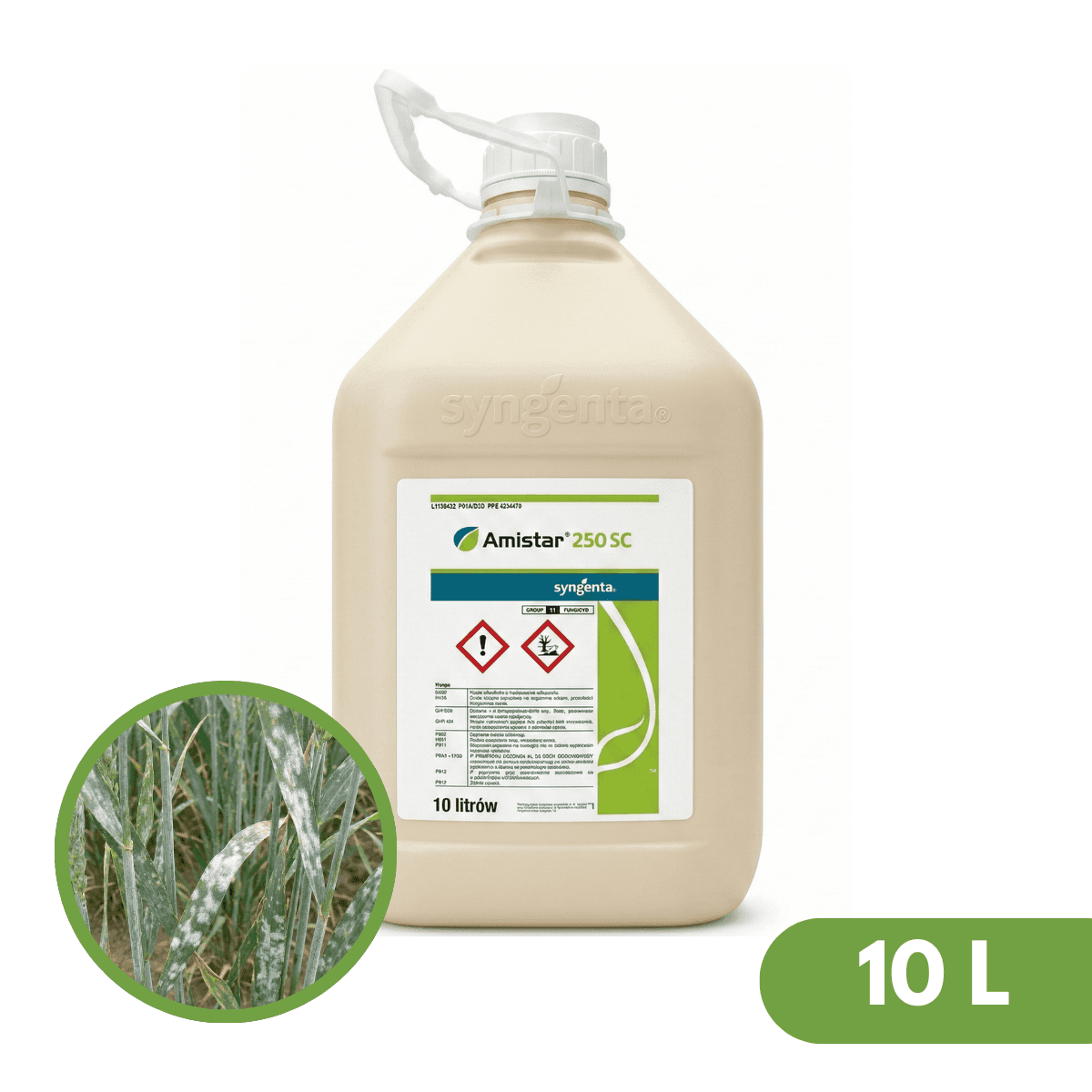
Amistar 250 SC (azoxystrobin) Twój Ogród - fungicide
Amistar 250 SC is a fungicide in the form of a concentrated suspension for dilution with water (SC), acting locally systemic and systemic.
Description
Amistar 250 SC Twój Ogród fungicide
- Prevents fungal diseases of vegetable plants,
- Acts both locally systemic and systemic,
- Broad spectrum of activity.
Amistar 250 SC is a fungicide, a concentrate in the form of a concentrated suspension for dilution with water (SC), with locally systemic and systemic action, intended mainly for preventive use in the control of fungal diseases of vegetable plants.
The product is intended for use with handheld sprayers.
Amistar Twój Ogród fungicide - active substance:
- Azoxystrobin (compound from the strobilurin group) – 250 g/l (22.81%).
Amistar 250 SC Twój Ogród - controlled fungal diseases:
- Leek alternaria,
- Bean anthracnose,
- Ascochyta,
- Tomato powdery mildew,
- Cruciferous black spot (alternaria),
- Leaf spots,
- Leek rust,
- Grey mould,
- Sclerotinia stem rot.
Amistar 250 SC Twój Ogród plant protection product - application in crops:
- Onion,
- French bean,
- Pea for green seeds,
- Head cabbage,
- Cauliflower,
- Carrot,
- Sweet pepper in tunnel cultivation,
- Tomato in field cultivation,
- Leek,
- Lettuce in protected cultivation,
- Lettuce in field cultivation,
- Celery,
- Potato.
Amistar 250 SC Twój Ogród - pre-harvest interval and re-entry period:
Pre-harvest interval - the period from the last application of the product to the day of crop harvest:
- leek – 21 days,
- onion, garlic, shallot, head cabbage, Chinese cabbage, cauliflower, pea for green seeds, root celery, lettuce, carrot – 14 days,
- potato, French bean – 7 days,
- sweet pepper, tomato – 3 days.
Re-entry period - the period from the application of the product until people can enter the treated area and animals can be introduced:
- Do not enter until the spray liquid on the plant surface is completely dry.
Amistar 250 SC Twój Ogród fungicide - usage instructions:
- Adjust the type of spraying to the amount of recommended water.
- Do not use the product near apple orchards.
- To prevent the development of resistant forms in pathogen populations, it is recommended to alternate the product with products containing active substances from other chemical groups with different modes of action.
- During application, avoid:
− drift of spray liquid onto neighbouring crops,
− overlapping of spray liquid at the edges of treated strips and headlands. - As part of resistance management strategy, it is recommended to:
− use the product mainly preventively (prophylactically),
− not use doses lower than those recommended on the label,
− not exceed the maximum number of treatments recommended on the label,
− alternate the product with fungicides containing active substances from other chemical groups with different modes of action or use the product in mixtures with products containing active substances from such groups,
− treat fungicide use as only one element of an integrated crop protection programme developed according to integrated pest management methods for individual plant species.
Warning! Plant protection products must be used safely. Before each use, read the information on the label and product information.
The buyer declares that they meet the conditions specified in Article 25 paragraph 3 point 5 of the Act of 8 March 2013 on plant protection products and have training in the use of plant protection products in the case of products for professional users. Before each use, read the information on the label and product information. Pay attention to detailed risk indications. Follow the safety rules contained on the label. Plant protection products may only be purchased by adults and persons who have completed training and have the qualifications required for persons purchasing plant protection products (Article 28 of the Act on plant protection products of 8 March 2013 as amended). Plant protection products must be used in a way that does not pose a threat to human health, animals or the environment. The buyer of plant protection products must be sober. By using this offer, you declare that you meet the above conditions.
Application and dosage
|
Crop |
Target pest control |
How to apply? Dosage |
When to apply? |
|---|---|---|---|
|
potato |
alternaria leaf spot |
Maximum/recommended dose for single application: 0.5 l/ha |
Apply preventively or immediately after the first symptoms appear, from the beginning of inflorescence development to the fruit and seed ripening stage (first fruit cluster berries turn brown) (BBCH 51-85). |
|
onion, garlic, shallot |
leek rust, sclerotinia stem rot, leaf spot, stemphylium |
Maximum/recommended dose for single application: 0.8 l/ha. |
Apply preventively or immediately after the first symptoms appear, from the 4-leaf stage to the end of bulb formation for harvest (visible drying of the bulb tip) (BBCH 14-48). |
|
French bean |
rust |
Maximum/recommended dose for single application: 0.8 l/ha. |
Apply preventively or immediately after the first symptoms appear, from the developed 7th true leaf stage to the pod development stage (20% of pods reach typical length) (BBCH 17-72). |
|
head cabbage, Chinese cabbage, cauliflower |
white rust of crucifers |
Maximum/recommended dose for single application: 0.8 l/ha. |
Apply preventively or immediately after the first symptoms appear, from the 6-leaf stage to the end of development of the harvestable part of the plant (heads reach typical size and shape) (BBCH 16-49). |
|
tomato |
tomato powdery mildew |
Maximum/recommended dose for single application: 0.8 l/ha. |
Apply preventively or immediately after the first symptoms appear, from the beginning of side shoot development to the end of fruit and seed ripening (fruits reach full maturity) (BBCH 21-89). |
|
leek |
phytophthora, stemphylium, leaf spot |
Maximum/recommended dose for single application: 0.8 l/ha. |
Apply preventively or immediately after the first symptoms appear, from the 6-leaf stage to the end of leek growth (BBCH 16-48). |
|
lettuce |
rhizoctonia |
field cultivation: maximum/recommended dose for single application: 0.8 l/ha |
Apply preventively or immediately after the first symptoms appear, from the 4-leaf stage to the end of development of the harvestable part of the plant (head reaches typical size and shape) (BBCH 14-49). |
|
potato |
rhizoctonia |
Maximum dose for single application: 3.0 l/ha |
Apply as band spraying of soil during spring tuber planting (BBCH 00), using devices mounted on the planter equipped with two spraying nozzles. |
|
onion, garlic, shallot |
downy mildew, grey mould, alternaria leaf spot |
Maximum/recommended dose for single application: 0.8 l/ha |
Apply preventively or immediately after the first symptoms appear, from the 4-leaf stage to the end of bulb formation for harvest (visible drying of the bulb tip) (BBCH 14-48). |
|
French bean |
anthracnose, grey mould, sclerotinia stem rot, ascochyta |
Maximum/recommended dose for single application: 0.8 l/ha |
Apply preventively or immediately after the first symptoms appear, from the beginning of flowering to the pod development stage (20% of pods reach typical length) (BBCH 60-72). |
|
pea |
ascochyta, downy mildew |
Maximum/recommended dose for single application: 0.8 l/ha |
Apply preventively or immediately after the first symptoms appear, from the beginning of inflorescence development to the end of flowering (BBCH 51-69). |
|
head cabbage, Chinese cabbage, cauliflower |
cruciferous black spot, alternaria leaf spot, grey mould |
Maximum/recommended dose for single application: 0.8 l/ha |
Apply preventively or immediately after the first symptoms appear, from the 6-leaf stage to the end of development of the harvestable part of the plant (heads reach typical size and shape) (BBCH 16-49). |
|
carrot |
leaf alternaria, umbelliferous powdery mildew |
Maximum/recommended dose for single application: 0.8 l/ha |
Apply preventively or immediately after the first symptoms appear, from the 6-leaf stage to the end of development of the harvestable part of the plant (root reaches typical size and shape) (BBCH 16-49). |
|
lettuce |
powdery mildew, downy mildew, grey mould, sclerotinia stem rot |
Maximum/recommended dose for single application: 0.8 l/ha |
Apply preventively or immediately after the first symptoms appear, from the beginning of development of the harvestable part of the plant to the end of development of the harvestable part of the plant (head reaches typical size and shape) (BBCH 41-49). |
|
tomato in field cultivation |
alternaria leaf spot |
Maximum/recommended dose for single application: 0.8 l/ha |
Apply preventively or immediately after the first symptoms appear, from the beginning of side shoot development to the end of fruit and seed ripening (fruits reach full maturity) (BBCH 21-89). |
|
leek |
rust, alternaria leaf spot |
Maximum/recommended dose for single application: 0.8 l/ha |
Apply preventively or immediately after the first symptoms appear, from the 6-leaf stage to the end of leek growth (BBCH 16-48). |
|
root celery |
septoria leaf blotch |
Maximum/recommended dose for single application: 0.8 l/ha |
Apply preventively or immediately after the first symptoms appear, from the 6-leaf stage to the end of development of the harvestable part of the plant (root reaches typical size and shape) (BBCH 16-49). |
|
sweet pepper, protected cultivation |
grey mould, sclerotinia stem rot, powdery mildew, alternaria leaf spot |
Maximum concentration for single application: 0.1% (100 ml product in 100 litres of water). |
Apply preventively or immediately after the first symptoms appear, from the 6-leaf stage to the end of fruit and seed ripening (fruits reach full maturity) (BBCH 16-89). |
|
lettuce, protected cultivation |
grey mould, powdery mildew, downy mildew, sclerotinia stem rot, rhizoctonia |
Maximum concentration for single application: 0.1% (100 ml product in 100 litres of water). |
Apply preventively or immediately after the first symptoms appear, from the 4-leaf stage to the end of development of the harvestable part of the plant (head reaches typical size and shape) (BBCH 14-49). |
|
broad bean |
ascochyta, chocolate spot, fusarium, rust |
Maximum/recommended dose for single application: 0.8 l/ha. |
Apply preventively or immediately after the first symptoms appear, from the emergence of the first flower buds from the leaves to the end of flowering (BBCH 51-69). |
|
herbal plants |
grey mould, powdery mildew, downy mildew, sclerotinia stem rot, rhizoctonia |
field cultivation: maximum/recommended dose for single application: 0.8 l/ha. |
Apply preventively or immediately after the first symptoms appear, from the 4-leaf stage to the end of development of the harvestable part of the plant (head reaches typical size and shape) (BBCH 14-49). |
|
multiflower bean, green pea, sugar pea |
anthracnose, grey mould, sclerotinia stem rot, rust, ascochyta, downy mildew |
Maximum/recommended dose for single application: 0.8 l/ha. |
Apply preventively or immediately after the first symptoms appear, from the developed 7th true leaf stage to the pod development stage (20% of pods reach typical length) (BBCH 17-72). |
|
chickpea, field pea, lentil, soybean |
anthracnose, grey mould, sclerotinia stem rot, rust, ascochyta, damping-off spot |
Maximum/recommended dose for single application: 0.8 l/ha. |
Apply preventively or immediately after the first symptoms appear, from the developed 7th true leaf stage to the pod development stage (20% of pods reach typical length) (BBCH 17-72). |
|
ornamental grasses |
powdery mildew, leaf spot, rust, sclerotinia stem rot |
Maximum/recommended dose for single application: 0.8 l/ha. |
Apply mainly preventively or immediately after the first symptoms appear, from the beginning of stem elongation to the end of heading (BBCH 30-59). |