 SKU 44031-c
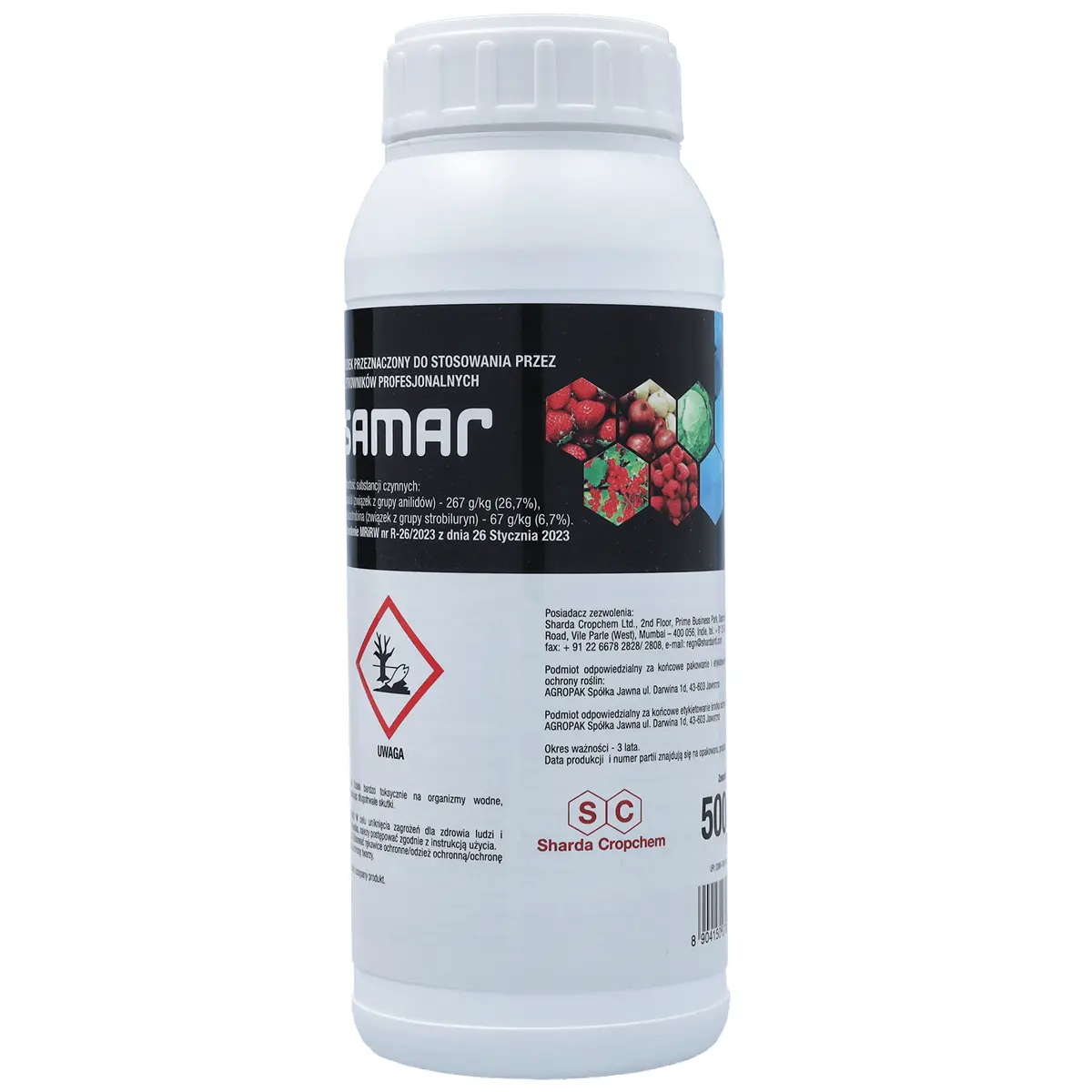
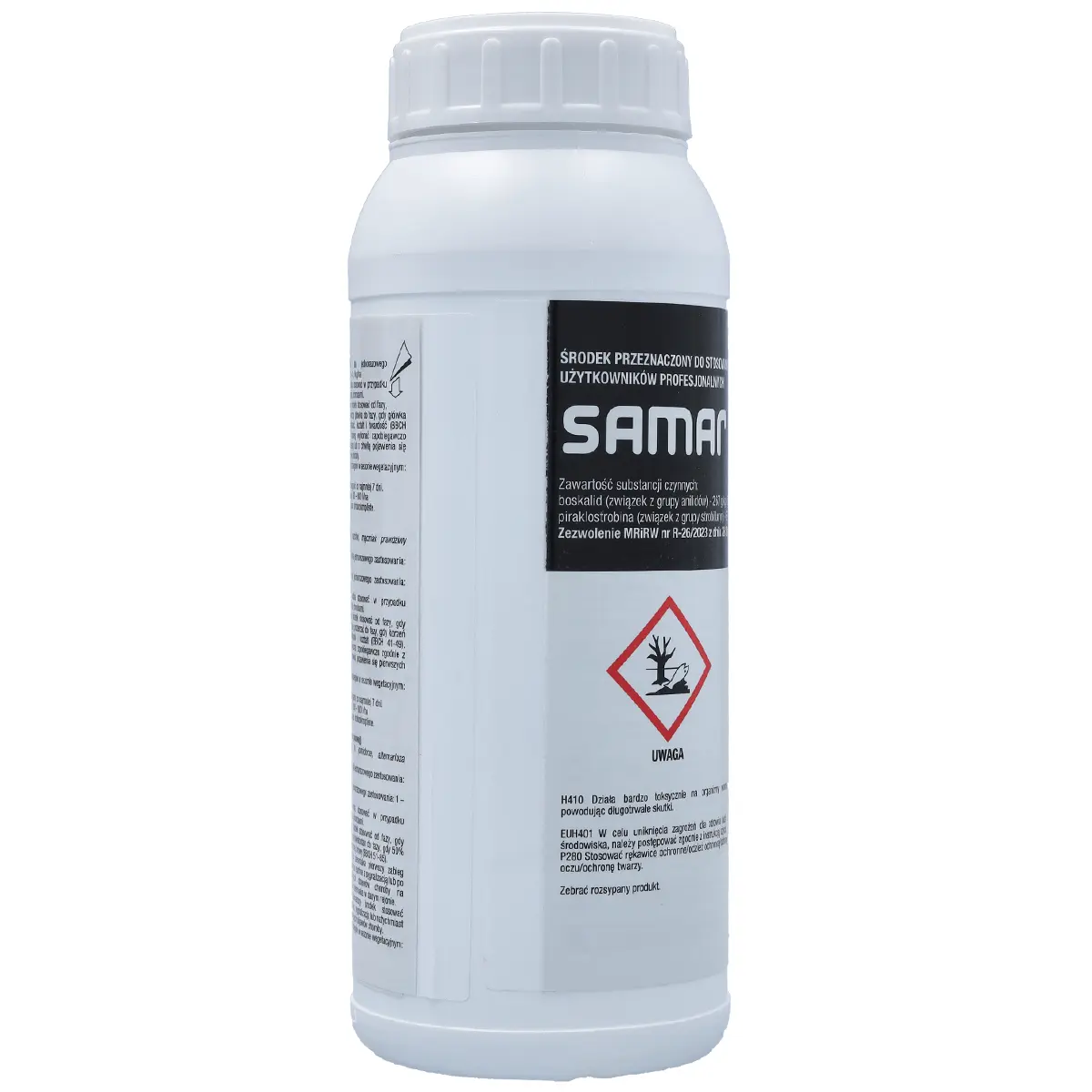
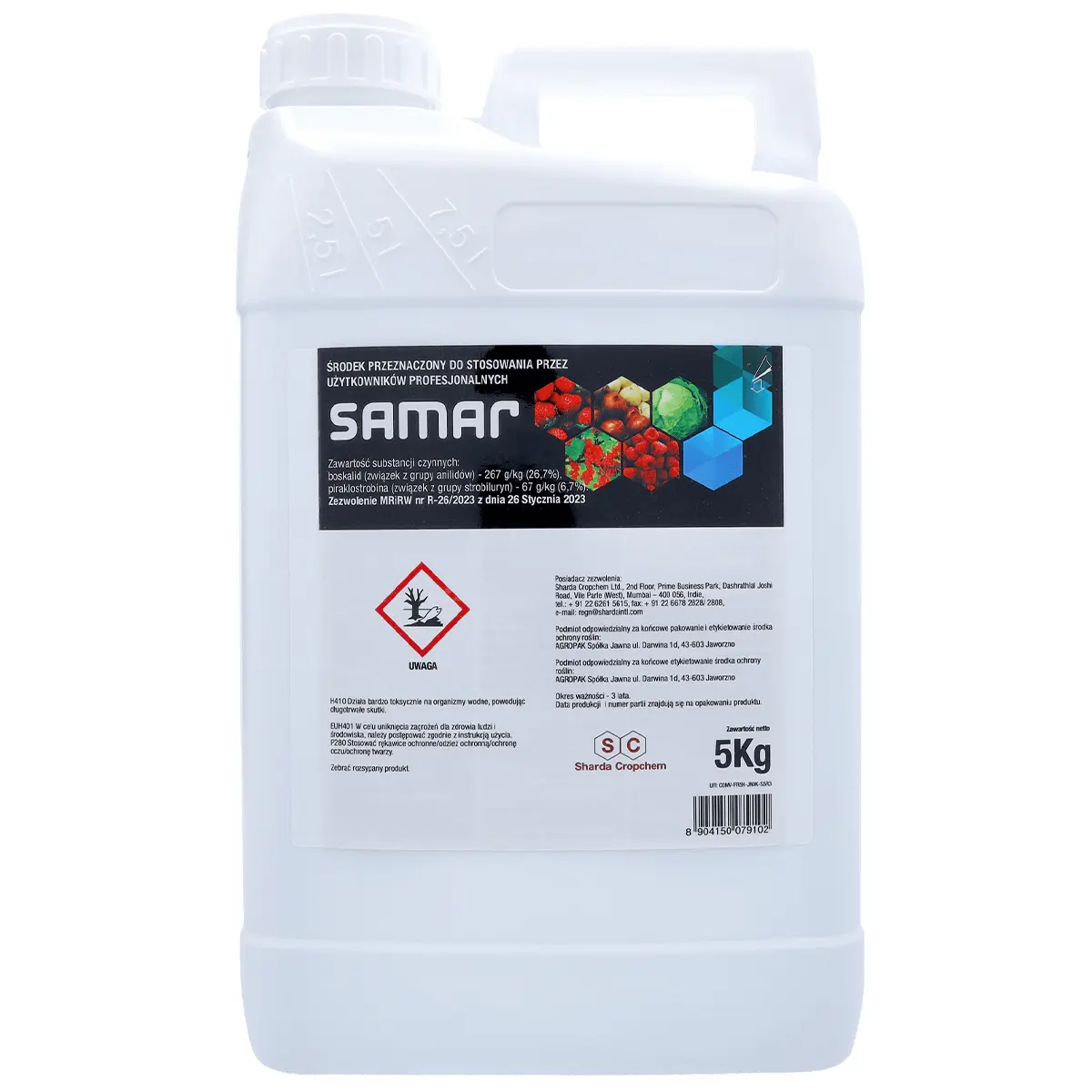
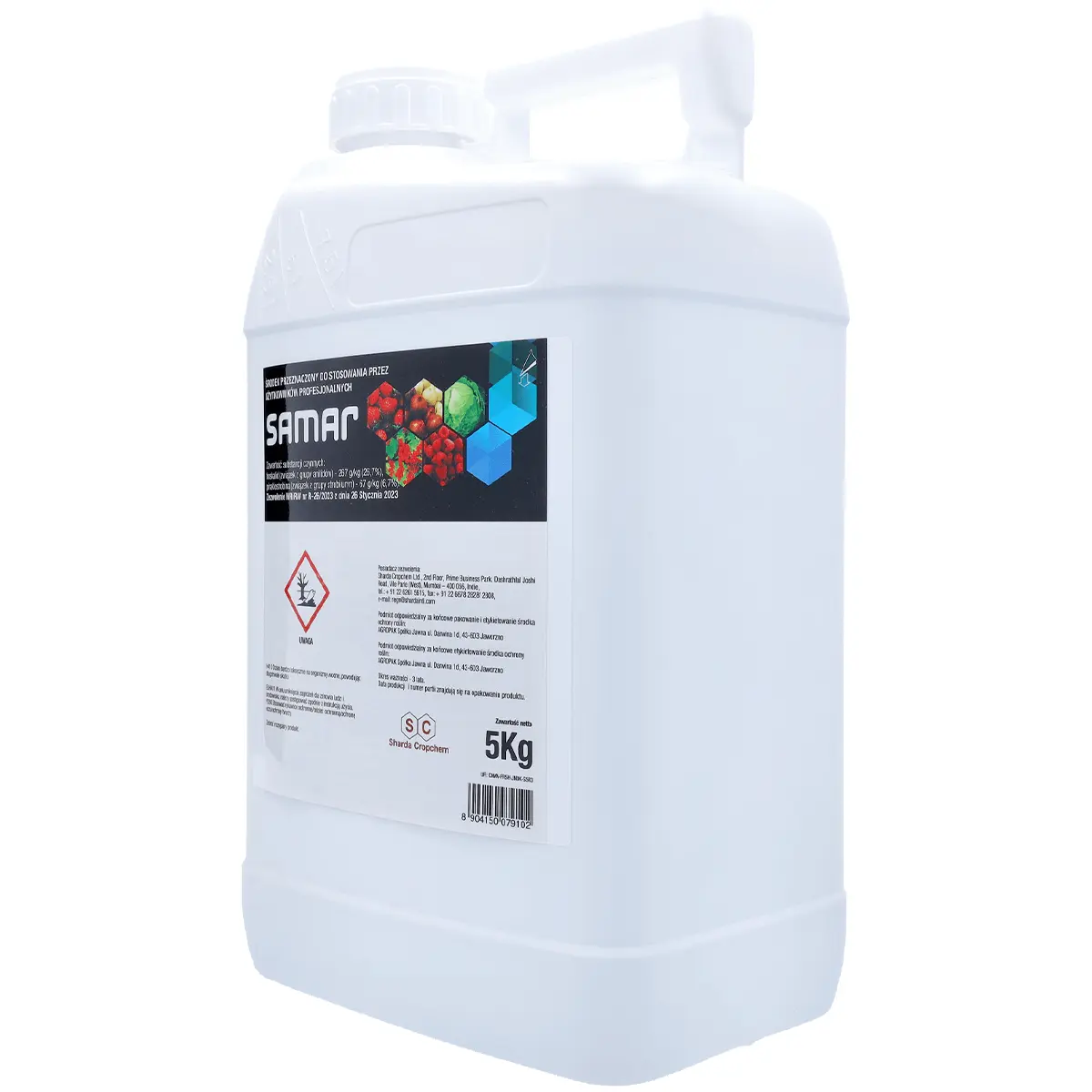
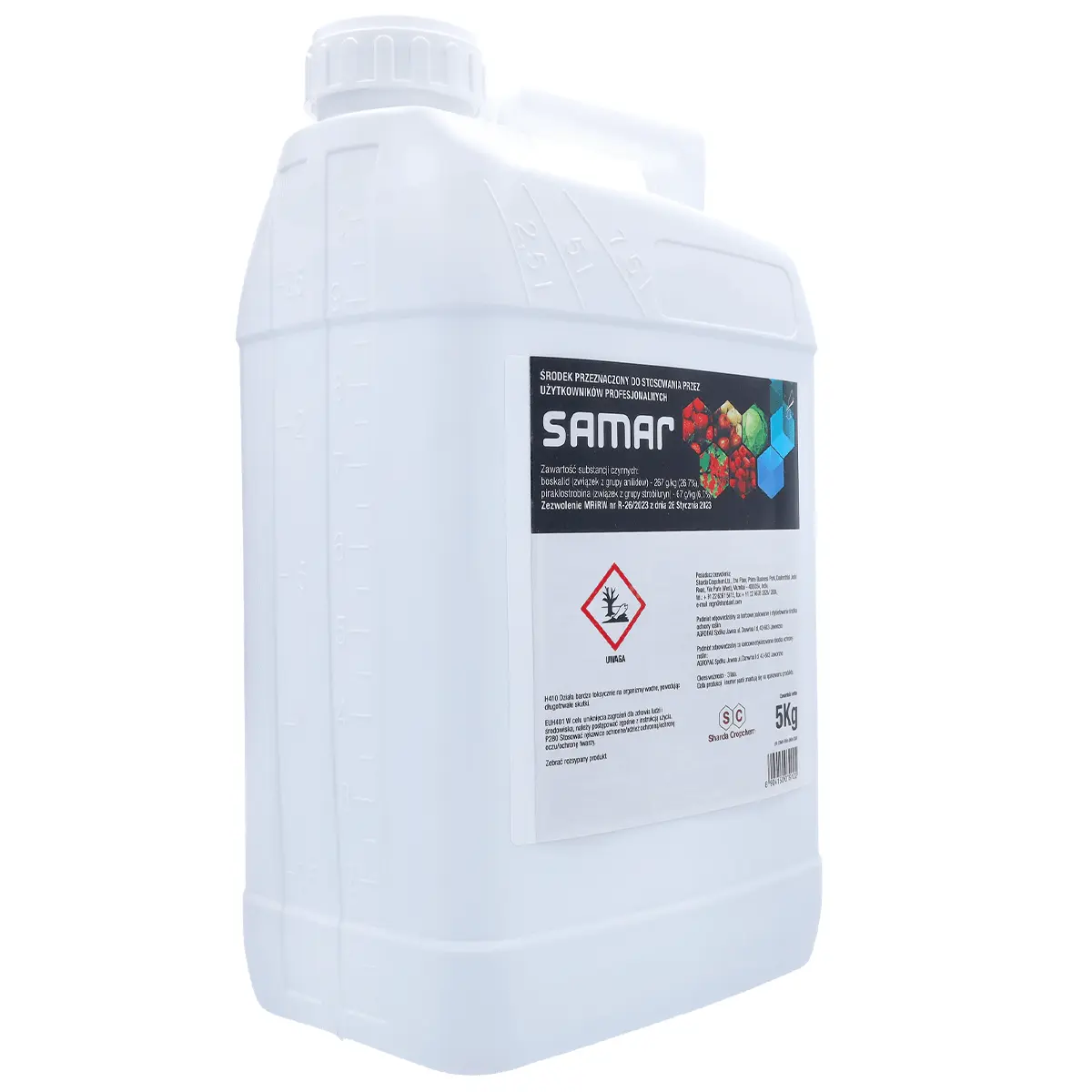
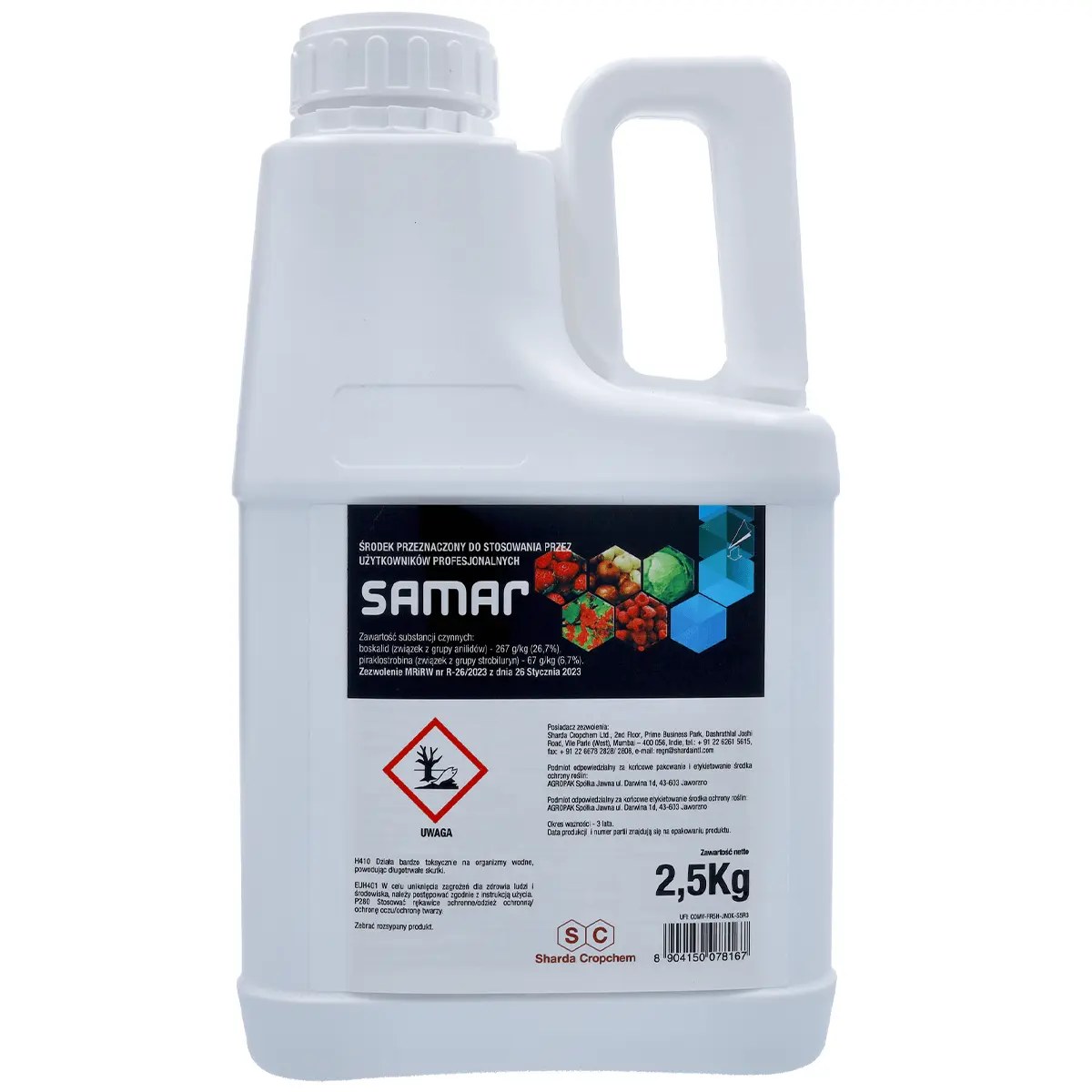
Samar - fungicide
Samar is a broad-spectrum fungicide designed to control diseases caused by fungi and fungus-like organisms.
Description
Samar - broad-spectrum fungicide
- High efficacy - contains two active substances,
- Active substances with different modes of action - the product reaches all parts of the plant, even those with limited access,
- Reduces pathogen spread from infected to uninfected areas,
- Convenient to use - in granule form,
- Controls and prevents multiple diseases simultaneously - saving time and money that would be spent on many different treatments,
- Can be used in the protection of many crop species grown on the farm and in the garden - reducing the likelihood of wasting product not used at a specific time,
- Improves storage ability of yields - excellent quality and mass of yields; adjusting the sales period to the time when the market offers the most favourable conditions for the seller,
- Broad action - controls and limits the occurrence of over 20 fungal diseases.
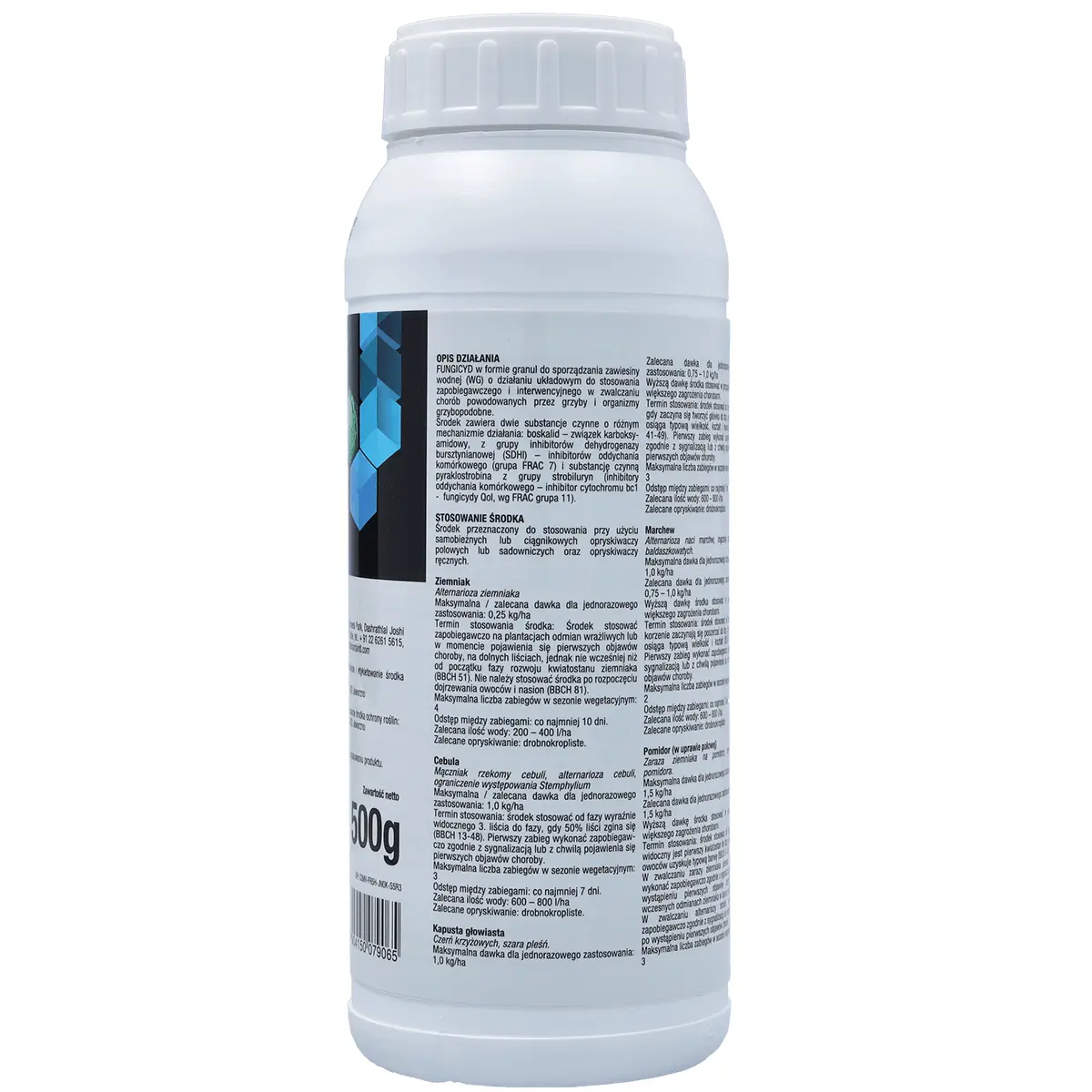
Samar is a fungicide for preventive and curative use in controlling diseases caused by fungi and fungus-like organisms. It is available as water-dispersible granules (WG) with systemic action. It contains two active substances with different modes of action (for even better effectiveness): boscalid and pyraclostrobin. Used in the protection of fruit trees, vegetables, and ornamental plants.
The product is intended for use with self-propelled or tractor-mounted field or orchard sprayers and hand sprayers.
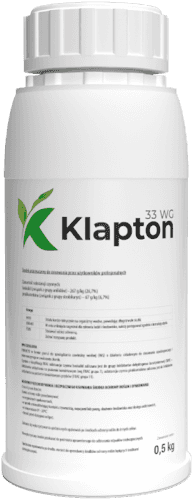
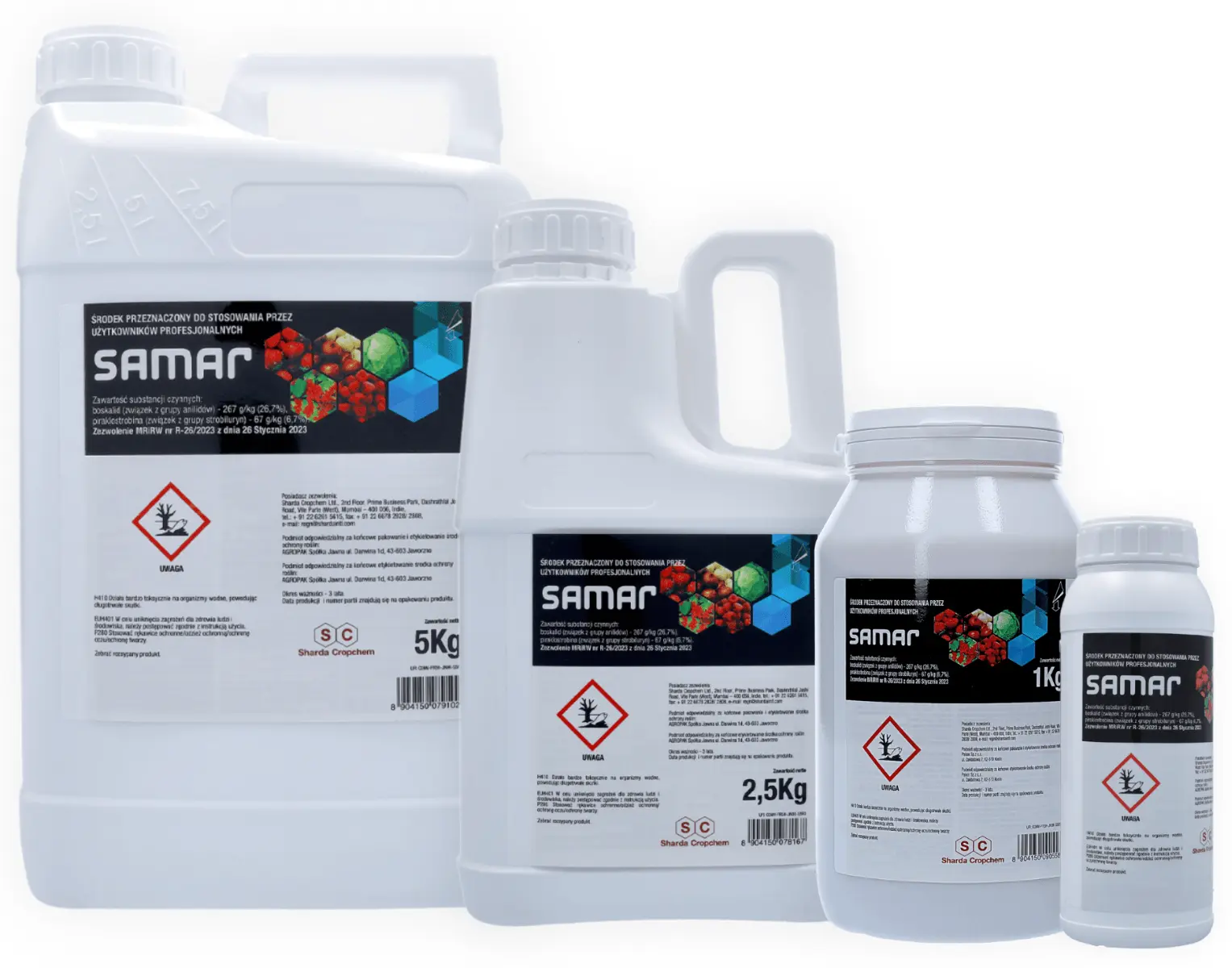
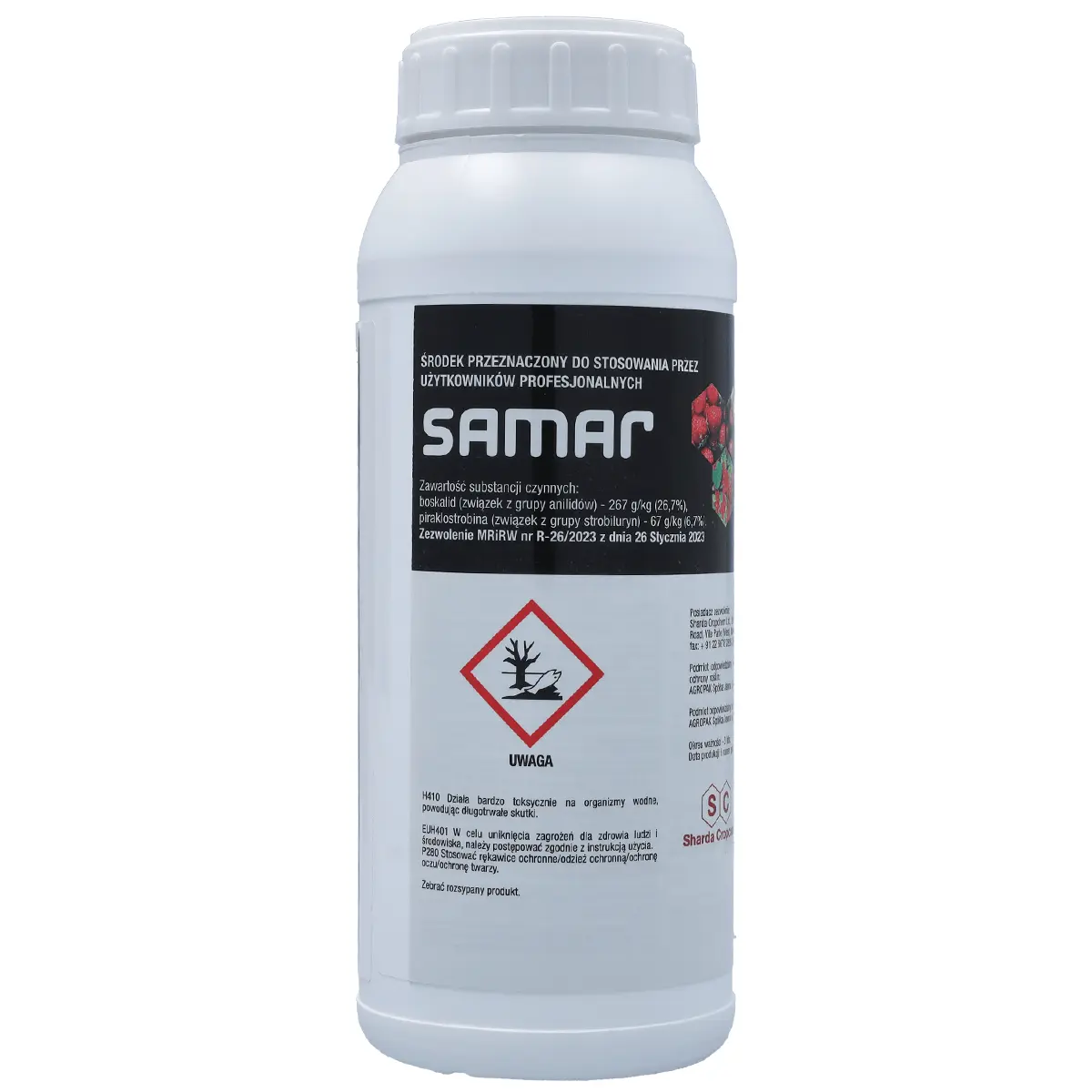
Fungicide Samar - active substance content:
- boscalid (anilide group compound) - 267 g/kg (26.7%),
- pyraclostrobin (strobilurin group compound) - 67 g/kg (6.7%).
Boscalid acts systemically and is intended for preventive and curative action. In the plant, it moves translaminarly through tissues to the lower leaf surface and acropetally with water and plant sap to leaf tips and edges. Boscalid inhibits spore germination, germ tube growth, and fungal appressoria. It disrupts pathogen energy processes by inhibiting respiration through blocking complex II in the mitochondrial electron transport chain, depriving the fungus of energy and limiting the availability of building materials for synthesising essential components for pathogen cell construction. This active substance is especially recommended for controlling grey mould, powdery mildew of cereals and grasses, septoria leaf blotch, sclerotinia stem rot, crucifer black spot, brown rot of stone fruit trees, and many other fungal diseases. It is characterised by a broad spectrum of activity.
Pyraclostrobin exhibits preventive and curative action, also enhancing the plant's ability to resist pathogens. It acts systemically in the plant, moving translaminarly. It strongly inhibits spore germination of fungi such as ascomycetes, basidiomycetes, anamorphic fungi, and oomycetes. Besides its direct effect on pathogens, pyraclostrobin can also influence plant physiology, especially in cereals. For example, it may increase nitrate reductase activity (nitrification), thereby enhancing nitrogen uptake during intensive growth phases. Simultaneously, it reduces ethylene biosynthesis, delaying plant senescence. Even in healthy plants, pyraclostrobin increases resistance to pathogens.
Fungicide Samar - use in crops:
- Potato,
- Onion,
- Head cabbage,
- Carrot,
- Tomato (field cultivation),
- Tomato (protected cultivation),
- Strawberry,
- Sour cherry,
- Raspberry,
- Black currant.
Small-scale:
- Parsnip,
- Root parsley,
- Beetroot,
- Root celery,
- Radish (field cultivation),
- Chives,
- Broccoli,
- Cauliflower,
- Kohlrabi,
- Brussels sprouts,
- Chinese cabbage,
- Leek,
- Welsh onion,
- Shallot,
- Asparagus,
- Lettuce,
- Endive,
- Spinach,
- Dill,
- Leaf parsley,
- Celery stalk,
- Rocket,
- Radish,
- Sweet pepper,
- Eggplant,
- Salad chicory,
- Ornamental plants (field and protected cultivation),
- Peppermint, common basil, sage, thyme, coriander, lovage (field and protected cultivation),
- Sweet cherry,
- Apricot,
- Peach,
- Plum tree,
- Strawberry,
- Wild strawberry,
- Aronia,
- Red currant,
- White currant,
- Gooseberry,
- Blackberry,
- Blueberry,
- Hazelnut,
- Walnut,
- Field pea grown for dry seeds,
- Field pea grown for fresh seeds,
- Feed pea (dry pea) grown for dry seeds,
- Narrow-leafed lupin,
- White lupin,
- Yellow lupin.
Plant protection product Samar - controlled fungal diseases:
- Alternaria leaf spot,
- Downy mildew,
- Reduction of Stemphylium occurrence,
- Crucifer black spot,
- Grey mould,
- Powdery mildew,
- Potato late blight on tomato,
- White leaf spot,
- Brown rot of stone fruit trees,
- Tip dieback,
- Currant anthracnose (leaf drop),
- White pine blister rust on currant,
- Sclerotinia stem rot,
- Rhizoctonia,
- White rust of crucifers,
- Rust,
- Phytophthora,
- Leaf spots,
- Anthracnose,
- Nut grey necrosis,
- Dieback,
- Monilinia,
- Ascochyta (blight leaf spot).
Samar - pre-harvest interval and re-entry period:
Pre-harvest interval - the period from the last application of the product to the day of crop harvest:
Field cultivation:
- Potato, tomato, strawberry, wild strawberry, raspberry, aronia, black currant, white currant, red currant, gooseberry, blackberry, blueberry – 3 days,
- Sour cherry, sweet cherry, apricot, peach, plum tree – 7 days,
- Onion, head cabbage, parsnip, root parsley, beetroot, root celery, chives, radish, broccoli, cauliflower, Brussels sprouts, Chinese cabbage, kohlrabi, lettuce, endive, salad chicory, leek, welsh onion, shallot, spinach, dill, celery stalk, leaf parsley, rocket, peppermint, common basil, sage, thyme, coriander, lovage, field pea grown for fresh seeds – 14 days,
- Field pea grown for dry seeds – 21 days,
- Carrot, walnut, hazelnut – 28 days,
- Ornamental plants, asparagus – not applicable.
Protected cultivation:
- Tomato – 3 days,
- Radish, sweet pepper, eggplant, lettuce, endive, peppermint, common basil, sage, thyme, coriander, lovage – 14 days,
- Ornamental plants – not applicable.
Pre-harvest interval for feed - the period from the last application on plants intended for feed to the day animals can be fed with these plants:
- Feed pea grown for dry seeds (dry pea), narrow-leafed lupin, white lupin, yellow lupin – 21 days.
Re-entry period - the period from application until people can enter the treated area and animals can be introduced:
- Do not enter until the spray liquid has completely dried on the plant surface.
Fungicide Samar - preparation of spray liquid:
Prepare the spray liquid immediately before use. Before preparing, accurately determine the required volume and amount of product. When filling the sprayer, follow the sprayer manufacturer's instructions. If no instructions are available, add the measured amount of product to the sprayer tank partially filled with water (with the agitator on). Rinse empty packaging three times with water, pouring the rinsate into the sprayer tank with the spray liquid, top up with water to the required volume and mix thoroughly. After adding the product to a sprayer tank without hydraulic agitation, mix mechanically. In case of interruptions during spraying, mix the spray liquid thoroughly before resuming work.
Fungicide Samar - usage guidelines:
- As part of resistance management strategy, it is recommended to use the product alternately with fungicides containing active substances from different chemical groups with different modes of action.
- Shorten intervals between treatments in case of higher disease pressure.
- Keep out of reach of children.
- Store the plant protection product:
- in places or facilities with appropriate measures to prevent environmental contamination and access by unauthorized persons,
- in original packaging, preventing contact with food, beverages, or feed,
- at temperatures between 0°C and 30°C, - Protect from moisture.
Warning! Plant protection products must be used safely. Before each use, read the information on the label and product information.
The buyer declares that they meet the conditions specified in Article 25 paragraph 3 point 5 of the Act of 8 March 2013 on plant protection products and has training in the use of plant protection products in the case of products for professional users. Before each use, read the information on the label and product information. Pay attention to detailed risk indications. Follow safety rules contained in the label. Plant protection products may only be purchased by adults and persons who have completed training and possess qualifications required for persons purchasing plant protection products (Article 28 of the Act on plant protection products of 8 March 2013, as amended). Plant protection products must be used in a way that does not pose a threat to human health, animals, or the environment. The buyer of plant protection products must be sober. By using this offer, you declare that you meet the above conditions.
Application and dosage
|
Crop |
Target Pest Control |
How to apply? Dosage |
When to apply? |
|---|---|---|---|
|
Potato |
Potato alternaria leaf spot |
Maximum / recommended dose per single application: 0.25 kg/ha. Maximum number of treatments per growing season: 4 Interval between treatments: at least 10 days. Recommended water volume: 200 – 400 l/ha Recommended spraying: fine droplet. |
Application timing: Apply preventively on sensitive variety plantations or at the first disease symptoms on lower leaves, but not earlier than the beginning of potato inflorescence development (BBCH 51). Do not apply after the start of fruit and seed maturation (BBCH 81). |
|
Onion |
Onion downy mildew, onion alternaria leaf spot, reduction of Stemphylium occurrence |
Maximum / recommended dose per single application: 1.0 kg/ha. Maximum number of treatments per growing season: 3 Interval between treatments: at least 7 days. Recommended water volume: 600 – 800 l/ha Recommended spraying: fine droplet. |
Application timing: Apply from the clearly visible 3rd leaf stage to the stage when 50% of leaves bend (BBCH 13-48). First treatment should be preventive according to signals or at first disease symptoms. |
|
Head cabbage |
Crucifer black spot, grey mould. |
Maximum dose per single application: 1.0 kg/ha Recommended dose per single application: 0.75 – 1.0 kg/ha Use higher dose in case of higher disease pressure. Maximum number of treatments per growing season: 3 Interval between treatments: at least 7 days. Recommended water volume: 600 – 800 l/ha Recommended spraying: fine droplet. |
Application timing: Apply from the stage when the head starts forming to the stage when the head reaches typical size, shape, and firmness (BBCH 41-49). First treatment should be preventive according to signals or at first disease symptoms. |
|
Carrot |
Carrot leaf alternaria, umbelliferous powdery mildew. |
Maximum dose per single application: 1.0 kg/ha Recommended dose per single application: 0.75 – 1.0 kg/ha Use higher dose in case of higher disease pressure. Maximum number of treatments per growing season: 2 Interval between treatments: at least 7 days. Recommended water volume: 600 – 800 l/ha Recommended spraying: fine droplet. |
Application timing: Apply from the stage when roots start to widen to the stage when root reaches typical size and shape (BBCH 41-49). First treatment should be preventive according to signals or at first disease symptoms. |
|
Tomato (field cultivation) |
Potato late blight on tomato, tomato alternaria leaf spot. |
Maximum dose per single application: 1.5 kg/ha Recommended dose per single application: 1 – 1.5 kg/ha Use higher dose in case of higher disease pressure. Maximum number of treatments per growing season: 3 Interval between treatments: at least 7 days. Recommended water volume: 600 – 800 l/ha Recommended spraying: fine droplet. |
Application timing: Apply from the stage when the first inflorescence is visible to the stage when 50% of fruits reach typical colour (BBCH 51-85). For potato late blight control, first treatment should be preventive according to signals or after first disease symptoms on early potato varieties in the region. For alternaria control, apply preventively according to signals or immediately after first disease symptoms. |
|
Tomato (protected cultivation) |
Grey mould, potato late blight on tomato. |
Maximum / recommended concentration per single application: 0.2% (200 g product in 100 l water). Maximum number of treatments per growing season (crop cycle): 2 Interval between treatments: at least 7 days. Spray liquid dose: 100 l /1000 m2. Adjust spray liquid volume to plant height. |
Application timing: Apply from the stage when the first inflorescence is visible to the stage when 50% of fruits reach typical colour (BBCH 51-85). First treatment should be preventive or at first disease symptoms. |
|
Strawberry |
Grey mould, strawberry white leaf spot, strawberry powdery mildew. |
Maximum / recommended dose per single application: 1.8 kg/ha. Number of treatments: 2 Interval between treatments: at least 5 days. Recommended water volume: 500 – 700 l/ha Recommended spraying: fine droplet. Maximum number of treatments per growing season considering product use from other label parts: 2 |
Application timing: Apply from the beginning of flowering to the second harvest phase (late harvest) (BBCH 60-81). |
|
Sour cherry |
Brown rot of stone fruit trees |
Maximum dose per single application: 1.0 kg/ha Recommended dose per single application: 0.75 – 1.0 kg/ha. Maximum number of treatments per growing season: 2 Interval between treatments: at least 5 days. Recommended water volume: 500 – 750 l/ha Recommended spraying: fine droplet. |
Application timing: First treatment at the beginning of flowering (bud burst) (BBCH 60), second treatment at full bloom (BBCH 67). |
|
Raspberry |
Grey mould, raspberry tip dieback. |
For raspberry tip dieback, the product shows moderate control. Maximum / recommended dose per single application: 1.8 kg/ha. Maximum number of treatments per growing season: 2 Interval between treatments: at least 7 days. Recommended water volume: 600 – 700 l/ha Recommended spraying: fine droplet. |
Application timing: Apply preventively or at first disease symptoms, from early inflorescence development (buds closed) to the end of fruit and seed maturation (BBCH 51-90). For grey mould control, apply from beginning of flowering (BBCH 61). For tip dieback control, first treatment before flowering when new shoots reach 10-20 cm (BBCH 51), next during flowering (BBCH 61-69) or after fruit harvest, after cutting old fruiting shoots (BBCH 89-90). |
|
Black currant |
Currant anthracnose (leaf drop), white pine blister rust on currant. |
Product shows moderate control. Maximum / recommended dose per single application: 1.8 kg/ha. Maximum number of treatments per growing season: 2 Interval between treatments: at least 7 days. Recommended water volume: 600 – 800 l/ha Recommended spraying: fine droplet. |
Application timing: Apply preventively or at first disease symptoms. First treatment just before flowering (BBCH 55-59), next after flowering (BBCH 69-90). |
|
Shallot |
Onion downy mildew, onion alternaria leaf spot, reduction of Stemphylium occurrence. |
Maximum / recommended dose per single application: 1.0 kg/ha. Maximum number of treatments per growing season: 3 Interval between treatments: at least 7 days. Recommended water volume: 600 – 800 l/ha Recommended spraying: fine droplet. |
Application timing: Apply from the clearly visible 3rd leaf stage to the stage when 50% of leaves bend (BBCH 13-48). First treatment should be preventive according to signals or at first disease symptoms. |
|
Asparagus |
Grey mould |
Maximum / recommended dose per single application: 1.5 kg/ha. Maximum number of treatments per growing season: 2 Interval between treatments: at least 21 days. Recommended water volume: 600 – 800 l/ha Recommended spraying: fine droplet. |
Application timing: Protection after harvest of spears, from the end of flowering to the stage when all branches have yellowed (BBCH 69-93). First treatment after disease symptoms appear (usually late July to August). |
|
Lettuce, endive (field cultivation) |
Grey mould, sclerotinia stem rot. |
Maximum / recommended dose per single application: 1.5 kg/ha. Number of treatments: 2 Interval between treatments: at least 14 days. Recommended water volume: 600 – 800 l/ha Recommended spraying: fine droplet. Maximum number of treatments per growing season for lettuce and endive: 2 |
Application timing: Apply from the 3rd leaf stage to the end of the stage when the plant reaches 70% of typical leaf mass for the variety (head reaches 70% of typical size) (BBCH 13-47). First treatment should be preventive or at first disease symptoms. |
|
Lettuce, endive (field cultivation) |
Rhizoctonia |
Maximum / recommended dose per single application: 1.5 kg/ha. Number of treatments: 1 Recommended water volume: 600 – 800 l/ha Recommended spraying: fine droplet. Maximum number of treatments per growing season for lettuce and endive: 2 |
Application timing: Apply from the 3rd leaf stage to the end of the stage when the plant reaches 70% of typical leaf mass for the variety (head reaches 70% of typical size) (BBCH 13-47). Treatment should be preventive or at first disease symptoms. |
|
Spinach |
Leaf spots (including anthracnose) |
Maximum / recommended dose per single application: 1.5 kg/ha. Maximum number of treatments per growing season: 2 Interval between treatments: at least 14 days. Recommended water volume: 600 – 800 l/ha Recommended spraying: fine droplet. |
Application timing: Apply from the 3rd leaf stage to the end of the stage when the plant (head) reaches 70% of typical leaf mass for the variety (BBCH 13-47). First treatment should be preventive or at first disease symptoms. |
|
Dill |
Grey mould, sclerotinia stem rot. |
Maximum / recommended dose per single application: 1.5 kg/ha. Number of treatments: 2 Interval between treatments: at least 14 days. Recommended water volume: 600 – 800 l/ha Recommended spraying: fine droplet. Maximum number of treatments per growing season for dill: 2 |
Application timing: Apply preventively or at first disease symptoms, from the five true leaf stage to the stage preceding inflorescence development (BBCH 15-49). |
|
Dill |
Rhizoctonia |
Maximum / recommended dose per single application: 1.5 kg/ha. Number of treatments: 1 Recommended water volume: 600 – 800 l/ha Recommended spraying: fine droplet. Maximum number of treatments per growing season for dill: 2 |
Application timing: Treatment should be preventive or at first disease symptoms, from the five true leaf stage to the stage preceding inflorescence development (BBCH 15-49), especially under high humidity and low air temperature conditions. |
|
Leaf parsley |
Grey mould, sclerotinia stem rot. |
Maximum / recommended dose per single application: 1.5 kg/ha. Number of treatments: 2 Interval between treatments: at least 14 days. Recommended water volume: 600 – 800 l/ha Recommended spraying: fine droplet. Maximum number of treatments per growing season for leaf parsley: 2 |
Application timing: Apply preventively or at first disease symptoms, usually at the beginning of the growing season, from the 3rd leaf stage to the stage when 60% of typical leaf mass for the variety is reached (BBCH 13-46). |
|
Leaf parsley |
Rhizoctonia |
Maximum / recommended dose per single application: 1.5 kg/ha. Number of treatments: 1 Recommended water volume: 600 – 800 l/ha Recommended spraying: fine droplet. Maximum number of treatments per growing season for leaf parsley: 2 |
Application timing: Treatment should be preventive or at first disease symptoms, usually at the beginning of the growing season, from the 3rd leaf stage to the stage when 60% of typical leaf mass for the variety is reached (BBCH 13-46), especially under high humidity and low air temperature conditions. |
|
Celery stalk |
Grey mould, sclerotinia stem rot. |
Maximum / recommended dose per single application: 1.5 kg/ha. Number of treatments: 2 Interval between treatments: at least 14 days. Recommended water volume: 600 – 800 l/ha Recommended spraying: fine droplet. Maximum number of treatments per growing season for celery stalk: 2 |
Application timing: Apply preventively or at first disease symptoms, usually at the beginning of the growing season, from the 5th leaf stage to the stage when typical leaf mass for the variety is reached (BBCH 15-49). |
|
Celery stalk |
Rhizoctonia |
Maximum / recommended dose per single application: 1.5 kg/ha. Number of treatments: 1 Recommended water volume: 600 – 800 l/ha Recommended spraying: fine droplet. Maximum number of treatments per growing season for celery stalk: 2 |
Application timing: Treatment should be preventive or at first disease symptoms, from the 5th leaf stage to the stage when typical leaf mass for the variety is reached (BBCH 15-49), especially under high humidity and low air temperature conditions. |
|
Rocket |
Grey mould, sclerotinia stem rot. |
Maximum / recommended dose per single application: 1.5 kg/ha. Number of treatments: 2 Interval between treatments: at least 14 days. Recommended water volume: 600 – 800 l/ha Recommended spraying: fine droplet. Maximum number of treatments per growing season for rocket: 2 |
Application timing: Apply preventively or at first disease symptoms, usually at the beginning of the growing season from the 3rd leaf stage to the stage when 70% of typical leaf mass for the variety is reached (BBCH 13-47). |
|
Rocket |
Rhizoctonia |
Maximum / recommended dose per single application: 1.5 kg/ha. Number of treatments: 1 Recommended water volume: 600 – 800 l/ha Recommended spraying: fine droplet. Maximum number of treatments per growing season for rocket: 2 |
Application timing: Treatment should be preventive or at first disease symptoms, usually at the beginning of the growing season from the 3rd leaf stage to the stage when 70% of typical leaf mass for the variety is reached (BBCH 13-47), especially under high humidity and low air temperature conditions. |
|
Radish (protected cultivation) |
Grey mould, rhizoctonia. |
Maximum / recommended dose per single application: 1.5 kg/ha. Recommended water volume: 600 – 800 l/ha Recommended spraying: fine droplet. Maximum number of treatments per growing season (production cycle): 1 |
Application timing: Apply from the developed first true leaf stage to the end of the stage when root reaches typical size and shape (BBCH 11-49). First treatment should be preventive or at first disease symptoms. |
|
Sweet pepper, eggplant (protected cultivation) |
Grey mould, sclerotinia stem rot, sweet pepper powdery mildew. |
Maximum / recommended dose per single application: 1.5 kg/ha. Maximum number of treatments per growing season (production cycle): 2 Interval between treatments: at least 7 days. Recommended water volume: 1000 l/ha Recommended spraying: fine droplet. |
Application timing: Apply from the developed second true leaf stage on the main shoot to the end of full maturity stage when fruits have typical colour (BBCH 12-89). First treatment should be preventive, according to signals, or at first disease symptoms. |
|
Lettuce, endive (protected cultivation) |
Grey mould, sclerotinia stem rot. |
Maximum / recommended dose per single application: 1.5 kg/ha. Number of treatments: 2 Interval between treatments: at least 14 days. Recommended water volume: 600 – 800 l/ha Recommended spraying: fine droplet. Maximum number of treatments per growing season for lettuce and endive: 2 |
Application timing: Apply from the 3rd leaf stage to the end of the stage when the plant reaches 70% of typical leaf mass for the variety (BBCH 13-47). First treatment should be preventive or at first disease symptoms. |
|
Lettuce, endive (protected cultivation) |
Rhizoctonia |
Maximum / recommended dose per single application: 1.5 kg/ha. Number of treatments: 1 Recommended water volume: 600 – 800 l/ha Recommended spraying: fine droplet. Maximum number of treatments per growing season for lettuce and endive: 2 |
Application timing: Apply from the 3rd leaf stage to the end of the stage when the plant reaches 70% of typical leaf mass for the variety (BBCH 13-47). Treatment should be preventive or at first disease symptoms. |
|
Salad chicory |
Chicory alternaria leaf spot, chicory rust. |
Maximum / recommended dose per single application: 1.5 kg/ha. Maximum number of treatments per growing season: 2 Interval between treatments: at least 14 days. Recommended water volume: 600 – 800 l/ha Recommended spraying: fine droplet. |
Application timing: Apply from the 3rd leaf stage to the end of the stage when the plant reaches 70% of typical leaf mass for the variety (BBCH 13-47). First treatment should be preventive or at first disease symptoms. |
|
Ornamental plants (field and protected cultivation) |
Alternaria leaf spot |
Maximum / recommended concentration per single application: 0.1 kg/100 l water. Number of treatments: 2 Interval between treatments: at least 7 days. Recommended water volume: 600 – 800 l/ha Recommended spraying: fine droplet. Maximum number of treatments per growing season for ornamental plants: 2 |
Application timing: First treatment should be preventive, according to signals, or at first disease symptoms. |
|
Ornamental plants (field and protected cultivation) |
Powdery mildew |
Maximum / recommended concentration per single application: 0.18 kg/100 l water. Number of treatments: 2 Interval between treatments: at least 7 days. Recommended water volume: 600 – 800 l/ha Recommended spraying: fine droplet. Maximum number of treatments per growing season for ornamental plants: 2 |
Application timing: First treatment should be preventive, according to signals, or at first disease symptoms. |
|
Ornamental plants (field and protected cultivation) |
Grey mould, sclerotinia stem rot, rhizoctonia. |
Maximum / recommended concentration per single application: 0.15 kg/100 l water. Number of treatments: 2 Interval between treatments: at least 7 days. |
Application timing: First treatment should be preventive or at first disease symptoms. |
|
Peppermint, common basil, sage, thyme, coriander, lovage (field and protected cultivation) |
Grey mould, sclerotinia stem rot |
Maximum / recommended dose per single application: 1.5 kg/ha. Number of treatments: 2 Interval between treatments: at least 14 days. Recommended water volume: 600 – 800 l/ha Recommended spraying: fine droplet. Maximum number of treatments per growing season for herbs: 2 |
Application timing: First treatment should be preventive or at first disease symptoms. |
|
Peppermint, common basil, sage, thyme, coriander, lovage (field and protected cultivation) |
Rhizoctonia |
Maximum / recommended dose per single application: 1.5 kg/ha. Number of treatments: 1 Recommended water volume: 600 – 800 l/ha Recommended spraying: fine droplet. Maximum number of treatments per growing season for herbs: 2 |
Application timing: Treatment should be preventive or at first disease symptoms. |
|
Sweet cherry |
Brown rot of stone fruit trees |
Maximum / recommended dose per single application: 0.75 kg/ha. Maximum number of treatments per growing season: 3 Interval between treatments: at least 10 days. Recommended water volume: 500 – 850 l/ha Recommended spraying: fine droplet. |
Application timing: First treatment at white bud stage (BBCH 57). Next treatment at full bloom (BBCH 65). If necessary, another treatment at the beginning of fruit colouring (BBCH 81). |
|
Apricot |
Brown rot of stone fruit trees |
Maximum / recommended dose per single application: 0.75 kg/ha. Maximum number of treatments per growing season: 3 Interval between treatments: at least 10 days. Recommended water volume: 500 – 850 l/ha Recommended spraying: fine droplet. |
Application timing: First treatment at pink bud stage (BBCH 57). Next treatment at full bloom (BBCH 65). If necessary, another treatment about 3 weeks after flowering, up to the beginning of fruit ripening (BBCH 81). |
|
Peach |
Brown rot of stone fruit trees |
Maximum / recommended dose per single application: 0.75 kg/ha. Maximum number of treatments per growing season: 3. Interval between treatments: at least 10 days. Recommended water volume: 500 – 850 l/ha Recommended spraying: fine droplet. |
Application timing: Spray just before flowering only susceptible varieties (BBCH 57). Treatments on all varieties start about 3 weeks after flowering to the beginning of fruit ripening (BBCH 81). |
|
Plum tree |
Brown rot of stone fruit trees |
Maximum / recommended dose per single application: 0.75 kg/ha. Maximum number of treatments per growing season: 3 Interval between treatments: at least 10 days. Recommended water volume: 500 – 850 l/ha Recommended spraying: fine droplet. |
Application timing: Spray just before flowering only susceptible varieties (BBCH 57). Treatments on all varieties start about 3 weeks after flowering to the beginning of fruit ripening (BBCH 81). |
|
Strawberry |
Strawberry anthracnose |
Maximum / recommended dose per single application: 1.8 kg/ha. Number of treatments: 2 Interval between treatments: at least 5 days. Recommended water volume: 500 – 700 l/ha Recommended spraying: fine droplet. Maximum number of treatments per growing season considering product use from earlier label parts: 2 |
Application timing: Apply from the beginning to the end of flowering phase (BBCH 61-69). |
|
Wild strawberry |
Grey mould, strawberry white leaf spot, strawberry powdery mildew, strawberry anthracnose. |
Maximum / recommended dose per single application: 1.8 kg/ha. Maximum number of treatments per growing season: 2 Interval between treatments: at least 5 days. Recommended water volume: 500 – 700 l/ha Recommended spraying: fine droplet. |
Application timing: Apply from the beginning to the end of flowering phase (BBCH 61-69). |
|
Aronia |
Grey mould |
Maximum / recommended dose per single application: 1.8 kg/ha. Maximum number of treatments per growing season: 2 Interval between treatments: at least 7 days. Recommended water volume: 600 – 700 l/ha Recommended spraying: fine droplet. |
Application timing: Apply from the beginning of flowering to the beginning of fruit ripening (BBCH 61-83). |
|
Red currant, white currant |
Currant anthracnose (leaf drop), grey mould. |
Product shows moderate control. Maximum / recommended dose per single application: 1.8 kg/ha. Maximum number of treatments per growing season: 2 Interval between treatments: at least 7 days. Recommended water volume: 600 – 800 l/ha. Recommended spraying: fine droplet. |
Application timing: Apply preventively or at first disease symptoms. First treatment just before flowering (BBCH 55-59), next after flowering to the end of fruit ripening (BBCH 69-90). |
|
Gooseberry |
Currant anthracnose (leaf drop), grey mould. |
Product shows moderate control. Maximum / recommended dose per single application: 1.8 kg/ha. Maximum number of treatments per growing season: 2 Interval between treatments: at least 7 days. Recommended water volume: 600 – 800 l/ha Recommended spraying: fine droplet. |
Application timing: Apply preventively or at first disease symptoms. First treatment just before flowering (BBCH 55-59), next after flowering to the end of fruit ripening (BBCH 69-90). |
|
Blackberry |
Grey mould, blackberry tip dieback. |
For blackberry tip dieback, the product shows moderate control. Maximum / recommended dose per single application: 1.8 kg/ha. Maximum number of treatments per growing season: 2 Interval between treatments: at least 7 days. Recommended water volume: 600 – 700 l/ha Recommended spraying: fine droplet. |
Application timing: Apply preventively or at first disease symptoms, from early inflorescence development (buds closed) to the end of fruit and seed maturation (BBCH 51-90). For grey mould control, apply from beginning of flowering (BBCH 61). For tip dieback control, first treatment before flowering when new shoots reach 10-20 cm (BBCH 51), next during flowering (BBCH 61-69) or after fruit harvest, after cutting old fruiting shoots (BBCH 89-90). |
|
Blueberry |
Grey mould |
Maximum / recommended dose per single application: 1.5 kg/ha. Maximum number of treatments per growing season: 2 Interval between treatments: at least 10 days. Recommended water volume: 500 – 1000 l/ha Recommended spraying: fine droplet. |
Application timing: Apply preventively or at first disease symptoms, from the initial flowering phase to advanced ripening, when the first berries at the base of the cluster reach the characteristic species colour (BBCH 61-85). |
|
Hazelnut, walnut |
Alternaria leaf spot, nut grey necrosis, anthracnose, walnut anthracnose, hazelnut shoot dieback, hazelnut monilinia. |
Maximum / recommended dose per single application: 1.0 kg/ha. Interval between treatments: at least 10 days. Maximum number of treatments per growing season: 2 Recommended water volume: 600 – 1500 l/ha Recommended spraying: fine droplet. |
Application timing: Apply preventively or at first disease symptoms. Apply from the beginning of flowering to the end of fruit development (BBCH 61-79). |
|
Field pea grown for dry seeds |
Pea ascochyta (ascochyta blight) |
Maximum / recommended dose per single application: 1.0 kg/ha. Maximum number of treatments per growing season: 2 Interval between treatments: at least 14 days. Recommended water volume: 200 – 400 l/ha Recommended spraying: fine droplet. |
Application timing: Apply preventively or at first disease symptoms. Apply from the beginning of flowering to the end of pod development (BBCH 60-80). |
|
Field pea grown for fresh seeds |
Pea ascochyta (ascochyta blight) |
Maximum / recommended dose per single application: 1.0 kg/ha. Maximum number of treatments per growing season: 1 Recommended water volume: 200 – 400 l/ha Recommended spraying: fine droplet. |
Application timing: Apply preventively or at first disease symptoms. Apply from the beginning of flowering to the end of pod development (BBCH 60-80). |
|
Feed pea (dry pea) grown for dry seeds |
Pea rust, pea chocolate spot. |
Maximum / recommended dose per single application: 1.0 kg/ha. Maximum number of treatments per growing season: 2 Interval between treatments: at least 21 days. Recommended water volume: 200-300 l/ha Recommended spraying: fine droplet. |
Application timing: Apply preventively or at first disease symptoms. Apply from the end of inflorescence development to the end of pod growth (BBCH 59-80). |
|
Narrow-leafed lupin, white lupin, yellow lupin |
Grey mould, lupin rust, lupin ascochyta, brown leaf spot of lupin. |
Maximum / recommended dose per single application: 1.0 kg/ha. Apply from the beginning of flowering to the end of pod growth (BBCH 60-80). Maximum number of treatments per growing season: 2 Interval between treatments: at least 21 days. Recommended water volume: 200-300 l/ha Recommended spraying: fine droplet. |
Application timing: Apply preventively or at first disease symptoms. |