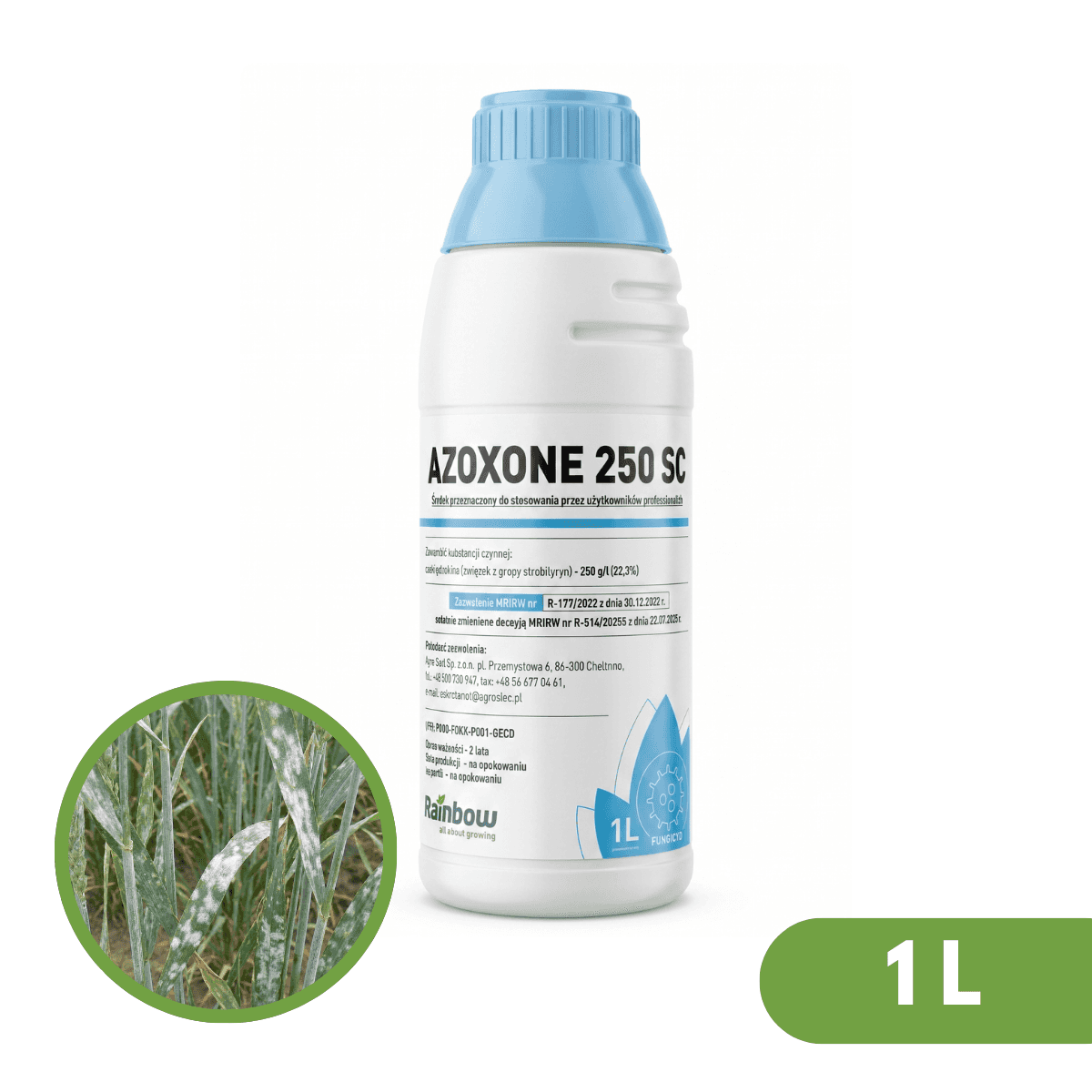
MODE OF ACTION OF AZO-MAT 250 SC:
AZO-MAT 250 SC is an innovative product with powerful penetrating and systemic action. This means that after application, the product quickly penetrates plant tissues and then moves with the plant sap, protecting even those parts that were not directly covered by the spray liquid during the treatment. This creates a comprehensive and long-lasting protective shield against attacks by dangerous pathogens and fungus-like organisms.
This product is primarily intended for preventive use. Applied early enough, it blocks fungal respiration processes at the cellular level, preventing infection development. It ensures excellent plant condition, the so-called "greenness" effect (prolongs the photosynthetic activity of leaves), which directly translates into maximising yield and its highest market quality.
CONTENT OF ACTIVE SUBSTANCES:
azoxystrobin (a substance from the strobilurin group) - 250 g/l (22.86%)
Advantages of using AZO-MAT 250 SC:
- Strong penetrating and systemic action: Guarantees reliable protection of developing plants from the inside, regardless of adverse weather conditions.
- Wide spectrum of protection: Extremely versatile fungicide combating key diseases in cereals, oilseed rape, and field and protected vegetable crops.
- Physiological effect ("green leaf"): Improves crop vigour, delays tissue ageing, and stimulates efficient photosynthesis, resulting in high yield formation.
Pre-harvest interval:
- Cereals - 35 days
- Hops - 28 days
- Oilseed rape, leek - 21 days
- Onion, garlic, shallot, cabbage, Chinese cabbage, cauliflower, pea for green seeds, celeriac, lettuce, carrot - 14 days
- Potato, runner bean - 7 days
- Sweet pepper, tomato - 3 days
AZO-MAT 250 SC - SCOPE OF USE, TIMING AND DOSES:
Winter wheat, spring wheat
| Target pests: |
powdery mildew of cereals and grasses, brown leaf spot, brown rust of wheat, septoria leaf blotch, septoria glume blotch, fusarium head blight, black grain mould |
| Maximum / recommended dose: |
0.8 l/ha |
| Application timing: |
Preventively or immediately after first symptoms appear, from the beginning of stem elongation to the end of heading phase (BBCH 30-59). |
| Maximum number of treatments per season: |
1 |
| Recommended water volume: |
200 - 300 l/ha (fine droplet spraying) |
Winter barley, spring barley
| Target pests: |
rhynchosporium of cereals (medium control level) |
| Maximum / recommended dose: |
0.8 l/ha |
| Application timing: |
Preventively or immediately after first symptoms appear, from the beginning of stem elongation to the end of heading phase (BBCH 30-59). |
| Maximum number of treatments per season: |
1 |
| Recommended water volume: |
200 - 300 l/ha (fine droplet spraying) |
Winter triticale
| Target pests: |
septoria glume blotch, brown rust |
| Maximum / recommended dose: |
0.8 l/ha |
| Application timing: |
Preventively or immediately after first symptoms appear, from the beginning of stem elongation to the end of heading phase (BBCH 30-59). |
| Maximum number of treatments per season: |
1 |
| Recommended water volume: |
200 - 300 l/ha (fine droplet spraying) |
Winter rye
| Target pests: |
brown rust of rye, rhynchosporium of cereals |
| Maximum / recommended dose: |
0.8 l/ha |
| Application timing: |
Preventively or immediately after first symptoms appear, from the beginning of stem elongation to the end of heading phase (BBCH 30-59). |
| Maximum number of treatments per season: |
1 |
| Recommended water volume: |
200 - 300 l/ha (fine droplet spraying) |
Winter oilseed rape
| Target pests: |
blackleg, grey mould, sclerotinia stem rot |
| Maximum / recommended dose: |
0.8 l/ha |
| Application timing: |
Preventively or immediately after first symptoms appear, during oilseed rape flowering (BBCH 60-69). |
| Maximum number of treatments per season: |
1 |
| Recommended water volume: |
200 - 300 l/ha (fine droplet spraying) |
Potato
| Target pests: |
potato rhizoctonia |
| Maximum / recommended dose: |
2.0 - 3.0 l/ha |
| Application timing: |
Band spraying of soil during spring tuber planting (BBCH 00), using planter equipment. Avoid direct spraying of tubers. |
| Number of treatments: |
1 |
| Recommended water volume: |
300 - 400 l/ha |
| Target pests: |
potato alternaria leaf spot |
| Maximum / recommended dose: |
0.5 l/ha |
| Application timing: |
Preventively or immediately after symptoms appear, from beginning of flower development to fruit and seed maturation (BBCH 51-85). |
| Number of treatments: |
3 (minimum interval 7 days) |
| Recommended water volume: |
300 - 400 l/ha (fine droplet spraying) |
| Maximum number of treatments per season: |
4 (total in the crop) |
Onion, garlic, shallot
| Target pests: |
onion downy mildew, onion alternaria leaf spot, grey mould (neck rot) |
| Maximum / recommended dose: |
0.8 l/ha |
| Application timing: |
From 4-leaf stage to end of bulb formation for harvest (BBCH 14-48). Adjuvant addition recommended. |
| Maximum number of treatments: |
3 (minimum interval between treatments: 7 days) |
| Recommended water volume: |
200 - 700 l/ha |
Runner bean
| Target pests: |
bean anthracnose, grey mould, sclerotinia stem rot, ascochyta blight |
| Maximum / recommended dose: |
0.8 l/ha |
| Application timing: |
From beginning of flowering to pod development phase (BBCH 60-72). |
| Maximum number of treatments: |
2 (minimum interval between treatments: 14 days) |
| Recommended water volume: |
150 - 800 l/ha |
Pea for green seeds
| Target pests: |
pea ascochyta blight (spot blight), pea downy mildew |
| Maximum / recommended dose: |
0.8 l/ha |
| Application timing: |
From beginning of flower development to end of flowering phase (BBCH 51-69). |
| Maximum number of treatments: |
2 (minimum interval between treatments: 14 days) |
| Recommended water volume: |
200 - 700 l/ha |
Cabbage, Chinese cabbage, cauliflower
| Target pests: |
blackleg (alternaria leaf spot), grey mould |
| Maximum / recommended dose: |
0.8 l/ha |
| Application timing: |
From 6-leaf stage to end of development of the harvestable part of the plant (BBCH 16-49). Adjuvant recommended. |
| Maximum number of treatments: |
2 (minimum interval between treatments: 12 days) |
| Recommended water volume: |
200 - 700 l/ha |
Carrot
| Target pests: |
carrot leaf alternaria, powdery mildew of umbellifers |
| Maximum / recommended dose: |
0.8 l/ha |
| Application timing: |
From 6-leaf stage to end of development of the harvestable part of the plant (BBCH 16-49). |
| Maximum number of treatments: |
3 (minimum interval between treatments: 7 days) |
| Recommended water volume: |
200 - 700 l/ha |
Lettuce (field cultivation)
| Target pests: |
lettuce downy mildew, grey mould, sclerotinia stem rot, powdery mildew |
| Maximum / recommended dose: |
0.8 l/ha |
| Application timing: |
From beginning of development of harvestable parts to end of this phase (BBCH 41-49). |
| Maximum number of treatments: |
2 (minimum interval between treatments: 7 days) |
| Recommended water volume: |
300 - 1200 l/ha |
Tomato (field cultivation)
| Target pests: |
potato late blight, tomato alternaria leaf spot |
| Maximum / recommended dose: |
0.8 l/ha |
| Application timing: |
From beginning of side shoot development to end of fruit ripening phase (BBCH 21-89). Do not apply in early growth phase or on wet plants. |
| Maximum number of treatments: |
3 (minimum interval between treatments: 7 days) |
| Recommended water volume: |
400 - 1200 l/ha (fine droplet spraying) |
Leek
| Target pests: |
leek rust, leek alternaria leaf spot |
| Maximum / recommended dose: |
0.8 l/ha |
| Application timing: |
From 6-leaf stage to end of leek growth phase (BBCH 16-48). |
| Maximum number of treatments: |
2 (minimum interval between treatments: 12 days) |
| Recommended water volume: |
200 - 1000 l/ha |
Celeriac
| Target pests: |
celery septoria leaf blotch |
| Maximum / recommended dose: |
0.8 l/ha |
| Application timing: |
From 6-leaf stage to end of development of the harvestable part of the plant (BBCH 16-49). |
| Maximum number of treatments: |
2 (minimum interval between treatments: 14 days) |
| Recommended water volume: |
200 - 700 l/ha |
Sweet pepper (protected cultivation - greenhouses)
| Target pests: |
grey mould, sclerotinia stem rot, powdery mildew, sweet pepper alternaria leaf spot |
| Recommended concentration: |
0.08 - 0.1% (80-100 ml per 100 l of water) |
| Application timing: |
From 6-leaf stage to end of fruit ripening phase (BBCH 16-89). |
| Maximum number of treatments: |
2 (minimum interval between treatments: 7 days) |
| Recommended spray volume: |
40 - 150 l / 1000 m2 |
Lettuce (protected cultivation)
| Target pests: |
grey mould, powdery mildew, lettuce downy mildew, sclerotinia stem rot, rhizoctonia |
| Recommended concentration: |
0.08 - 0.1% (80-100 ml per 100 l of water) |
| Application timing: |
From 4-leaf stage to end of development of plant parts (BBCH 14-49). |
| Maximum number of treatments: |
2 (minimum interval between treatments: 7 days) |
| Recommended spray volume: |
30 - 120 l / 1000 m2 |
SMALL-AREA APPLICATIONS:
The user alone is responsible for the efficacy and phytotoxicity of the plant protection product used in small-area crops.
Hops
| Target pests: |
hop downy mildew (prevention of secondary infections) |
| Maximum / recommended dose: |
1.6 l/ha |
| Application timing: |
From end of flower development phase (BBCH 55). |
| Maximum number of treatments: |
2 (minimum interval between treatments: 14 days) |
| Recommended water volume: |
1000 - 4000 l/ha |
Onion, garlic, shallot
| Target pests: |
leaf spot (Cladosporium), leek rust (on onion), rot (Sclerotium) |
| Maximum / recommended dose: |
0.8 l/ha |
| Application timing: |
From 4-leaf stage to end of bulb formation for harvest (BBCH 14-48). |
| Maximum number of treatments: |
3 (total) (minimum interval between treatments: 7 days) |
| Recommended water volume: |
200 - 700 l/ha |
Runner bean
| Target pests: |
bean rust |
| Maximum / recommended dose: |
0.8 l/ha |
| Application timing: |
From developed 7th true leaf stage to pod development phase (BBCH 17-72). |
| Maximum number of treatments: |
2 (total) (minimum interval between treatments: 14 days) |
| Recommended water volume: |
150 - 800 l/ha |
Cabbage, Chinese cabbage, cauliflower
| Target pests: |
white spot of crucifers |
| Maximum / recommended dose: |
0.8 l/ha |
| Application timing: |
From 6-leaf stage to end of development of the harvestable part of the plant (BBCH 16-49). |
| Maximum number of treatments: |
2 (total) (minimum interval between treatments: 12 days) |
| Recommended water volume: |
200 - 700 l/ha |
Tomato (field cultivation)
| Target pests: |
tomato powdery mildew |
| Maximum / recommended dose: |
0.8 l/ha |
| Application timing: |
From beginning of side shoot development to full fruit maturity (BBCH 21-89). |
| Maximum number of treatments: |
3 (total) (minimum interval between treatments: 7 days) |
| Recommended water volume: |
400 - 1200 l/ha |
Leek
| Target pests: |
leaf spot (Cladosporium), phytophthora |
| Maximum / recommended dose: |
0.8 l/ha |
| Application timing: |
From 6-leaf stage to end of leek growth phase (BBCH 16-48). |
| Maximum number of treatments: |
2 (total) (minimum interval between treatments: 12 days) |
| Recommended water volume: |
200 - 1000 l/ha |
Lettuce (field and protected cultivation)
| Target pests: |
rhizoctonia |
| Recommended dose / concentration: |
Field cultivation: 0.8 l/ha
Protected cultivation: 0.08 - 0.1% (80-100 ml / 100 l) |
| Application timing: |
From 4-leaf stage to end of development phase (BBCH 14-49). |
| Maximum number of treatments: |
2 (minimum interval between treatments: 7 days) |
| Recommended spray volume: |
Field cultivation: 300-1200 l/ha
Protected cultivation: 30-120 l/1000 m2 |
 SKU CH-15265