 SKU 40066-c
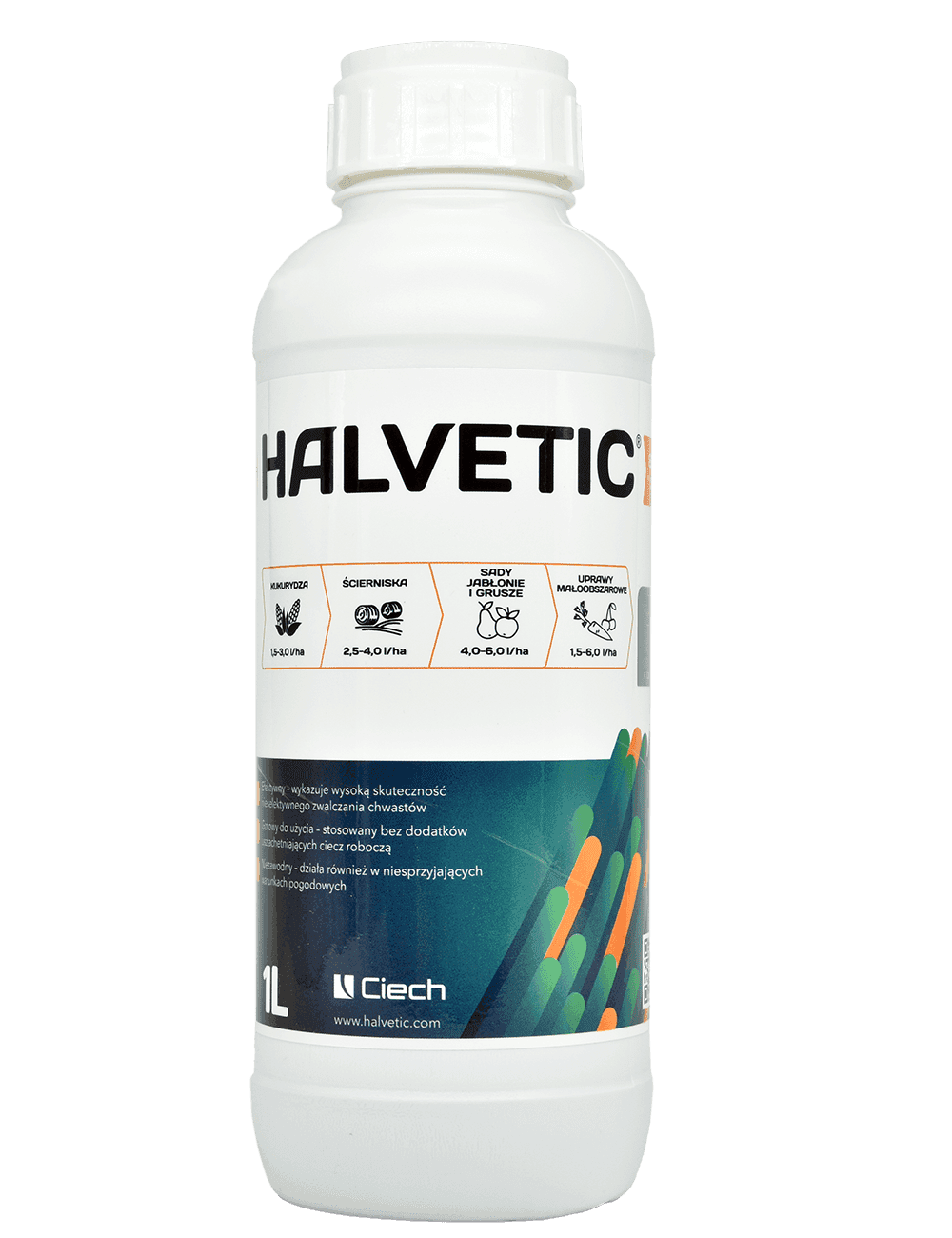
Halvetic 180 SL (glyphosate) - herbicide
Halvetic 180 SL is a herbicide available as a water-soluble concentrate. It contains glyphosate (180 g/l), which inhibits the EPSP synthase enzyme, leading to plant death.
Description
Halvetic - an effective product for weed control
What are the benefits of using Halvetic?
- For controlling a wide range of weeds,
- For use with self-propelled or tractor-mounted field sprayers,
- Causes a reduction of active substance use per hectare by half,
- In concentrate form (convenience),
- Effective in hard water and under adverse stress conditions,
- Effective in weed control.
Halvetic 180 SL is a herbicide. It is available as a water-soluble concentrate (SL).
Halvetic contains glyphosate. The active substance glyphosate inhibits the EPSP synthase enzyme, which is a key metabolic enzyme involved in plant biosynthesis.
Halvetic features a breakthrough, patented glyphosate technology called BGT. It contains half the dose of active substance (180 SL), yet its field efficacy at the same dose per hectare is identical to the standard product (360 SL).
The product is intended for use with self-propelled or tractor-mounted field sprayers.
What is the active substance content in Halvetic 180 SL?
- Active substance content: glyphosate (a phosphonic acid derivative) in the form of isopropylamine salt - 180 g/l (14.83%).
How does Halvetic work?
Halvetic is absorbed through various green parts of the plants. Then the product moves within the plant, reaching underground parts such as roots and rhizomes. This is how it causes the entire plant to die.
When will I see the first effects of Halvetic?
The first symptoms, such as yellowing and wilting, appear 7-10 days after treatment. After this time, plants should not be removed to allow complete death, which occurs after 2-4 weeks.
Under warm and moist conditions, the product acts faster.
What is the pre-harvest interval when using Halvetic 180 SL?
The interval from the last application to crop harvest, i.e. the pre-harvest interval, is:
- Apple and pear orchards – 7 days,
- Other uses - not required.
What are the recommendations for using Halvetic?
- All crops can be grown on fields where the product was applied.
- Tillage, sowing or planting can begin 2 days after treating annual weeds and 5 days after treating perennial weeds. If both annual and perennial weeds were controlled simultaneously, tillage should be done after 5 days.
- The interval from the last application to sowing or planting succeeding crops: 2 - 5 days.
- Do not use the plant protection product in parks and public gardens, sports and recreational areas, schools, kindergartens, nurseries, and healthcare facilities.
- Adjust the dose according to the sensitivity of dominant weed species in the crop.
- Do not apply:
– before weed emergence,
– on leaves, shoots, or non-lignified bark of trees and shrubs due to risk of damage,
– on wet plants,
– before expected rain (rain within 1 hour after spraying may reduce efficacy),
– during windy conditions that may cause spray drift. - During application, avoid:
– spray drift onto neighbouring crop plantations,
– overlapping spray on treatment strip edges and headlands.
For more information on using Halvetic, please visit the Orchard Advisory website.
Warning! Use plant protection products safely. Before each use, read the label and product information carefully.
The buyer declares that they meet the conditions specified in Article 25(3)(5) of the Act of 8 March 2013 on plant protection products and have training in the use of plant protection products for professional users. Before each use, read the label and product information carefully. Pay attention to detailed risk indications. Follow safety rules on the label. Plant protection products may only be purchased by adults who have completed training and hold the required qualifications (Article 28 of the Act on plant protection products of 8 March 2013, as amended). Use plant protection products in a way that does not pose a risk to human health, animals, or the environment. The buyer must be sober. By purchasing, you declare that you meet the above conditions.
Application and dosage
|
Crop |
Target Pest Control |
How to apply? Dosage |
When to apply? |
|---|---|---|---|
|
maize |
cornflower, annual grass, field violet, common chickweed, white goosefoot, scentless mayweed, couch grass, black nightshade, knotweed, volunteer cereals, shepherd's purse, field pennycress, small-flowered yellowcress |
Maximum dose for single application: 3.0 l/ha. Recommended water volume: 100-300 l/ha. |
Apply after sowing but before maize emergence (BBCH 00-09). Maximum number of treatments per growing season: 1 |
|
post-harvest, before starting post-harvest cultivation, stubble field |
cornflower, annual grass, field violet, common chickweed, white goosefoot, scentless mayweed, couch grass, black nightshade, knotweed, volunteer cereals, shepherd's purse, field pennycress, small-flowered yellowcress, common mugwort, red fescue, common yarrow, brome grass, common dandelion, common nettle, common ragwort, sand reed, annual meadow grass |
Maximum dose for single application: 4.0 l/ha. Recommended water volume: 100-300 l/ha. |
Apply after crop harvest until late autumn on green, actively growing weeds. After crop harvest and before application, do not perform any tillage, especially when controlling perennial weeds (mainly couch grass). At application, couch grass should be at least 10-25 cm tall and have at least 3-4 fully developed leaves. Annual monocotyledonous weeds should be at least 5 cm tall, and dicotyledonous weeds should have two fully developed true leaves. Maximum number of treatments per growing season: 1. |
|
apple and pear orchards |
cornflower, annual grass, field violet, common chickweed, white goosefoot, scentless mayweed, couch grass, black nightshade, knotweed, volunteer cereals, shepherd's purse, field pennycress, small-flowered yellowcress, common mugwort, red fescue, common yarrow, brome grass, common dandelion, common nettle, common ragwort, sand reed, annual meadow grass, ribwort plantain |
Maximum dose for single application: 6.0 l/ha. Recommended water volume: 100-300 l/ha. Maximum dose for single application: 60.0 ml/100 m2. Recommended water volume: 1.0 - 3.0 l/100 m2. |
Apply from spring to autumn on green weeds during their intensive growth. Use higher doses on well-developed weeds. Maximum number of treatments per growing season: 1. |
|
non-agricultural land, tram tracks, storage yards, industrial areas, road shoulders, roads, paths, sidewalks |
cornflower, annual grass, field violet, common chickweed, white goosefoot, scentless mayweed, couch grass, black nightshade, knotweed, volunteer cereals, shepherd's purse, field pennycress, small-flowered yellowcress, common mugwort, red fescue, common yarrow, brome grass, common dandelion, common nettle, common ragwort, sand reed, annual meadow grass, ribwort plantain |
Maximum dose for single application: 6.0 l/ha. Apply using self-propelled or tractor-mounted field sprayers or hand sprayers (including backpack sprayers). When using hand sprayers (including backpack sprayers), use a 2% spray liquid concentration, e.g. 0.2 l product per 10 litres of water. Recommended water volume: 100-300 l/ha. Maximum dose for single application: 60.0 ml/100 m2. Recommended water volume: 1.0 - 3.0 l/100 m2. |
Apply during the period of intensive green plant growth throughout the growing season. Adjust dose and timing according to weed species present. For a high proportion of perennial weeds to ensure lasting control, a second spray in the second half of the growing season is recommended. Maximum number of treatments per growing season: 1. |
|
sour cherry, sweet cherry, plum tree, peach, apricot, nectarine, wild apple, Asian pear, quince, medlar, grapevine, sweet chestnut, common hazel, walnut (small area crops) |
cornflower, annual grass, field violet, common chickweed, white goosefoot, scentless mayweed, couch grass, black nightshade, knotweed, volunteer cereals, shepherd's purse, field pennycress, small-flowered yellowcress, common mugwort, red fescue, common yarrow, brome grass, common dandelion, common nettle, common ragwort, sand reed, annual meadow grass, ribwort plantain |
Maximum dose for single application: 6.0 l/ha. Recommended water volume: 100-300 l/ha. |
Apply from the stage when flower buds swell but are closed in light brown scales until the beginning of ripening when fruits are coloured (BBCH 51 -81), on green weeds during their intensive growth. Maximum number of treatments per growing season: 1. |
|
carrot, parsley, parsnip, salsify, rutabaga, Japanese radish, radish, black radish, turnip, sugar beet, celeriac, horseradish, Jerusalem artichoke, root chicory, leaf chicory, tomato, eggplant (small area crops) |
annual grass, field violet, white goosefoot, scentless mayweed, knotweed, cornflower, common chickweed, couch grass, black nightshade, volunteer cereals, shepherd's purse, field pennycress, small-flowered yellowcress |
Maximum dose for single application: 3.0 l/ha. Recommended water volume: 100-300 l/ha. |
Apply after sowing but before crop emergence (BBCH 00-09). Maximum number of treatments per growing season: 1. |
|
leek, chive, Welsh onion, zucchini, pattypan squash, marrow, cauliflower, cabbage, kale, rocket, corn salad, endive, garden cress, lettuce (small area crops) |
annual grass, field violet, white goosefoot, scentless mayweed, knotweed, cornflower, common chickweed, couch grass, black nightshade, volunteer cereals, shepherd's purse, field pennycress, small-flowered yellowcress |
Maximum dose for single application: 3.0 l/ha. Recommended water volume: 100-300 l/ha. |
Apply up to 3 days before sowing or planting the crop (BBCH 00). Maximum number of treatments per growing season: 1. |
|
onion, Welsh onion, garlic, shallot (small area crops) |
annual grass, field violet, white goosefoot, scentless mayweed, knotweed, cornflower, common chickweed, couch grass, black nightshade, volunteer cereals, shepherd's purse, field pennycress, small-flowered yellowcress |
Maximum dose for single application: 3.0 l/ha. Recommended water volume: 100-300 l/ha. |
Apply after sowing but before emergence or before planting the crop (BBCH 00-03). Maximum number of treatments per growing season: 1. |
|
zucchini (small area crops) |
annual grass, field violet, white goosefoot, scentless mayweed, knotweed, cornflower, common chickweed, couch grass, black nightshade, volunteer cereals, shepherd's purse, field pennycress, small-flowered yellowcress |
Maximum dose for single application: 3.0 l/ha. Recommended dose for single application: 1.5 - 3.0 l/ha. Recommended water volume: 100-300 l/ha. |
Apply after sowing but before crop emergence (BBCH 00-09). Maximum number of treatments per growing season including earlier label uses: 1. |
|
sweet corn, popping corn, sorghum, millet (small area crops) |
annual grass, field violet, white goosefoot, scentless mayweed, knotweed, cornflower, common chickweed, couch grass, black nightshade, volunteer cereals, shepherd's purse, field pennycress, small-flowered yellowcress |
Maximum dose for single application: 3.0 l/ha. Recommended water volume: 100-300 l/ha. |
Apply before sowing or after sowing but before crop emergence (BBCH 00-09). Maximum number of treatments per growing season: 1. |
|
tobacco, willow (syn. energy willow), purple willow (syn. wicker) (small area crops) |
cornflower, annual grass, field violet, common chickweed, white goosefoot, scentless mayweed, couch grass, black nightshade, knotweed, volunteer cereals, shepherd's purse, field pennycress, small-flowered yellowcress, common mugwort, red fescue, common yarrow, brome grass, common dandelion, common nettle, common ragwort, sand reed, annual meadow grass, ribwort plantain |
Maximum dose for single application: 6.0 l/ha. Recommended water volume: 100-300 l/ha. |
Apply before planting the crop. Maximum number of treatments per growing season: 1. |
|
ornamental plants, ornamental nursery plants, forest nursery plants, regeneration, afforestation, forest tree seed plantations, Christmas tree plantations |
annual grass, field violet, white goosefoot, scentless mayweed, knotweed, cornflower, common chickweed, couch grass, black nightshade, volunteer cereals, shepherd's purse, field pennycress, small-flowered yellowcress |
Maximum dose for single application: 3.0 l/ha. Recommended water volume: 100-300 l/ha. |
Apply during the growing season (BBCH 00-99). Maximum number of treatments per growing season: 1. |