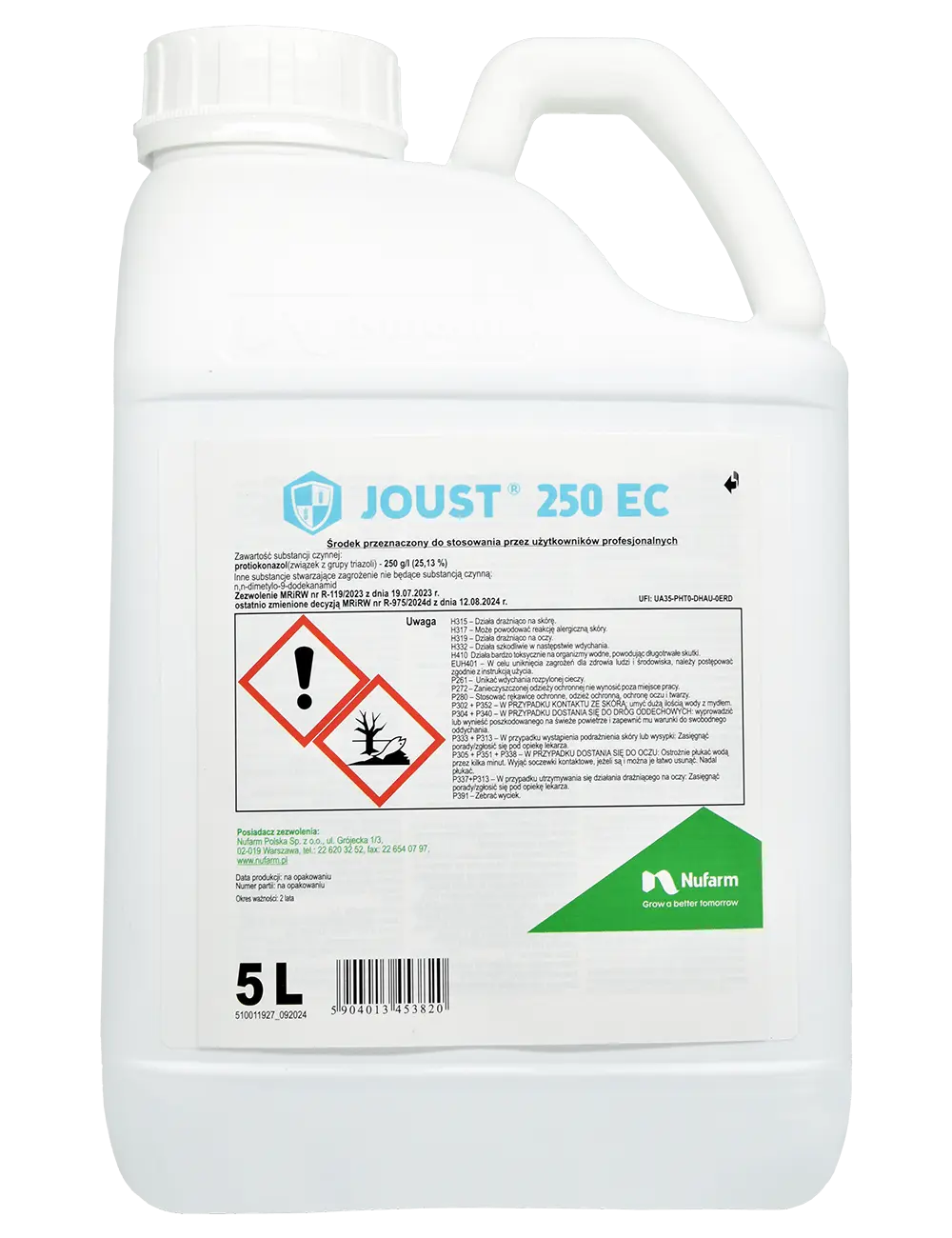
 SKU CH-13135
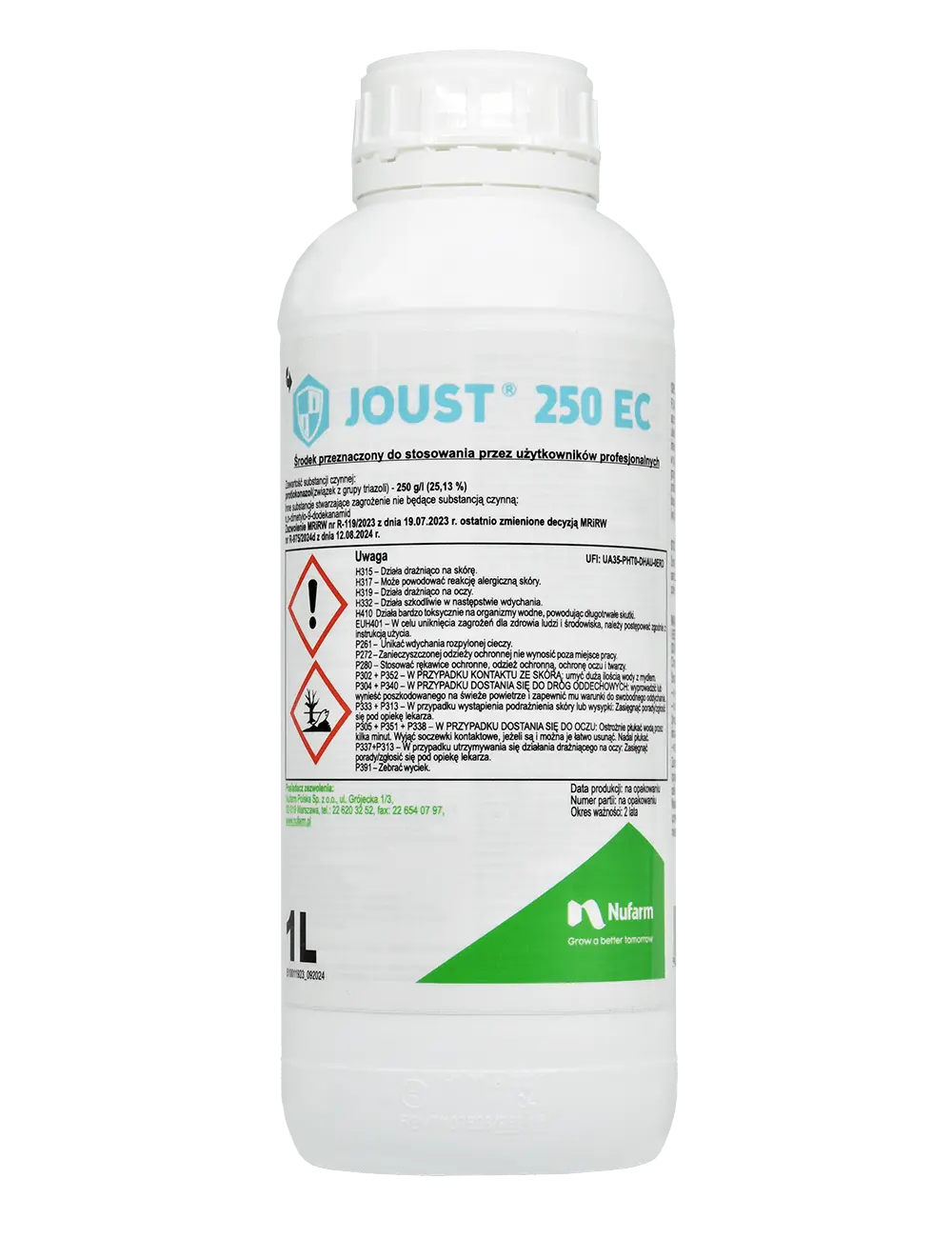
Joust 250 EC
Description
ACTION OF JOUST 250 EC:
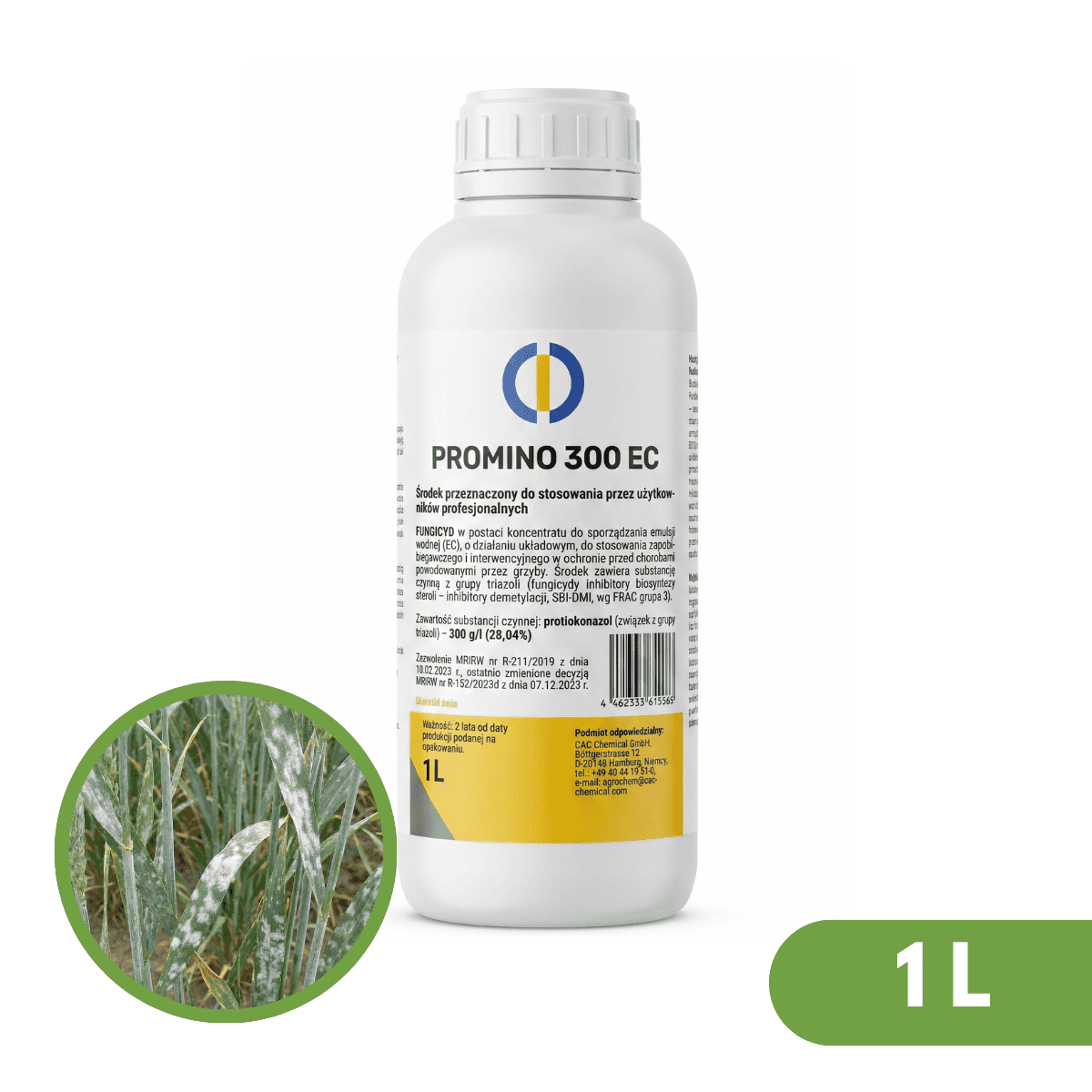
Joust 250 EC is a fungicide in the form of a concentrate for preparing a water emulsion (EC). The product contains protioconazole - a well-known and valued active substance effective in fungicidal protection. The product has systemic action and is intended for preventive, as well as intervention and eradication use in the control of diseases caused by fungi.
Advantages of using Joust 250 EC:
- contains protioconazole - very effective in fungicidal protection,
- wide range of applications - registered for almost all cereal species as well as oilseed rape and mustard,
- flexible application timing in cereals and oilseed rape,
- contains advanced formulation technology that ensures better solubility and stability of the spray liquid.
JOUST 250 EC ACTIVE SUBSTANCE CONTENT:
protioconazole (compound from the triazole group) - 250 g/l (25.13%)
JOUST 250 EC SCOPE OF APPLICATION, TIMING AND DOSES:
The product is intended for use with self-propelled or tractor-mounted field sprayers.
How to use Joust 250 EC:
Winter barley
net blotch of barley, barley rust, cereal rhynchosporium, powdery mildew of cereals and grasses (medium efficacy), leaf blotches caused by Ramularia collo–cygnii (medium efficacy)
Recommended/maximum dose for single application: 0.6 l/ha
Application timing: Apply preventively or immediately after the first symptoms of diseases appear, from the beginning of stem elongation (stem shooting) to the beginning of flowering (first anthers visible) (BBCH 30-61).
Number of treatments: 1-2
Interval between treatments: at least 14 days.
Recommended water volume: 100-400 l/ha
Recommended spraying: fine droplet.
Maximum number of treatments per growing season: 2
Winter wheat
powdery mildew of cereals and grasses, brown rust of wheat, wheat leaf blotch septoria (medium efficacy), brown leaf spot (medium efficacy), fusarium head blight (medium efficacy)
Maximum dose for single application: 0.8 l/ha
Recommended dose for single application: 0.6-0.8 l/ha
The dose of 0.8 l/ha is recommended under forecasted and/or observed high disease pressure.
Application timing: Apply preventively or immediately after the first symptoms of diseases appear, from the beginning of stem elongation (stem shooting) to the end of flowering (all florets have finished flowering, dried anthers visible) (BBCH 30-69).
For protection against fusarium head blight, apply from the beginning of heading (inflorescence tip emerging from the sheath, first spikelet visible) (BBCH 51).
Number of treatments: 1-2
Interval between treatments: at least 14 days.
Recommended water volume: 100-400 l/ha
Recommended spraying: fine droplet.
Maximum number of treatments per growing season: 2
Winter triticale
powdery mildew of cereals and grasses, brown rust, leaf septoria (medium efficacy), fusarium head blight (medium efficacy)
Maximum dose for single application: 0.8 l/ha
Recommended dose for single application: 0.6-0.8 l/ha
The dose of 0.8 l/ha is recommended under forecasted and/or observed high disease pressure.
Application timing: Apply preventively or immediately after the first symptoms of diseases appear, from the beginning of stem elongation (stem shooting) to the end of flowering (all florets have finished flowering, dried anthers visible) (BBCH 30-69).
For protection against fusarium head blight, apply from the beginning of heading (inflorescence tip emerging from the sheath, first spikelet visible) (BBCH 51).
Number of treatments: 1-2
Interval between treatments: at least 14 days.
Recommended water volume: 100-400 l/ha
Recommended spraying: fine droplet.
Maximum number of treatments per growing season: 2
Winter rye
brown rust of rye, cereal rhynchosporium, wheat leaf blotch septoria
Maximum dose for single application: 0.8 l/ha
Recommended dose for single application: 0.6-0.8 l/ha
The dose of 0.8 l/ha is recommended under forecasted and/or observed high disease pressure.
Application timing: Apply preventively or immediately after the first symptoms of diseases appear, from the beginning of stem elongation (stem shooting) to the end of flowering (all florets have finished flowering, dried anthers visible) (BBCH 30-69).
Number of treatments: 1-2
Interval between treatments: at least 14 days.
Recommended water volume: 100-400 l/ha
Recommended spraying: fine droplet.
Maximum number of treatments per growing season: 2
Durum wheat
powdery mildew of cereals and grasses
Maximum dose for single application: 0.8 l/ha
Recommended dose for single application: 0.6-0.8 l/ha
The dose of 0.8 l/ha is recommended under forecasted and/or observed high disease pressure.
Application timing: Apply preventively or immediately after the first symptoms of diseases appear, from the beginning of stem elongation (stem shooting) to the end of flowering (all florets have finished flowering, dried anthers visible) (BBCH 30-69).
Number of treatments: 1-2
Interval between treatments: at least 14 days.
Recommended water volume: 100-400 l/ha
Recommended spraying: fine droplet.
Maximum number of treatments per growing season: 2 (including uses listed in the minor crop section).
Spring barley
net blotch of barley, barley rust, cereal rhynchosporium, powdery mildew of cereals and grasses (medium efficacy), leaf blotches caused by Ramularia collo–cygnii (medium efficacy)
Recommended/maximum dose for single application: 0.6 l/ha
Application timing: Apply preventively or immediately after the first symptoms of diseases appear, from the beginning of stem elongation (stem shooting) to the beginning of flowering (first anthers visible) (BBCH 30-61).
Number of treatments: 1-2
Interval between treatments: at least 14 days.
Recommended water volume: 100-400 l/ha
Recommended spraying: fine droplet.
Maximum number of treatments per growing season: 2 (including uses listed later in the label).
Oats
crown rust of oats
Recommended/maximum dose for single application: 0.6 l/ha
Application timing: Apply preventively or immediately after the first symptoms of diseases appear, from the beginning of stem elongation (stem shooting) to the beginning of flowering (first anthers visible) (BBCH 30-61).
Number of treatments: 1-2
Interval between treatments: at least 14 days.
Recommended water volume: 100-400 l/ha
Recommended spraying: fine droplet.
Maximum number of treatments per growing season: 2
Winter oilseed rape
blackleg, powdery mildew of brassicas, dry rot of brassicas, sclerotinia stem rot
Maximum dose for single application: 0.7 l/ha
Recommended dose for single application: 0.6-0.7 l/ha
The dose of 0.7 l/ha is recommended under forecasted and/or observed high disease pressure.
Apply according to one of the two application schemes below.
1. Scheme (two treatments – autumn and spring)
Application timing:
first treatment (autumn): apply from the fourth leaf stage to the eighth leaf stage (BBCH 14-18). Apply preventively or immediately after first disease symptoms appear.
second treatment (spring): apply from the beginning of stem elongation to the end of flowering (BBCH 30-69). Apply preventively or immediately after first disease symptoms appear.
For protection against sclerotinia stem rot, apply from the beginning of flowering – first open flowers (BBCH 60).
Number of treatments: 1-2
Interval between treatments: at least 90 days.
2. Scheme (two treatments in spring)
Application timing:
Apply preventively or immediately after first disease symptoms appear, from the beginning of stem elongation to the end of flowering (BBCH 30-69).
For protection against sclerotinia stem rot, apply from the beginning of flowering – first open flowers (BBCH 60).
Number of treatments: 1-2
Interval between treatments: at least 14 days.
Recommended water volume: 100-400 l/ha
Recommended spraying: fine droplet.
Maximum number of treatments per growing season: 2 (1 treatment in autumn and 1 treatment in spring or 2 treatments in spring)
USE OF THE PLANT PROTECTION PRODUCT IN MINOR CROPS AND APPLICATIONS
The user alone is responsible for the efficacy and phytotoxicity of the plant protection product used in minor crops.
Spring barley
cereal and grass stem breakage
Recommended/maximum dose for single application: 0.6 l/ha
Application timing: Apply preventively or immediately after the first symptoms of the disease appear, from the beginning of stem elongation (stem shooting) to the 2nd node stage (BBCH 30-32).
Number of treatments: 1
Recommended water volume: 100-400 l/ha
Recommended spraying: fine droplet.
Maximum number of treatments per growing season: 2 (including all uses in spring barley cultivation).
Spelt wheat, emmer wheat, rivet wheat
brown leaf spot, fusarium head blight, cereal and grass stem breakage, powdery mildew of cereals and grasses, brown rust of wheat, wheat glume blotch septoria, yellow rust of cereals and grasses, wheat leaf blotch septoria
Maximum dose for single application: 0.8 l/ha
Recommended dose for single application: 0.6-0.8 l/ha
The dose of 0.8 l/ha is recommended under forecasted and/or observed high disease pressure.
Application timing: Apply preventively or immediately after the first symptoms of diseases appear, from the beginning of stem elongation (stem shooting) to the end of flowering (all florets have finished flowering, dried anthers visible) (BBCH 30-69).
For protection against stem breakage, apply up to the 2nd node stage (BBCH 32).
For protection against fusarium head blight, apply from the beginning of heading (inflorescence tip emerging from the sheath, first spikelet visible) (BBCH 51).
Number of treatments: 1-2
Interval between treatments: at least 14 days.
Recommended water volume: 100-400 l/ha
Recommended spraying: fine droplet.
Maximum number of treatments per growing season: 2
Durum wheat
fusarium head blight, brown rust of wheat, wheat leaf blotch septoria.
Maximum dose for single application: 0.8 l/ha
Recommended dose for single application: 0.6-0.8 l/ha
The dose of 0.8 l/ha is recommended under forecasted and/or observed high disease pressure.
Application timing: Apply preventively or immediately after the first symptoms of diseases appear, from the beginning of stem elongation (stem shooting) to the end of flowering (all florets have finished flowering, dried anthers visible) (BBCH 30-69).
For protection against fusarium head blight, apply from the beginning of heading (inflorescence tip emerging from the sheath, first spikelet visible) (BBCH 51).
Number of treatments: 1-2
Interval between treatments: at least 14 days.
Recommended water volume: 100-400 l/ha
Recommended spraying: fine droplet.
Maximum number of treatments per growing season: 2 (including all uses in durum wheat cultivation).
Spring triticale
yellow rust of cereals and grasses
Maximum dose for single application: 0.8 l/ha
Recommended dose for single application: 0.6-0.8 l/ha
The dose of 0.8 l/ha is recommended under forecasted and/or observed high disease pressure.
Application timing: Apply preventively or immediately after the first symptoms of the disease appear, from the beginning of stem elongation (stem shooting) to the end of flowering (all florets have finished flowering, dried anthers visible) (BBCH 30-69).
Number of treatments: 1-2
Interval between treatments: at least 14 days.
Recommended water volume: 100-400 l/ha
Recommended spraying: fine droplet.
Maximum number of treatments per growing season: 2
Spring rye
powdery mildew of cereals and grasses, cereal and grass stem breakage, cereal rhynchosporium, brown rust of rye, wheat leaf blotch septoria.
Maximum/recommended dose for single application: 0.6 l/ha
Application timing: Apply preventively or immediately after the first symptoms of diseases appear, from the beginning of stem elongation (stem shooting) to the end of flowering (all florets have finished flowering, dried anthers visible) (BBCH 30-69).
For protection against stem breakage, apply up to the 2nd node stage (BBCH 32).
Number of treatments: 1-2
Interval between treatments: at least 14 days.
Recommended water volume: 100-400 l/ha
Recommended spraying: fine droplet.
Maximum number of treatments per growing season: 2
Spring oilseed rape
dry rot of brassicas, sclerotinia stem rot, powdery mildew of brassicas, blackleg, cylindrosporium of cruciferous plants
Maximum dose for single application: 0.7 l/ha
Recommended dose for single application: 0.6-0.7 l/ha
The dose of 0.7 l/ha is recommended under forecasted and/or observed high disease pressure.
Application timing: Apply preventively or immediately after first disease symptoms appear, from the beginning of side shoot development to the end of flowering (BBCH 20-69).
Number of treatments: 1
Recommended water volume: 100-400 l/ha
Recommended spraying: fine droplet.
Maximum number of treatments per growing season: 1
Flax (for fibre production)
powdery mildew of flax
Maximum dose for single application: 0.7 l/ha
Recommended dose for single application: 0.6-0.7 l/ha
The dose of 0.7 l/ha is recommended under forecasted and/or observed high disease pressure.
Application timing: Apply preventively or immediately after first disease symptoms appear, from the stage when the stem has reached 30% of the typical length for the variety, to the stage when first flower buds are visible (BBCH 33-51).
Number of treatments: 1-2
Interval between treatments: at least 14 days.
Recommended water volume: 100-400 l/ha
Recommended spraying: fine droplet.
Maximum number of treatments per growing season: 2
Mustard
dry rot of brassicas, sclerotinia stem rot, powdery mildew of brassicas, blackleg, cylindrosporium of cruciferous plants.
Maximum dose for single application: 0.7 l/ha
Recommended dose for single application: 0.6-0.7 l/ha
The dose of 0.7 l/ha is recommended under forecasted and/or observed high disease pressure.
Application timing: Apply preventively or immediately after first disease symptoms appear, from the beginning of side shoot development to the end of flowering (BBCH 20-69). For protection against sclerotinia stem rot, apply from the beginning of flowering – first open flowers (BBCH 60).
Number of treatments: 1-2
Interval between treatments: at least 90 days.
Recommended water volume: 100-400 l/ha
Recommended spraying: fine droplet.
Maximum number of treatments per growing season: 2
Fiber flax
dry rot of brassicas, sclerotinia stem rot, powdery mildew of brassicas, blackleg, cylindrosporium of cruciferous plants.
Maximum dose for single application: 0.7 l/ha
Recommended dose for single application: 0.6-0.7 l/ha
The dose of 0.7 l/ha is recommended under forecasted and/or observed high disease pressure.
Application timing: Apply preventively or immediately after first disease symptoms appear. First treatment in autumn from the fourth leaf stage to the eighth leaf stage (BBCH 14-18). Second treatment in spring from the beginning of stem elongation to the end of flowering (BBCH 30-69). For protection against sclerotinia stem rot, apply from the beginning of flowering – first open flowers (BBCH 60).
Number of treatments: 1-2
Interval between treatments: 90 days.
Recommended water volume: 100-400 l/ha
Recommended spraying: fine droplet.
Maximum number of treatments per growing season: 2 (1 treatment in autumn and 1 treatment in spring).
Pre-harvest interval of Joust 250 EC :
winter barley, spring barley, oats, winter wheat, spelt wheat, emmer wheat, rivet wheat, durum wheat, winter triticale, spring triticale, winter rye, spring rye – 35 days,
winter oilseed rape, spring oilseed rape, mustard, fiber flax grown for seed – 56 days,
flax – not applicable